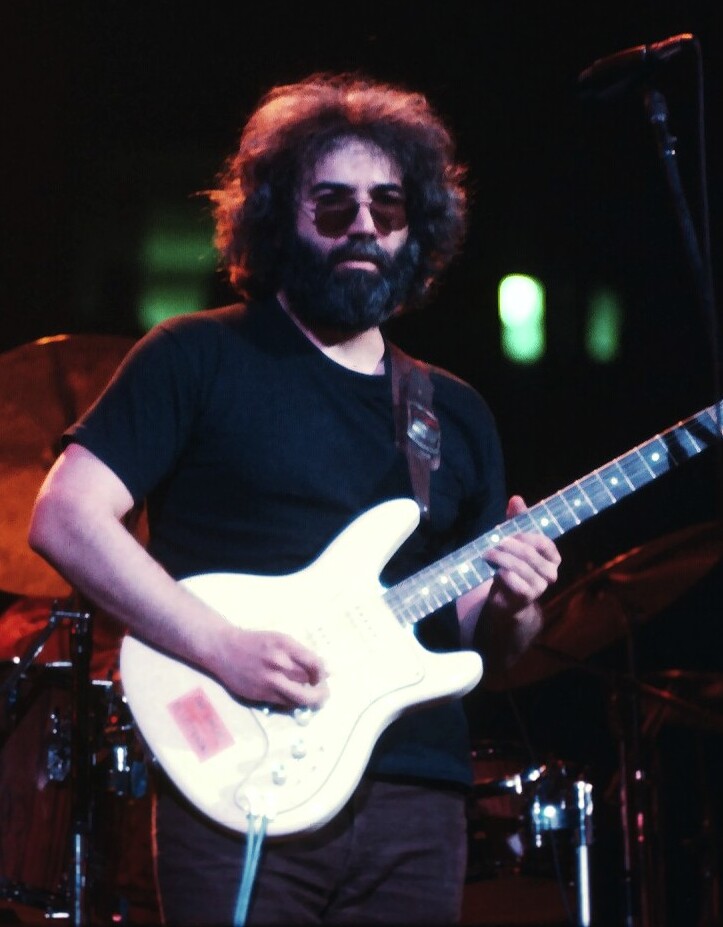
Welcome back to Guitardoor.com, where we celebrate the artists who weren’t just musicians, but cultural phenomena. Today, we take a trip down the golden road to explore the legacy of a true American original: the iconic and beloved Jerry Garcia. As the lead guitarist, singer, and spiritual heart of the Grateful Dead, Garcia was more than a rock star; he was the charismatic center of a universe, a master improviser whose lyrical, exploratory, and endlessly inventive guitar playing was the voice of a counter-cultural movement.
The Great American Musical Stew
Jerry Garcia’s musical style was a joyous and uniquely American melting pot. He was a musical omnivore, seamlessly blending a vast array of influences into a sound that was entirely his own. His first love was the banjo, and the rolling, intricate lines of bluegrass and old-time folk music forever remained a part of his guitar playing’s DNA. He combined this with the deep emotional language of the blues, the twang and storytelling of country and western, the raw energy of early rock and roll, and, crucially, the harmonic freedom and improvisational spirit of modal jazz.
He was, without question, one of the greatest improvisers in the history of rock music. For Jerry, a song was not a fixed object but a launching pad for exploration. His solos were not pre-planned or rehearsed; they were spontaneous, melodic journeys created in the moment, full of curiosity, joy, and a sense of endless possibility. He was a master of “playing the changes,” using his deep knowledge of scales, modes, and arpeggios to weave intricate, beautiful lines through the band’s often complex chord progressions, making his guitar sing with a voice that was as expressive and articulate as any human’s.
Anatomy of a Cosmic Sound: Technique and Tone
Jerry Garcia’s technique was as unique as his musical outlook. He had a light, articulate touch, and his picking—likely influenced by both his banjo background and the loss of part of his middle finger in a childhood accident—was a fluid, dynamic mix of flatpicking and hybrid picking. His approach to soloing was like melodic guitar storytelling; he masterfully used arpeggios to outline the harmony and was a famous proponent of the Mixolydian mode, which gave his playing its signature, uplifting, major-key blues sound.
His gear was as iconic and customised as his playing. He was a pioneer in using custom-built guitars that were less like off-the-shelf instruments and more like highly specialised sonic tools. His most famous guitars are legendary in their own right, each with a name and a story: “Wolf” and “Tiger,” both built by Luther Doug Irwin. These instruments were equipped with complex electronics, including onboard preamps and effects loops, which gave him ultimate control over his tone directly from the guitar.

Garcia’s signature tone was famously clean, bright, and incredibly dynamic. He achieved this sound by using powerful Fender Twin Reverb amplifiers, often modified with more powerful speakers and tubes for even more clean headroom. He rarely used heavy, saturated distortion; his legendary, singing sustain was the result of pure, clean volume and his masterful, nuanced technique. His use of effects was tasteful but integral to his sound. The Mu-Tron III envelope filter was absolutely crucial for his signature funky, quacking, auto-wah sound that defined songs like “Estimated Prophet” and “Shakedown Street.” This, along with a classic wah pedal and various delays, formed the core of his cosmic journey, exploratory sound palette.
Essential Garcia: A Trip Through the Golden Road
The Grateful Dead’s live catalogue is the true testament to Jerry Garcia’s genius. To begin to understand his improvisational magic and soulful playing, these quintessential Dead experiences are a perfect place to start.
“Sugaree”
“Truckin'”
“Scarlet Begonias” > “Fire on the Mountain”
Jerry Garcia was a true American original, a cultural icon whose legacy transcends music. He was a reluctant guru whose exploratory, joyful, and genre-defying approach to the guitar inspired not only countless musicians but also spawned the entire jam band scene. He fostered a community built on a shared love for musical adventure, creating a phenomenon that continues to thrive long after his passing. He wasn’t just playing for the moment; he was creating a moment, and for that, his music is truly timeless.
Cover Photo Credit “Jerry-Garcia-01cropped” by Carl Lender is licensed under CC BY 2.0