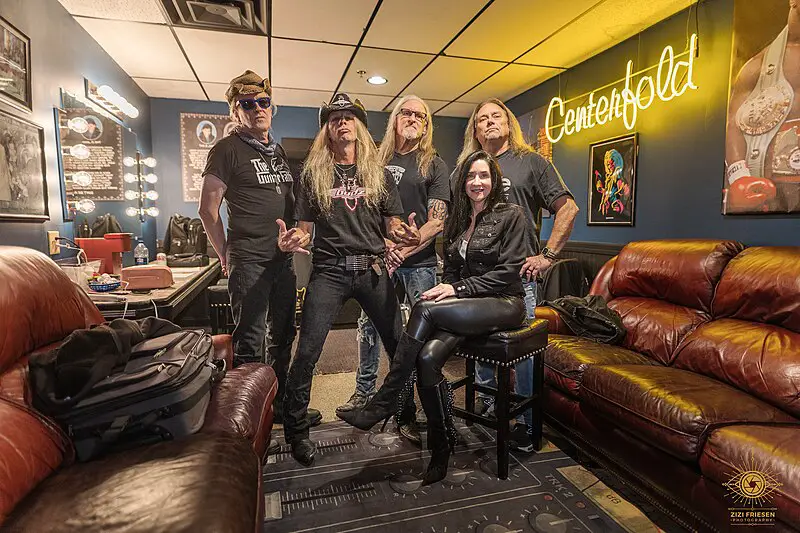
The Godz were an American hard rock band formed in 1976 in Columbus, Ohio. Combining a gritty biker image with an uncompromising wall of sound, the band consisted of Eric Moore on vocals and bass, Glen Cataline on drums, Mark Chatfield on guitar, and Garry Brandon on bass. They released their self-titled debut album in 1978, followed by a series of heavy rock records throughout the 1980s. Known for their high-energy live performances and raw sonic weight influenced by legendary acts like AC/DC and Kiss, The Godz never achieved mainstream commercial success but maintained a fiercely dedicated global following that keeps their legacy alive.
Ohio’s Rock N’ Roll Machines: The Origins of The Godz
My home state of Ohio has produced countless successful bands that went on to achieve global recognition, but those of us who knew the down-and-dirty truth of seeing The Godz live realize they were a completely different breed. If you loved raw, straightforward, guitar-driven rock ‘n’ roll, they were the ultimate realization of it. Earned by decades of brutal touring, they rightfully became known as “Ohio’s Rock N’ Roll Machines.” Eric Moore’s battered Fender Precision bass was a testament to that workhorse lifestyle—an instrument that put in so much hard labor it practically belongs in the Smithsonian.
The core lineup that first started revving engines, cranking Marshall stacks, and downing whiskey in 1975 featured Eric Moore on bass and lead vocals, Mark Chatfield on guitar, Glen Cataline on drums, and Bob Hill on guitar. Even in their earliest days without a formal record contract, the band possessed a relentless work ethic and an expansive vision. Within two short years of relentless regional gigging, they found themselves out on the highway opening for KISS on their legendary 1977 Love Gun tour, as well as sharing stages with Cheap Trick.
The Casablanca Records Era and the KISS Kinship
Their persistent roadwork paid off when they became official label mates with KISS on the famed Casablanca Records roster. This professional kinship opened major doors, leading to their inclusion on the celebrated “Heaven and Hell” tour alongside the theatrical rock band Angel. Music journalists quickly took notice of their raw, unpolished energy. In 1978, renowned rock critic Sylvie Simmons famously wrote that The Godz were “macho, mean biker boys” whose songs focused squarely on dope, bikes, rock, and real life. She summarized them as a loud, brash, and crude, yet a bloody good rock band.
When Casablanca later shifted its distribution channels to another label, the band released their sophomore effort, Nothing Is Sacred. Although shifting label priorities and faulty record distribution hindered their commercial charts, it couldn’t kill their momentum. The Godz were fundamentally a live band. Throughout the late 1970s and early 1980s, they stayed on the asphalt constantly, touring alongside powerhouse rock acts like Kansas, Blue Öyster Cult, Angel, and Judas Priest.
Mark Chatfield: Cowtown Guitars and the Silver Bullet Band
Guitarist Mark Chatfield frequently stepped away from the camp to balance multiple musical iron projects, including fronting the band Rosie and touring as a touring guitarist for Michael Bolton and Bob Seger’s Silver Bullet Band. Yet, the gravity of The Godz always pulled him back, and he returned periodically to play blistering reunion shows. Beyond his stage work, Chatfield became a fixture of the local music community by opening Cowtown Guitars in Columbus, Ohio.
Frequenting the shop back then was an education in the vintage guitar trade. It wasn’t uncommon to walk in and find Chatfield on the phone negotiating a vintage instrument sale with legends like John Fogerty. Cowtown Guitars eventually relocated to Las Vegas, where Chatfield’s business partner became a regular vintage instrument expert on the hit television show Pawn Stars, evaluating rare musical gear for the cameras.
Running with the Big Dog: My Time Backstage with Eric Moore
Eric Moore was the undisputed Superman of Ohio rock. No matter what illnesses or personal setbacks came his way, he always fought his way back to the stage. By the late 1980s, I was sneaking into venues underage just to catch their ferocious sets at Columbus staples like the Alrosa Villa and the Newport Music Hall. By the mid-90s, I was well past legal age and had seen the band countless times, eventually developing an unexpected personal rapport with Moore himself.
Much like the legendary stories of Keith Moon adopting musicians he took a liking to, Eric Moore decided to pull me into his inner circle. Before gigs, he would flash an evil, mischievous grin and motion me backstage. I wasn’t much for drinking liquor back in those days, but when the Big Dog handed you a shot of whiskey, you didn’t say no. You drank it and matched his pace because you simply didn’t tell a force of nature like Eric Moore no.
The last time I hung out with Eric personally was at an intimate club show. As we were leaving the back room, he looked at me and said, “Watch this.” He walked out onto the stage while the crowd was still loudly talking amongst themselves. Standing center stage under the lights, he surveyed the room, leaned directly into the microphone, and roared: “HEY! SHUT UP. NOW LISTEN! IT’S SATURDAY NIGHT AND YOU GOT ALL DAY TOMORROW TO GET OVER IT! WE ARE GONNA HAVE A PARTY IN HERE!” He pointed straight toward the floor, commanding the crowd to dance. He was a genuine musical outlaw who refused to play by anyone else’s rules.
The Praise & Worship Mix-Up and the Two-Guitar Blend
The legendary tales surrounding the band’s survival tactics are wild. In their early lean years, stories circulated that they survived by hunting small game with a .44 Magnum just to put food on the table. But the ultimate piece of lore involves a hilarious booking mistake where a youth camp coordinator mistakenly booked The Godz under the assumption they were a Christian Praise and Worship act.
Instead of an acoustic ensemble, a wall of Marshall speaker stacks and bottles of Jack Daniel’s rolled onto the stage. Eric Moore looked down at the crowd of young children, leaned into the mic, and said, “Man, y’all are LITTLE!” He then announced they were going to play a track about their favorite little pills and tore straight into their heavy anthem, “Feeling Fine on a 714.” The horrified organizers cut the power almost instantly, desperately offering to help load their amplifiers just to get them out of the camp.
Beneath the chaotic rock ‘n’ roll lifestyle, the musical foundation of the band was incredibly sophisticated. The dual-guitar interplay between Mark Chatfield and Bob Hill went far beyond standard roots-rock blues leads. They possessed a rare mastery of rhythm guitar arrangements, using clever chord voicings, rhythmic vamps, and tight power-chord structures to make the backing tracks shine. It sounded effortless, but it required meticulous planning. They were master sonic builders, a trait deeply respected by every heavy rock guitarist who stepped into the lineup in the decades that followed.
The Godz Live in Cleveland and Their Underground Legacy
The raw power of their live show is perfectly preserved on historical recordings like Rock N’ Roll Machines Live in Cleveland. This performance captured the unfiltered energy that defined the 1970s Midwest heavy rock movement. When the band ripped into crowd favorites like “Gotta Keep a Runnin'” and “Rock N’ Roll Machine,” the connection between the band and the roaring Ohio crowd was undeniable.
Their reputation crossed oceans in unusual ways. When an interviewer later asked Eric Moore about the discovery that bootleg cassette tapes of The Godz had become highly prized underground treasures behind the Iron Curtain in Soviet Russia, his response was classic. He noted that while politics, tanks, and military power were one thing, it was his firm belief that the Berlin Wall fell because of blue jeans, long hair, marijuana, and raw rock ‘n’ roll.
The history of the band spans an estimated 12 albums including studio records, live compilations, and retrospective collections. Over a forty-year history, various musicians stepped in to keep the engine running, with Eric Moore occasionally slinging a Gibson Les Paul himself and handing bass duties over to others. Sadly, the classic era came to a close in 2019 when drummer Glen Cataline passed away on April 14, followed shortly by Eric Moore on May 17 at the age of 67, earning a poignant tribute in Kerrang! Magazine. They defined rock success entirely on their own terms, leaving an indelible mark as Ohio’s definitive rock ‘n’ roll machine.