Welcome back to Guitardoor.com, where we pay homage to the foundational pillars of the electric guitar. Today, we step into the immense shadow of a true giant of the genre, one of the undisputed “Three Kings” of the blues: the mighty Albert King. With a guitar tone that could cut like a razor and a voice as big and soulful as his 6’4″ frame, King played with a raw, primal power that was matched only by the deep emotion behind every note. He was “The Velvet Bulldozer”—a musician whose influence is so profound that the very language of modern blues and rock guitar is peppered with his unique phrasing.
The Soul of Stax

Albert King’s musical style was the pure, unadulterated essence of the blues. He was a master of economy, never playing a single note that wasn’t absolutely necessary. His genius was rooted in feel, not flash. While other guitarists might play a flurry of notes, Albert would play just one, but he would bend it, shake it, and squeeze every drop of human emotion out of it until it brought you to your knees. His guitar playing was a direct extension of his powerful, gospel-inflected singing, creating a seamless and conversational “call and response.” The guitar didn’t just accompany his voice; it answered it, argued with it, and finished its sentences.
While he had a long and storied career, his most iconic and influential period was his time with Stax Records in Memphis during the 1960s. Here, his raw, biting guitar was backed by the world’s greatest soul bands, including Booker T. & the M.G.’s and The Memphis Horns. This potent combination of gritty Mississippi blues and tight, funky Memphis soul created a sound that was fresh, powerful, and utterly unique. It was on these recordings that Albert King cemented his legacy and created the tracks that would be studied, copied, and revered by generations of guitarists to come.
The Left-Handed Secret: Technique and Tone
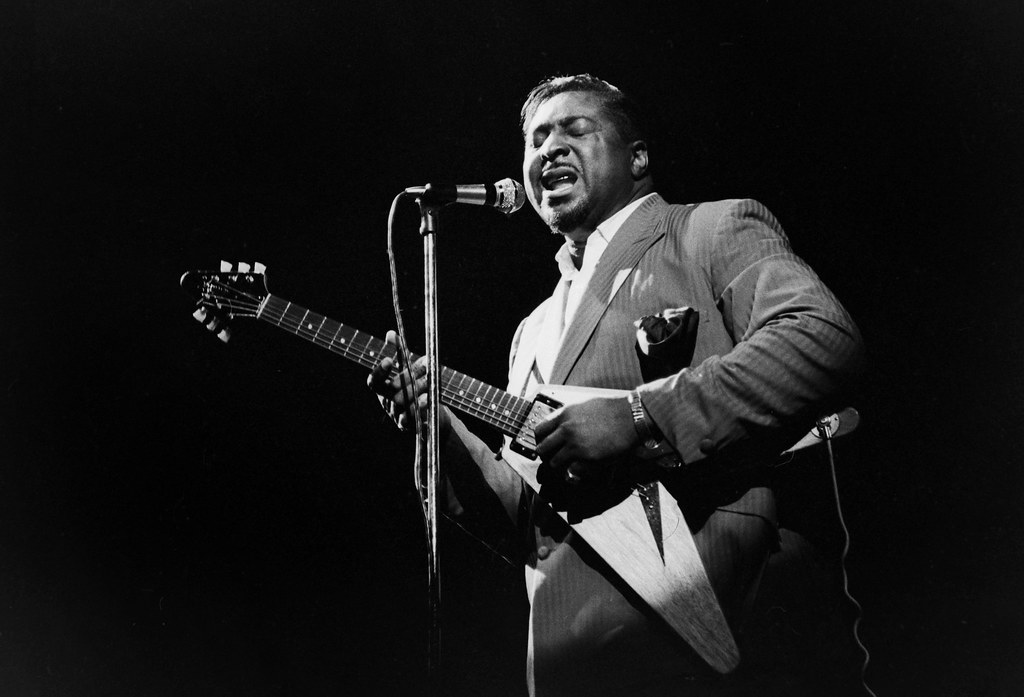
The secret to Albert King’s one-of-a-kind sound lies in his completely unorthodox playing technique. Albert was left-handed, but unlike other lefties who had their guitars restrung, he simply took a standard right-handed guitar and flipped it upside down. This meant that for him, the high E string was on top and the low E string was on the bottom. This seemingly simple choice had a profound impact on his playing and is the key to his signature sound.
Because the strings were “upside-down,” he had to pull down on the strings to bend them, rather than pushing up in the conventional manner. This, combined with his immense finger strength, allowed him to execute massive, multi-step string bends that were simply impossible for other players to replicate. It was this technique that created his stinging, instantly recognizable tone. He often used his thumb to fret bass notes, further adding to his unconventional approach. There was no one on earth who played the guitar like Albert King.
His choice of gear was as iconic as his technique. While he played various guitars in his early days, his name is forever linked with the Gibson Flying V. His most famous was a 1958 model he nicknamed “Lucy,” and he would play various custom and stock Flying V models throughout his career. The guitar’s aggressive shape was a perfect match for his powerful stage presence. To get his signature tone—a sound that was piercingly loud, sharp, and clean—he often eschewed tube amps in favor of powerful solid-state models. He was famously associated with the Acoustic 260 head and its accompanying cabinet, and also used the Roland JC-120. He wasn’t looking for warm overdrive; he wanted a clean, high-fidelity sound that would allow the raw, unadulterated tone of his hands and his unique bends to slice through the mix.
Essential King: The Cornerstones of the Blues
Albert King’s Stax recordings are a foundational text for any student of the blues guitar. To understand his immense power and influence, these three tracks are absolutely essential listening.
“Born Under a Bad Sign”
“Born Under a Bad Sign” is arguably the signature song of blues legend Albert King and a cornerstone of the electric blues genre. Released in 1967, the song was co-written by Booker T. Jones and William Bell and served as the title track for King’s seminal album. The track is famous for its iconic, unforgettable bass line and King’s fierce, stinging guitar work on his famous Gibson Flying V, “Lucy.” The lyrics use astrological imagery to convey a tale of misfortune and hard luck (“Born under a bad sign / Been down since I began to crawl”), which resonated deeply with audiences. More than just a song, it became an anthem for the unlucky and a defining moment for the blues, cementing Albert King’s reputation as one of the most powerful and influential guitarists of his era, inspiring a generation of rock and blues musicians, including Eric Clapton and Stevie Ray Vaughan.
“The Hunter”
“The Hunter” is another aggressive, guitar-forward highlight from Albert King’s revolutionary 1967 album, Born Under a Bad Sign, co-written by the legendary Booker T. and the M.G.’s. This track features a swaggering, mid-tempo groove that perfectly captures the boasts in the lyrics: “They call me the hunter, that’s my name / A pretty woman like you is my only game.” Guitar-wise, the song is a powerful vehicle for King’s signature upside-down, left-handed playing style, defined by his fierce bends and stinging vibrato. The song is punctuated by short, sharp, and confident blues licks, demonstrating King’s ability to inject immense personality into just a few choice notes. The overall feel is a blend of traditional blues grit with the modern, punchy soul-funk rhythm section of the Stax house band, making it a highly influential track for blues-rock guitarists that followed, notably covered by the band Free.
“Crosscut Saw”
“Crosscut Saw” is a quintessential Albert King track, notable for its infectious Afro-Cuban or “rumba” rhythm and King’s masterful, expressive guitar work. Released in 1966 on Stax Records, prior to the Born Under a Bad Sign album, it became an R&B chart hit and remains one of his most recognized songs. While the song is lyrically rooted in the classic blues double-entendre (the saw and log serving as sexual metaphors), its musical identity is defined by the unique, loping groove laid down by the Stax house band, Booker T. & the M.G.’s. King’s guitar tone is pristine yet powerful, and the performance is a spectacular display of his famous wide, vocal-like string bends and economical, perfectly placed phrasing. It is a cornerstone of the modern blues-rock repertoire, and the clarity and force of King’s playing on this track served as a direct blueprint for guitarists like Eric Clapton (who famously borrowed a lick for Cream’s “Strange Brew”) and Stevie Ray Vaughan.
Albert King was more than just one of the Three Kings; he was a true original whose unique approach created a whole new vocabulary for the electric guitar. From Eric Clapton and Jimi Hendrix to Stevie Ray Vaughan and beyond, countless guitar heroes built their styles on the foundation that he laid. He proved that the most powerful music comes not from the head, but straight from the heart and through the hands.
Cover Photo Credit “Albert King – 1969 R-169” by Winston J.Vargas is licensed under CC BY-NC 2.0