
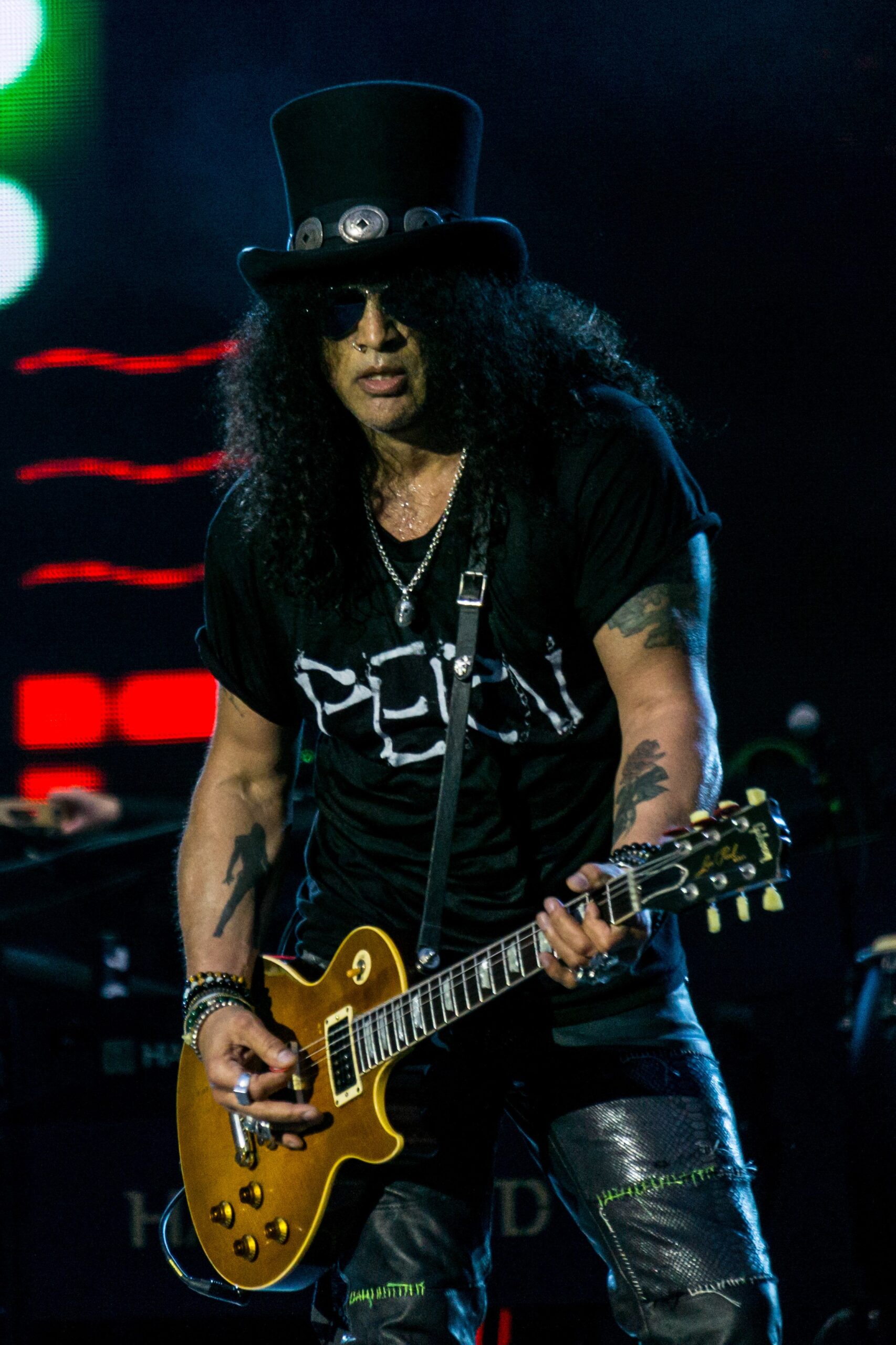
When Guns N’ Roses exploded out of the chaotic Los Angeles club circuit, they injected a dangerous dose of grit into a sterile, over-polished music scene. Driving that sonic assault was a player who instantly became the definitive visual and sonic archetype of the modern guitar hero: Slash. Armed with a low-slung Les Paul, a signature top hat, and a fluid, blues-drenched swagger, he single-handedly brought raw emotion, danger, and melodic hooks roaring back to the absolute forefront of mainstream rock.
The Sunset Strip Savant
Slash’s musical style is pure, uncut hard rock distilled down to its most potent form. His foundations are deeply rooted in the classic, blues-based British and American guitar giants of the 1970s. The expressive DNA of players like Jimmy Page, Joe Perry, Jeff Beck, and Mick Ronson echoes in every phrase he executes. However, he took that classic rock vocabulary and supercharged it with the aggressive, unhinged energy of the Hollywood punk and metal underworlds, creating a timeless crossover sound.
His true genius lies in an extraordinary gift for memorable melodic phrasing. In an era dominated by hyper-speed neoclassical shredding and technical pyrotechnics, Slash focused entirely on the pocket and the groove. His solos are meticulously structured arcs—memorable, hummable vocal lines played on six strings that act as independent compositions within the song. He is also a premier architect of the modern rock riff, having penned some of the most enduring hooks in radio history, from the menacing, delay-driven intro of “Welcome to the Jungle” to the cascading patterns of “Sweet Child o’ Mine.”
The Anatomy of Appetite: Technique and Tone
The magic of Slash’s tone is found in his aggressive left-hand attack and vocal-like string bending. Relying heavily on the expressive textures of the minor pentatonic and blues scales, his approach values note choice and emotional weight over sheer velocity. His wider, dramatic pitch-bends and deep, singing vibrato give his sustained notes a human vocal quality, proving that a single well-placed tone can carry more sonic authority than a flurry of notes.
His choice of gear established one of the most celebrated guitar-and-amp configurations in history. His name is permanently synonymous with the Gibson Les Paul Standard. The story of the legendary 1959 replica built by luthier Kris Derrig, which Slash used exclusively during the gritty Appetite for Destruction recording sessions, has become permanent rock folklore. That single instrument fundamentally shifted the industry away from plastic-coated superstrats and brought heavy, resonant mahogany back into style.
The second half of his tonal equation is a roaring, mid-forward Marshall amplifier. His early, iconic crunch was forged using a modified Marshall JCM800 head, pushing out a biting British character that sliced clean through the rhythm section. To complement his vintage-voiced setups, Slash utilizes low-output Seymour Duncan Alnico II Pro humbuckers, allowing the natural resonance of the wood to drive the front end of his tube amps. While his signal chain remains wonderfully minimalist, his main expressive tool is a classic Dunlop Cry Baby Wah pedal, which he steps on to add a dramatic vocal sweep to his climactic lead lines.
3 Essential Tracks: The Cornerstones of Rock Radio
Slash’s work with Guns N’ Roses shaped the modern landscape of alternative and hard rock composition. To fully capture the scope of his playing, these three timeless anthems are essential listening.
“Sweet Child o’ Mine”
What started out as a simple, cyclical finger-skipping exercise in a warm-up session became one of the greatest opening guitar hooks of all time. The song features a brilliant transition from clean, melodic phrasing into a soaring, high-gain modal masterpiece of a solo that resolves into raw blues fury.
“Welcome to the Jungle”
A masterclass in tension, atmosphere, and rhythmic drive. Slash utilizes an explicit, tempo-sync’d tape delay effect in the intro to build a wall of sound before dropping into a sleazy, syncopated rhythm. The solo is brief, jagged, and full of the chaotic punk energy that defined early GNR.
“November Rain”
This epic ballad houses what is widely regarded as one of the finest melodic guitar performances ever put to tape. Using his neck pickup for a warm, fluid tone, Slash plays a series of solos that perfectly track the song’s emotional weight, culminating in an aggressive, out-of-phase modern outro solo that delivers pure theatrical drama.
An Enduring Legacy
Slash remains far more than a technical player; he is a global cultural icon who kept the lineage of pure, blues-infused rock guitar alive when mainstream styles began to lean into digital abstraction. Much like how other stylistic innovators used specific tools to carve out a signature sound, Slash leaned into classic wood, glowing valves, and uncompromising focus on individual feel. He wrote the riffs that became the definitive soundtrack for an era, securing his enduring legacy as a legendary rock arranger whose melodies will echo out of amplifiers forever.
Cover Photo Credit “Slash, Guitarist of Guns N’ Roses in 2017” by Raph_PH is licensed under CC BY 2.0