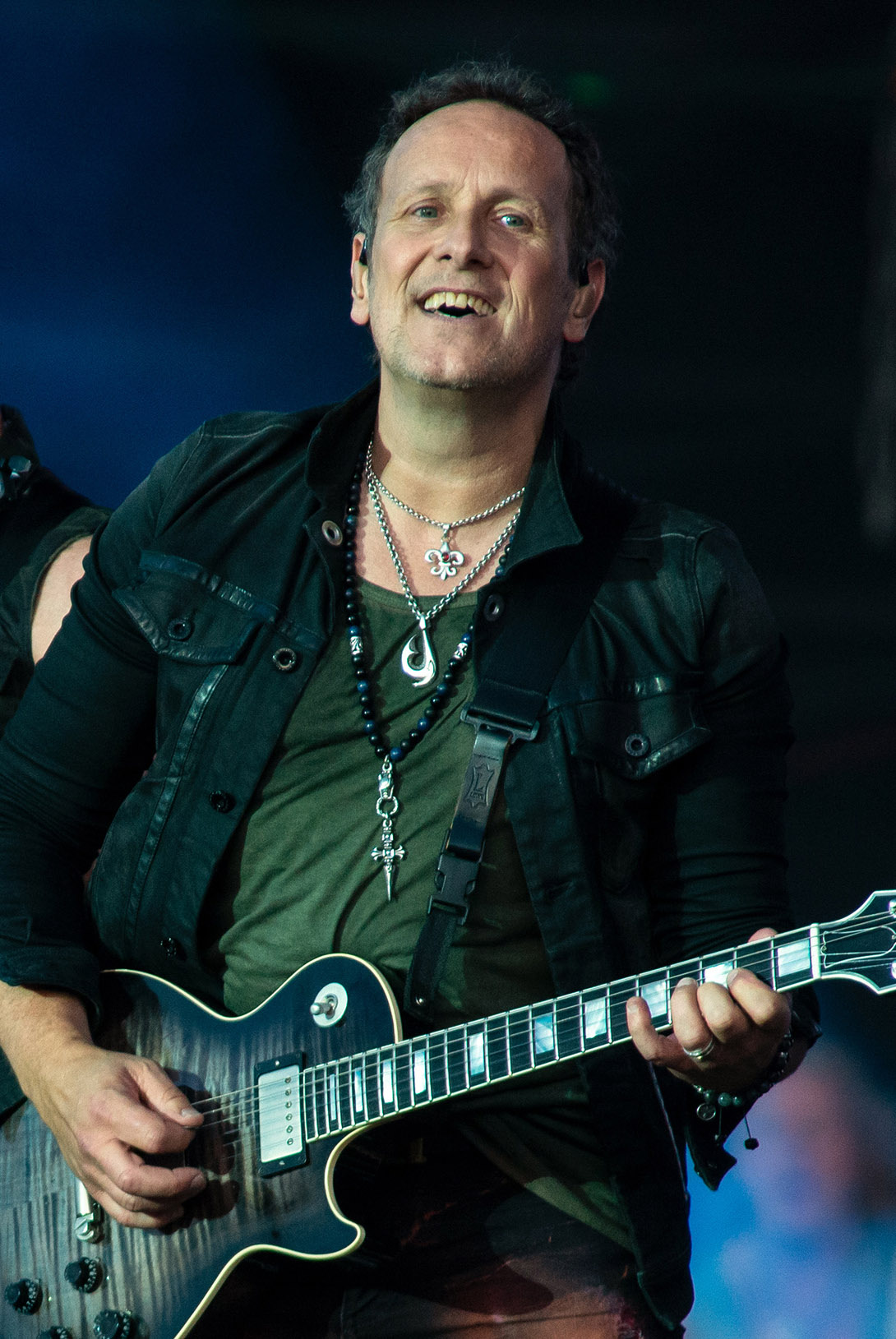
Welcome back to Guitardoor.com, where we celebrate the true guitar heroes who have proven their greatness through both fiery virtuosity and decades of road-tested resilience. Today, we’re focusing on one of the most respected and versatile players in rock: the incredible Vivian Campbell. He is a man of two distinct, legendary careers. The first as the young, ferocious Irish shredder who defined the sound of Dio, and second as the precision-based, melodic anchor and “Terror Twin” in the pop-metal institution Def Leppard.
The Holy Diver and the Hired Gun
Vivian Campbell exploded onto the global scene in 1983 as the original guitarist for Dio, and his impact was immediate and massive. On the seminal albums Holy Diver and The Last in Line, his playing was a revelation, a raw, aggressive, and incredibly fast style that was less about blues and more about a dark, European-influenced virtuosity. He was the perfect, fiery foil for Ronnie James Dio’s legendary vocals, and his solos were a brilliant, chaotic storm of notes that set a new standard for 80s metal. After his fiery exit from Dio, he served as a high-profile “hired gun,” most notably bringing his powerful, blues-rock chops to Whitesnake for the Slip of the Tongue tour, proving he could fill the massive shoes of any guitarist.
Anatomy of a Rock ‘n’ Roll Survivor
The guitar playing of Vivian Campbell is a fascinating study in adaptation. He possesses two distinct and equally masterful skill sets: the raw, untamed aggression of his youth and the meticulous, song-serving precision of his modern career. He is a true “chameleon” who can be whatever the music needs, from a lead-role virtuoso to a perfect “team player.”
The Dio-Era Fire: His early style was defined by its raw, aggressive energy. It was built on incredibly fast and precise alternate picking, a frantic, “shakey-leg” vibrato, and a “go-for-broke” attitude. His solos were brilliant, composed pieces of shred, full of neo-classical-inspired runs and screaming harmonics.
The Def Leppard Precision: In 1992, he joined Def Leppard, replacing the late, great Steve Clark. This role required a complete transformation. He had to become the perfect “other half” to his “Terror Twin,” Phil Collen. His job was no longer to be the solo star, but to be a master of texture, harmony, and precision. He became a phenomenal rhythm player and a master of recreating the band’s complex, layered “guitar orchestras” live, a skill that demands incredible discipline.
The Les Paul Man: Campbell is, and always has been, a Gibson Les Paul man. It is his unmistakable signature. His iconic Dio-era sound was a Les Paul (often a black one) plugged straight into a roaring, high-gain Marshall amplifier.The Modern Rig: While his hands and his Les Pauls remain the core of his sound, his modern Def Leppard rig has evolved. To perfectly recreate the band’s massive, multi-layered studio tones, he has become a master of modern tech, famously using Fractal Audio modelers to have every single complex, processed, and harmonized sound at his feet.
The Essential Licks
Vivian Campbell’s career is full of iconic guitar moments, from raw metal fire to pop-rock perfection. To understand his incredible range, these three tracks are absolutely essential.
Holy Diver (by Dio)
This is the definitive anthem of his early career. The main riff is a masterclass in heavy, powerful, and perfectly timed rhythm. To approach playing it, the key is the heavy, palm-muted “chug” and the sense of dark, epic drama. The solo is pure, untamed Campbell—a perfectly composed burst of high-speed alternate picking, screaming string bends, and raw, aggressive phrasing. It’s a lesson in 80s metal attitude.
Still of the Night (by Whitesnake)
While he didn’t record the original, his role was to bring this (and other) John Sykes-penned tracks to life on a massive world tour. It’s an epic, Zeppelin-esque masterpiece. The approach here is all about dynamics. A guitarist must master the spooky, clean-toned arpeggios of the verses before exploding into the heavy, powerful, and blues-based riffs of the chorus. The solo is a pure, over-the-top, 80s-hero showpiece that demands aggressive, wide bends and blistering pentatonic speed.
Pour Some Sugar on Me (by Def Leppard)
This is the ultimate lesson in his “second career” as a precision team player. To approach this song, you must stop thinking like a traditional rock guitarist. The song is not built on big, raw power chords; it’s built on layers. The key is to master the clean, “chimey” single-note lines, the small, funky chord stabs, and the clean arpeggios that all interlock perfectly. It is a masterclass in rhythmic precision, texture, and the art of serving the song.
In the end, Vivian Campbell’s legacy is that of one of rock’s most talented, versatile, and enduring players. He is one of the very few guitarists to have two completely distinct, Hall of Fame-worthy careers. His ability to flawlessly transition from a fiery, “lead dog” shred god to a meticulous, song-serving craftsman is a true testament to his incredible musicality and professionalism, securing his place as one of the most respected and admired rock guitarists of his generation. Speaking of Generations while you are here why not check out song’s like My generation in our feature on “Who guitarist” Pete Townshend and many more rock guitar greats.
Cover Photo Credit “Vivian Campbell guitarist (cropped)” by Selbymay is licensed under CC BY-SA 4.0