
Have you ever wondered why your favourite guitarist sounds so unique, even when playing simple chords? The secret might have nothing to do with their fingers or their fancy equipment. It could all come down to guitar tuning.
Most beginners start out learning standard tuning, and that is a great foundation. But here is the thing: some of the most iconic sounds in music history came from guitarists who decided to twist those tuning pegs in a completely different direction. They experimented, got creative, and accidentally (or intentionally) changed the way we hear guitar forever.
In this post, we are going to walk through some of the most popular alternative guitar tunings and introduce you to the legendary players who made each one famous. Whether you recognise names like Keith Richards, Joni Mitchell, or Robert Johnson, you are about to discover the tuning choices that shaped their signature sounds.
By the end, you will have a solid understanding of why tuning matters and maybe even feel inspired to try something new yourself. Let’s dive in!
Standard Tuning (EADGBE): Where Every Guitar Journey Begins
If you’ve ever picked up a guitar for the first time, standard tuning is where your story starts. EADGBE, read from the thickest string to the thinnest, is the universal home base for guitar players across every genre imaginable. A handy way to remember the string order is the mnemonic “Eddie Ate Dynamite, Good Bye Eddie”, and honestly, once you hear it, you never forget it. Those six notes span a frequency range from E2 at roughly 82Hz on the low end all the way up to E4 at around 329Hz on the high end, covering a beautifully expressive sonic range that works for strumming chords around a campfire or wailing a blues solo on a stage.
Standard tuning didn’t just appear overnight. It evolved over centuries, growing out of lute and vihuela traditions in Renaissance Europe before settling into the six-string EADGBE format that folk, blues, and early rock players adopted as their common language. According to historical analysis from Fender, the pattern was chosen to balance the physical geometry of human hands with the logical layout of musical intervals. This intervals-based configuration makes chord shapes manageable, scales feel logical, and barre chords actually moveable up the neck. When blues and rock and roll exploded in the 20th century, musicians needed a shared tuning that worked for both rhythm and lead playing, and EADGBE delivered.
Listen to Jimi Hendrix, Eric Clapton, or Stevie Ray Vaughan and you’re hearing what standard tuning sounds like when it’s pushed to its absolute limits. Their bends, vibrato, and chord voicings are all deeply rooted in the natural feel of EADGBE, which is a big part of why their playing sounds so immediate and alive.
When it comes to actually getting in tune, you’ve got solid options. The 5th-fret method trains your ear by matching fretted notes to open strings. Clip-on tuners are reliable, especially in noisy rooms. Apps like GuitarTuna, trusted by over 100 million users, make it dead simple from your phone. There are also browser-based online tuning tools that work in a pinch.
Here’s the most important thing to carry with you: standard tuning is a starting point, not a ceiling. Once you feel at home in EADGBE, a whole world of alternate tunings opens up, and that’s where things get really interesting.
Drop D Tuning: The Tuning That Built a Generation of Rock Riffs
If standard tuning is home base, Drop D is the moment you kick the door open. To get there, you simply loosen your low E string down one whole step until it matches the pitch of your open fourth string (also a D). That’s it. We’re talking three seconds, maybe five if you’re moving slow. One string changes, everything else stays the same, and suddenly your guitar sounds noticeably heavier and more resonant.
That shift in sound is exactly what a whole generation of bands grabbed onto. Foo Fighters, Soundgarden, Tool, Alice in Chains, and Nirvana all reached for Drop D when they wanted riffs that felt like they had real weight behind them. As documented in detail by Guitar Player, the lowered string adds a deeper, darker tone that standard tuning just can’t touch, giving alternative rock bands a massive sonic foundation that became instantly recognizable. Think about the dense, churning quality of grunge and alternative metal from the 90s. A lot of that comes directly from this one small adjustment.
To really hear what Drop D does, put on three songs back to back. Start with “Heart-Shaped Box” by Nirvana. That brooding, hypnotic intro riff has a claustrophobic heaviness that pulls you in. Then jump to “Black Hole Sun” by Soundgarden, where Drop D helps create those eerie, suspended chords that feel like a fever dream. Finish with “The Pretender” by Foo Fighters and notice the punchy, anthemic drive in the heavier sections. Each song feels different emotionally, but that low resonance is doing serious work in all three.
The reason these riffs are so powerful comes down to one simple technique: the one-finger power chord. In standard tuning, power chords need two or three fingers. In Drop D, you just lay one finger flat across the bottom three strings and you’ve got a full, massive-sounding chord. Move that shape anywhere on the neck and you’re covering ground fast. This unlocked a whole new rhythmic vocabulary for rock and metal players, making aggressive, palm-muted riffing faster and more fluid than ever before.
If you want to try it yourself, these songs are genuinely great starting points. “Heart-Shaped Box” and “Black Hole Sun” both feature repetitive, low-string riffs that are beginner-friendly once you’ve got the tuning dialed in. Alice in Chains’ “Them Bones” is another fantastic choice because that jagged, driving riff is mostly just you and the low D string getting acquainted. Foo Fighters’ “Everlong” also appears frequently in Drop D lessons and rewards even a little practice. Pick one, watch a lesson on YouTube, and just let that open low D ring out. You’ll understand immediately why so many players never went back.
Open G Tuning: How Keith Richards Removed a String and Changed Rock and Roll
Open G tuning is spelled out as DGDGBD, and when you strum those six open strings together, you’re already playing a G major chord without touching a single fret. That’s the magic of it.
But here’s where Keith Richards took things even further: he removes the low E string entirely. What you’re left with is a five-string guitar tuned GDGBD, and that one simple choice sits at the heart of some of the most recognizable riffs in rock history. Richards has discussed in numerous interviews, including profiles featured by MusicRadar, how losing that low string clears space in the mix, letting the drums and bass breathe while he locks into a rhythmic groove that feels almost banjo-like in its punch and clarity.

Keith Richards’ iconic 5-string setup
The Stones Tracks That Made This Tuning Famous
“Honky Tonk Women,” “Brown Sugar,” and “Street Fighting Man” all live in Open G, and once you hear those riffs through the lens of the tuning, everything clicks. The chord shapes are minimal, sometimes just two or three fingers, and the open strings ring out as drones underneath. That’s why they feel so locked-in and infectious. Richards isn’t chasing complexity; he’s chasing feel. The tuning does a lot of the heavy lifting, and his job is to stay in the pocket and let the groove do its work.
A Natural Home for Slide and Barre Chords
Open G is genuinely one of the best tunings for slide guitar, because every open string already forms a major chord. Slide to the 5th fret and you’re on C; slide to the 7th and you’re on D. A full I-IV-V blues progression becomes almost effortless. Barring major chords up the neck works the same way, one finger across all strings gives you a clean major chord in any key you land on.
Who Was There Before Richards
Ry Cooder was using Open G before Richards adopted it, and Richards has openly credited him as a key influence. Mick Taylor, who played with the Stones from 1969 to 1975, also worked within open tunings for his slide and lead work. Roots-blues players like Son House and Robert Johnson were exploring similar territory long before rock and roll had a name.
If you want to start somewhere, learn “Honky Tonk Women.” The riff is approachable, the shapes are simple, and it immediately shows you what this tuning is built for.
DADGAD Tuning: The Modal Sound That Sounds Like a Question
Spell it out loud: D, A, D, G, A, D. That’s the tuning, and those six strings together form something that standard tuning simply cannot give you. When you strum DADGAD open, you get a Dsus4 chord, which is a suspended sound that floats right between major and minor without landing in either.
That ambiguity is the whole point. There’s no major third and no minor third pulling the chord toward a clear emotional destination. It just sits there, wide open, like a musical question waiting for an answer. For a beginner, this might sound strange at first, but strange is often where the most interesting music lives.
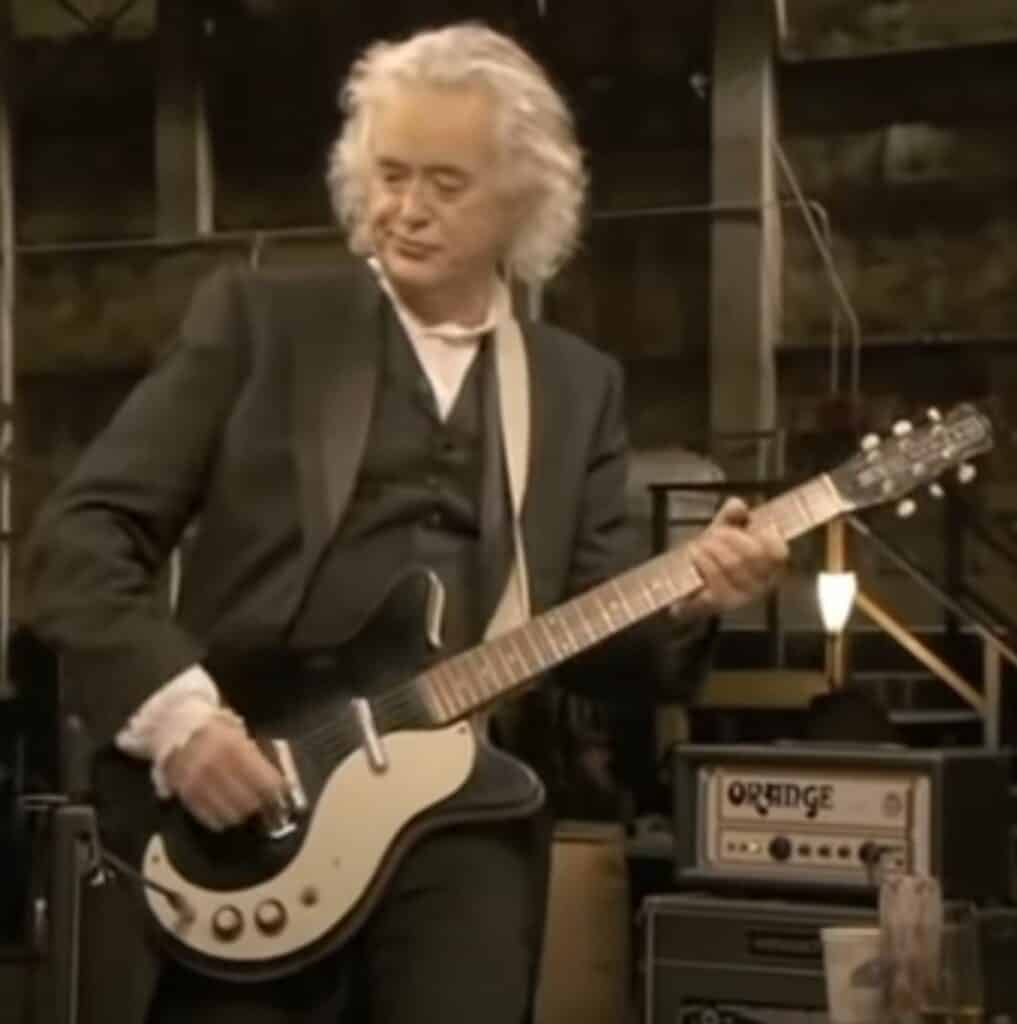
Jimmy Page using DADGAD on his Danelectro
The Rock Moments That Put DADGAD on the Map
Jimmy Page brought this tuning into the mainstream with two tracks that still stop people in their tracks. “Black Mountain Side” from the debut Led Zeppelin record is a fingerpicked instrumental built entirely around DADGAD’s droning, mystical texture. It draws from British and Irish folk traditions and sounds like nothing else in rock.
Then came “Kashmir” on Physical Graffiti, where those open-string drones create that massive, hypnotic riff that feels like it could go on forever. Technical performance breakdowns from Premier Guitar highlight how Page reportedly favored a light-body Danelectro guitar for this configuration, allowing the tuning’s unique acoustic resonance to bleed into an almost orchestral, sitar-like quality. These two recordings are a great place to start your discovery.
The Fingerstyle World That Grew Around It
French-Algerian guitarist Pierre Bensusan has played exclusively in DADGAD since 1978, and his work helped make the tuning central to Celtic and acoustic world music. His arrangements feel like a full band compressed into six strings. Beyond Bensusan, players like Laurence Juber, a former Wings guitarist and Grammy winner, have built entire teaching careers around DADGAD’s creative possibilities. Kaki King uses it alongside percussive tapping techniques that make the guitar sound more like a rhythm section than a solo instrument.
What makes DADGAD genuinely exciting is that it pushes you toward ideas you would never stumble onto in standard tuning. The open strings act as a constant backdrop, and the fretted notes create color and tension against them. Many players describe it as picking up a completely different instrument.
Open D Tuning: Blues at Its Roots and the Slide Player’s Foundation
Tune your guitar to D A D F# A D and strum all six strings open. What you hear isn’t just a chord. It’s over a hundred years of blues history ringing out at once. Open D creates a rich, full D major chord with that low D on the sixth string giving everything a deep, almost swampy resonance that standard tuning simply can’t replicate. The strings sit at lower tension too, which makes the whole guitar feel looser, more expressive, and a little bit dangerous in the best way possible.
The Delta Blues Foundation
This tuning goes by another name in the old world: Vestapol. Pre-war and Delta blues players knew it well. Historical sound archives curated by PBS The Blues document how Robert Johnson, Charley Patton, and Elmore James all worked within this tuning tradition to lay the groundwork for modern American roots music. Those open-string drones, that haunting slide tone, the rhythmic shuffle patterns, they all come from having a major chord ready to ring out at any moment. Elmore James built “Dust My Broom” on this foundation, and that riff has lived in the bones of blues music ever since. Open D gave the Delta blues its emotional texture, something between longing and fury that no other tuning quite captures the same way.
Joni Mitchell’s Entry Point
Joni Mitchell has been mentioned in the same breath as alternate tunings for good reason. She eventually used over 50 different tunings throughout her career, but she started where a lot of blues and folk players start: open major tunings, including Open D. Songs like “Chelsea Morning” and “Conversation” came out of this tuning’s resonance. It unlocked chords and voicings she couldn’t find in standard tuning, and that discovery set her on one of the most adventurous tuning journeys in the history of popular music.
Open D vs. Open E for Slide Playing
Slide players are drawn to open tunings because the whole neck becomes a playground. You can lay your slide across any fret and you’re already playing a chord. Open D and Open E share the exact same intervals, with Open E simply being Open D tuned up a whole step.
The practical difference is feel and tone. Open D’s lower tension suits acoustic and resonator guitars beautifully, delivering a warm, earthy slide tone. Open E hits harder and brighter, which is why electric slide players like Derek Trucks lean that direction. Many players simply capo Open D at the second fret to get there.
What to Listen to First
If you want to feel what Open D actually does to a song, start with Mississippi Fred McDowell’s “You Gotta Move.” Then follow it with Elmore James’ “The Sky Is Crying.” After that, put on Joni Mitchell’s “Chelsea Morning” and notice how completely different the same tuning can feel in different hands. That contrast is the whole point.
Open E Tuning: The Slide Player’s Paradise
Think of Open E as Open D’s louder, more wound-up sibling. The tuning spells out E B E G# B E, and if you’ve just read the previous section on Open D, those interval shapes will look familiar. That’s because they’re identical: root, fifth, root, major third, fifth, root. The only difference is that everything sits a whole step higher. You can actually get there by putting a capo on the second fret of an Open D guitar, which tells you something useful about how these two tunings relate to each other.
If you want to get into Open E from standard tuning, you raise your A string up to B, your D string up to E, and your G string up a half step to G#. Your low E, B, and high E strings stay exactly where they are.
Duane Allman and Derek Trucks are, honestly, the two most persuasive reasons this tuning exists. Duane built most of his slide vocabulary here with the Allman Brothers Band. Tracks like “Statesboro Blues,” “Done Somebody Wrong,” and “One Way Out” are worth putting on just to hear what Open E sounds like in the hands of someone who understood it completely. Derek Trucks picked up that torch and carried it further, describing Open E as opening up “a whole new world” for his playing. Both players found something vocal and fluid in this tuning that standard simply couldn’t offer.
The reason Open E rewards slide so generously comes down to what those open strings are doing. Because they already form a complete E major chord, you can move the slide anywhere on the neck and the open strings keep ringing sympathetically beneath you. That creates a sustain and resonance that feels almost orchestral. Notes hang in the air longer, harmonics bloom, and simple phrases start to sing.
The trade-off is physical. Open E puts noticeably more tension on your strings than Open D does, and some players find that harder on their guitar, particularly on acoustics. That’s why plenty of slide players prefer Open D for the same musical ideas, sometimes using a capo to match the pitch when needed.
Beyond slide players, Open E has shown up in some unexpected places. The Black Crowes used it on “She Talks to Angels,” Blink-182 on “Feeling This,” and Coldplay’s Chris Martin has worked with it too. The tuning has range, and the slide world barely scratches its surface.
Double Drop D Tuning: Why ‘Cinnamon Girl’ Feels the Way It Feels
Think of Double Drop D as Drop D’s slightly more adventurous sibling. Where Drop D only lowers the sixth string from E down to D, Double Drop D goes one step further and drops the first string (your high E) down to D as well. The result is DADGBD, a tuning with D notes anchoring both the bottom and the top of the guitar at once. The middle four strings stay exactly where they are in standard tuning, which means a lot of what you already know still works.
That symmetry is the whole secret. When both outer strings ring open on D, they create a natural drone that hums underneath whatever you play on top of it. It’s not just a technical detail; it’s an emotional one. That sustained, open quality is exactly why “Cinnamon Girl” by Neil Young hits the way it does.
Released in 1969 on Everybody Knows This Is Nowhere, the track uses Double Drop D (sometimes called D Modal by Young himself) to build something that feels simultaneously raw and hypnotic. The riff is simple, almost primitive, but it resonates with an urgency that standard tuning just wouldn’t produce. The open strings breathe underneath everything, giving the song a kind of restless, locked-in groove.
Young kept coming back to this tuning throughout his career. “Cortez the Killer,” “The Loner,” “Ohio,” and “Don’t Let It Bring You Down” all live in this same sonic world. Other artists found their way here too. Led Zeppelin’s “Going to California,” The Doobie Brothers’ “Black Water,” and Elliott Smith’s “Satellite” all explore the folk-rock territory that Double Drop D tends to unlock naturally. It’s a tuning that suits storytelling, atmosphere, and songs that feel bigger than their parts.
What makes Double Drop D genuinely special for beginners is that it doesn’t feel like starting over. Because the middle strings stay untouched, your familiar chord shapes mostly transfer across with only small adjustments on the outer strings. You get a tuning with a real, distinct personality without the steeper learning curve of something like DADGAD or Open G. You drop two strings, and suddenly your guitar sounds fuller, more resonant, and a little more alive.
Open C Tuning: The Low, Dark, and Resonant One
Spell it out: C G C G C E. That’s Open C tuning, read from the thickest string to the thinnest, and the moment you strum those six open strings, something shifts. You’re not hearing a standard chord shape. You’re hearing a full, booming C major chord that seems to bloom outward from the guitar itself.
What makes this tuning feel so unusually deep and atmospheric is the wide intervallic spread built into its design. The low E string drops all the way down to C, giving you a cavernous low end that standard tuning simply cannot produce. Meanwhile, the repeated C and G notes across multiple strings create sympathetic vibration, where strings ring in response to each other, filling the sonic space with warm harmonics and natural sustain. The result is one of the most resonant, immersive sounds you can pull from an acoustic guitar.
Nick Drake found something in this territory that fit his particular emotional world almost perfectly. He favored a close relative of Open C called CGCFCE, which he used on songs from his 1972 album Pink Moon. Performance retrospectives from NPR Music break down how his intricate fingerpicking style used those slackened, droning low strings as an emotional anchor while the upper strings carried delicate, ambiguous melodies. The tuning gave his arrangements a quality that’s hard to describe but immediately recognizable: sparse, melancholy, and somehow intimate and enormous at the same time.
Chris Cornell explored a slightly different variation, tuning to C G C G C G for Soundgarden songs like “Burden in My Hand” and “Pretty Noose.” That unison doubling between strings created a particular thickness and weight that suited Soundgarden’s sound. And then there’s Devin Townsend, who brought Open C into progressive and experimental metal territory entirely, using the tuning’s resonant depth for sweeping, atmospheric textures that feel nothing like Drake’s folk intimacy.
That contrast is actually one of the most fascinating things about Open C. John Butler built his extended solo piece “Ocean” around it, using a 12-string guitar to create cascading, percussive patterns full of groove and motion. John Fahey explored it through American primitive guitar, quiet and meditative. The same six-string setup produces completely different emotional worlds depending on who is sitting behind it.
For fingerstyle players especially, Open C is almost generous in what it offers. The open strings give you instant access to lush, full-sounding chords without complex left-hand shapes, which frees your picking hand to explore intricate patterns and dynamics. It rewards composers who want harmonic richness and depth without needing distortion or heavy processing to fill the room.
Joni Mitchell’s 50+ Tunings: The Guitarist Who Proved There Are No Rules
Let’s talk about Joni Mitchell, because if any artist in popular music has ever made the strongest possible case for throwing out the rulebook on guitar tuning, it’s her.
Over the course of her career, Mitchell used more than 50 distinct guitar tunings. She’s cited the number herself as 51, though researchers and dedicated fans who’ve cataloged her work have identified over 60 tuning variants by note name, and closer to 80 or more when you factor in capo positions. That puts her in a category essentially by herself. According to archival logs maintained by the official Joni Mitchell Archive, almost every song in her catalog lives in its own harmonic world, and only a tiny handful of her recordings use standard EADGBE at all.
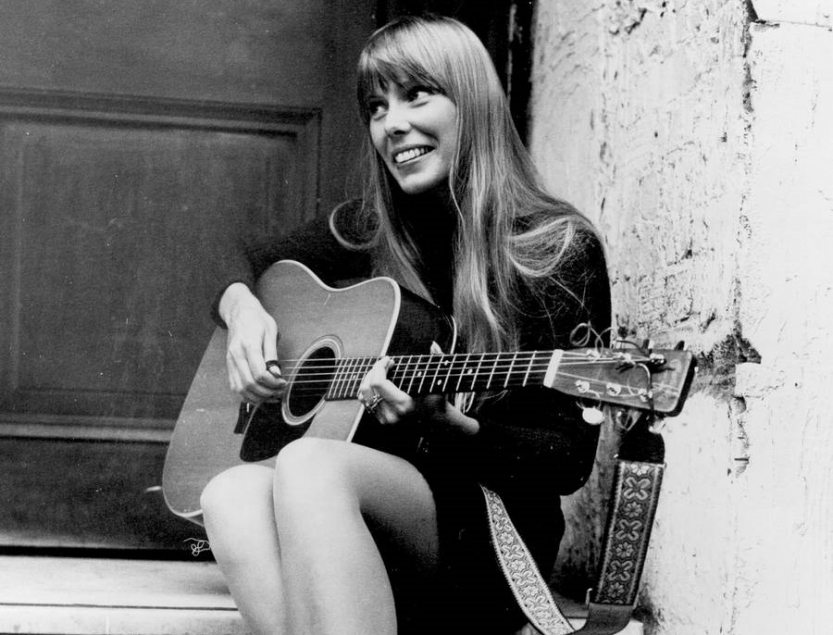
Joni Mitchell exploring the fretboard
What’s worth understanding, especially if you’re just starting to explore alternate tunings, is that Mitchell wasn’t just randomly spinning her tuning pegs and seeing what happened. Her approach was deeply intentional. She described it as “twiddling” strings until she stumbled onto new harmonic colors, then building entire compositions around what she found.
She treated the guitar like a small orchestra, with the higher strings functioning like horns and the lower strings carrying the weight of a cello or bass. Standard tuning, in her view, boxed her in. Each new tuning opened up voicings and emotional textures she simply couldn’t access otherwise.
You can hear this evolution across her records. Blue (1971) draws on open G and open D-style tunings to support its raw, confessional intimacy. Court and Spark (1974) moves into richer open D variants that match the album’s jazzy, layered arrangements. Hejira (1976) is where things get genuinely transportive; tunings like C G D F G C give the record its cascading, wandering atmosphere, with Jaco Pastorius’s fretless bass weaving underneath.
Her influence on the singer-songwriters who came after her is hard to overstate. Artists exploring fingerstyle, folk, and acoustic experimentation have pointed to Mitchell as proof that the guitar is a compositional instrument, not just a chord machine.
The real takeaway for anyone just beginning their guitar journey is this: tuning is a creative decision. It always has been.
How Players Actually Stay in Tune Today
Keeping your guitar in tune is honestly one of the most important habits you can build, and the good news is that there are more easy, accessible options than ever before.
Most players today reach for one of four tools: clip-on tuners, smartphone apps, pedal tuners, or browser-based online tuners. Clip-ons attach to your headstock and read vibrations directly from the wood, which means they work even in noisy rooms. Apps like GuitarTuna use your phone’s microphone and are free to download. Pedal tuners sit on your pedalboard, mute your signal while you tune, and are a staple for anyone playing live. Online tuners work straight from your browser with no download needed.
The scale of app-based tuning is genuinely staggering. GuitarTuna alone has over 100 million users and supports 111 different tunings across 15 instruments. That number matters because it tells you something bigger: experimenting with alternate tunings like Open G or DADGAD is now completely normal for everyday players. You don’t need to figure out reference pitches manually. You just tap a preset and go.
For players who switch tunings frequently, automatic tuners like the Roadie 4 are worth knowing about. It physically turns your tuning pegs for you and can handle multiple guitars and alternate setups quickly. It’s particularly useful in live or recording situations where speed genuinely matters.
Honestly though, the best tuner is simply the one that gets you back to playing faster. Apps are perfect for beginners and home practice. Clip-ons balance portability and reliability really well. Pedals are built for the stage.
Here’s something worth sitting with: a guitar that sounds in tune is genuinely more enjoyable to play. For newer players especially…