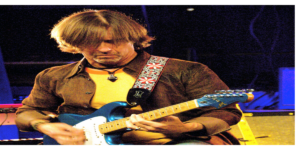
To truly understand the sonic possibilities of the acoustic guitar, one must look past the conventional boundaries of standard tuning and academic fingerpicking. For over five decades, French-Algerian guitarist Pierre Bensusan has operated not merely as a musician, but as a sonic alchemist. Often hailed by peers as the “Mojo Man” or the “Mozart of Guitar,” Bensusan has completely rewritten the vocabulary of the acoustic instrument. His style completely bypasses traditional folk clichés, transforming a single box of wood and six strings into a sprawling orchestral canvas that seamlessly blends genres, cultures, and centuries into a unified musical voice.
The Master of a Single Universe: Unlocking DADGAD
While the vast majority of acoustic guitarists treat alternative tunings as occasional novelties or specific performance tools, Bensusan made a radical, uncompromising choice early in his career to adopt a single modal tuning as his permanent musical home: DADGAD. Rather than feeling restricted by the boundaries of a single setting, Bensusan mapped the fretboard with such absolute precision that he unlocked a completely parallel musical dimension. Through his hands, this tuning strips away the traditional, rigid major and minor shapes of standard guitar playing, replacing them with open, ambiguous intervals that can shift from a dark, brooding melancholy to a blinding, euphoric brightness in the span of a single chord change. He is universally recognized as the definitive pioneer who brought this tuning into the global mainstream, forever altering how acoustic composers approach the instrument.
Anatomy of the Bensusan Style: The Campanella Effect
The defining characteristic of Bensusan’s revolutionary technique is his breathtaking use of the campanella, or “little bell,” effect. Borrowed from classical lute and harp techniques, this approach involves structuring fingerings so that notes from a melodic line ring out concurrently across adjacent strings, rather than stopping abruptly when the next note is fretted. This creates a cascading, fluid wall of sound where notes bleed into one another like a watercolor painting. When combined with his extraordinarily precise right-hand attack, his guitar begins to sound less like a single instrument and more like a complex duet between a Celtic harp and an early classical piano, delivering maximum harmonic depth with minimal physical waste.
This intricate acoustic architecture is further elevated by Bensusan’s unique approach to phrasing, which is deeply rooted in his diverse cultural heritage. Born in French Algeria, his musical DNA is a rich, borderless tapestry. His compositions effortlessly fuse traditional Celtic jigs and reels with the intricate modal scales of North African and Middle Eastern music, all while utilizing the sophisticated harmonic movements of French impressionist classical music and the spontaneous energy of American jazz improvisation. To watch him play live is to witness a masterclass in rhythm; he frequently incorporates subtle left-hand slaps, sudden percussive dampening, and complex syncopations that keep the listener in a perpetual state of wonder.
The Voice as a Secondary Fretboard
What truly separates Bensusan from the crowded field of solo acoustic virtuosos is his brilliant integration of the human voice as a literal extension of his guitar. He treats his vocals not as a vehicle for traditional lyrics, but as a secondary, fluid melodic instrument. During intense improvisational sections, Bensusan utilizes wordless vocalizing, pristine whistling, and rapid jazz scatting that perfectly mirrors his complex guitar lines in real-time. This striking unison between voice and fingerboard adds an eerie, beautiful, and deeply human layer to his performances, shattering the invisible wall that often separates instrumental acoustic music from the raw emotional immediacy of vocal expression.
Acoustic Architecture: The Tools of the Alchemist
For decades, Bensusan’s legendary tone was inseparable from a single, battle-tested instrument: a 1978 Lowden acoustic guitar affectionately dubbed the “Old Lady.” Crafted by legendary Northern Irish luthier George Lowden, this cedar-topped, rosewood-backed masterpiece became the sonic blueprint for modern fingerstyle guitar. The instrument was played with such unrelenting, passionate intensity over decades of world touring that the soft cedar wood surrounding the soundhole completely wore away, leaving a physical testament to Bensusan’s aggressive, dynamic picking style. Much like how the beautiful black magic of Peter Green’s Les Paul defined a generation of blues players, Bensusan’s weathered Lowden became an iconic visual symbol of his musical identity.
In his modern touring eras, Bensusan has transitioned to a highly advanced instrument developed in collaboration with master American luthier Kevin Ryan. The Kevin Ryan Signature Pierre Bensusan model is a marvel of contemporary acoustic engineering, featuring a prolonged scale length explicitly optimized to handle the lower string tension of DADGAD tuning without sacrificing clarity or bass response. The guitar incorporates an ergonomic acoustic bevel to protect the player’s forearm during marathon performances, alongside specialized acoustic flutes—small sound ports cut into the side of the guitar body—that project the complex mid-range frequencies and rich overtones directly up toward the guitarist’s ears, creating an immersive, high-fidelity monitoring experience right on the stage.
Featured Performance: The Masterpiece of “L’Alchimiste”
To fully appreciate the jaw-dropping scope of his influence, one must experience his definitive composition, “L’Alchimiste” (The Alchemist). This track provides the ultimate textbook definition of the campanella technique, showcasing his ability to spin blindingly fast, intricate lines that retain a flawless, bell-like clarity. The way the open DADGAD strings ring out beneath the complex fretwork creates an illusion of multiple instruments playing simultaneously. It is a piece that demands absolute physical precision and deep emotional maturity, serving as a perfect introduction to his revolutionary style.
Expanding the Journey: Further Recommendations
Once you have absorbed the complex layers of “L’Alchimiste,” his broader catalog offers a wealth of acoustic exploration. His masterpiece “Le Voyage pour l’Irlande” highlights his uncanny ability to capture the rolling, misty atmosphere of traditional landscapes while infusing them with modern, sophisticated harmonic twists. Meanwhile, later compositions like “Wu Wei” highlight his contemporary evolution, blending percussive left-hand techniques with elastic, jazz-fusion phrasing that pushes the acoustic guitar far beyond its traditional folky roots.
Pierre Bensusan remains one of the few completely uncompromising, authentic voices in the global guitar community. He approaches the acoustic guitar not as a box of wires and wood to be tamed, but as a living, breathing acoustic orchestra. If you are a guitarist looking to break free from standard compositional ruts and explore the true emotional depth of your instrument, discovering Bensusan’s catalog is a perfect step. For those just beginning their own musical path, exploring our resources on must-know guitar riffs for beginners or finding out how to access standard structures through platforms like Ultimate Guitar or Chordify can help build the foundational muscle memory required before stepping into the advanced, borderless world of open-tuning mastery.