Welcome back to Guitardoor.com, where we celebrate the true, one-of-a-kind artists who leave an indelible mark on the world. Today, we remember one of the most powerful, iconic, and revered voices in modern rock history: the incredible Chris Cornell. As the legendary frontman for the pioneering grunge titans Soundgarden, the rock and roll supergroup Audioslave, and the iconic tribute project Temple of the Dog, Cornell was a masterful songwriter and a uniquely powerful rhythm guitarist whose unconventional style created the perfect, heavy foundation for his once-in-a-generation voice.
Chris Cornell’s musical style was a brilliant and heavy fusion, drawing from the colossal power of 70s hard rock and metal gods like Black Sabbath and Led Zeppelin, filtering it through the raw, unfiltered energy of punk, and infusing it with a deep, almost psychedelic melodicism. He was a lyricist of incredible depth and intelligence, a true poet whose words were often dark, introspective, and full of complex, soul-searching imagery. But it was his voice that was the true force of nature. Possessing a staggering four-octave range, he could move from a soulful, bluesy whisper to a feral, primal scream with breathtaking power and control. He was, without question, one of the greatest singers in the history of rock.
The guitar playing of Chris Cornell was an act of pure, powerful invention, born out of creativity and the need to create a sonic landscape vast enough to match his voice. He was not a traditional lead guitarist; he was a master of the heavy, unorthodox, and incredibly creative riff. His genius as a rhythm player was his extensive and innovative use of alternate tunings. By tuning his guitar down, especially to drop-D but also to a variety of more obscure tunings, he was able to conjure huge, sludgy, and dissonant chord voicings that would have been impossible in a standard setup. This became the very foundation of the Soundgarden sound. His main tools for this heavy work were most often Gibson guitars, from the semi-hollow ES-335 to the classic Les Paul, plugged into roaring, high-gain Mesa/Boogie or Marshall amplifiers to create a massive wall of sound.
“Black Hole Sun,”
His iconic guitar work is woven into the very fabric of his most legendary songs. For Soundgarden’s most famous anthem, “Black Hole Sun,” he created a dark and beautiful psychedelic masterpiece. To approach playing it, the key is the main arpeggiated riff, which was famously played through a Leslie speaker (a rotating speaker cabinet, though a simulator pedal works perfectly). It requires a clean but slightly gritty tone and a fluid, precise picking hand to capture that signature swirling, hypnotic, and slightly queasy atmosphere. The song’s deep roots in the blues, twisted into a modern psychedelic form, show how even the most forward-thinking rock still owes a debt to the masters, a lineage that goes all the way back to artists like David “Honeyboy” Edwards: The Last of the Delta Bluesmen.
“Like a Stone.”
With Audioslave, he crafted the beautiful and powerful ballad “Like a Stone.” The approach here is one of subtlety and space; the main guitar part is a simple, clean, arpeggiated figure decorated with a pulsing tremolo effect. It’s a perfect lesson in supporting a powerful vocal, a skill shared by many great musical craftsmen, a theme we explored in our feature on Dave Mason: The Long Farewell of a Journeyman.
“Fell on Black Days.”
And for a classic, heavy Soundgarden riff, look no further than “Fell on Black Days.” This moody and powerful track is in an unusual 6/4 time signature, so the first step for any player is to internalize that lopsided, hypnotic groove. The challenge isn’t technical speed, but capturing the heavy, world-weary feel of the simple, down-tuned riff.
In the end, Chris Cornell’s legacy is that of a true and total artist—a phenomenal singer, a profound lyricist, and an innovative guitarist who created a sound that was entirely his own. He was the soulful, searching voice that defined an era for millions of listeners. His tragic passing left a void in the music world that can never be filled, but his powerful, honest, and beautiful music continues to resonate with an incredible and timeless emotional power.
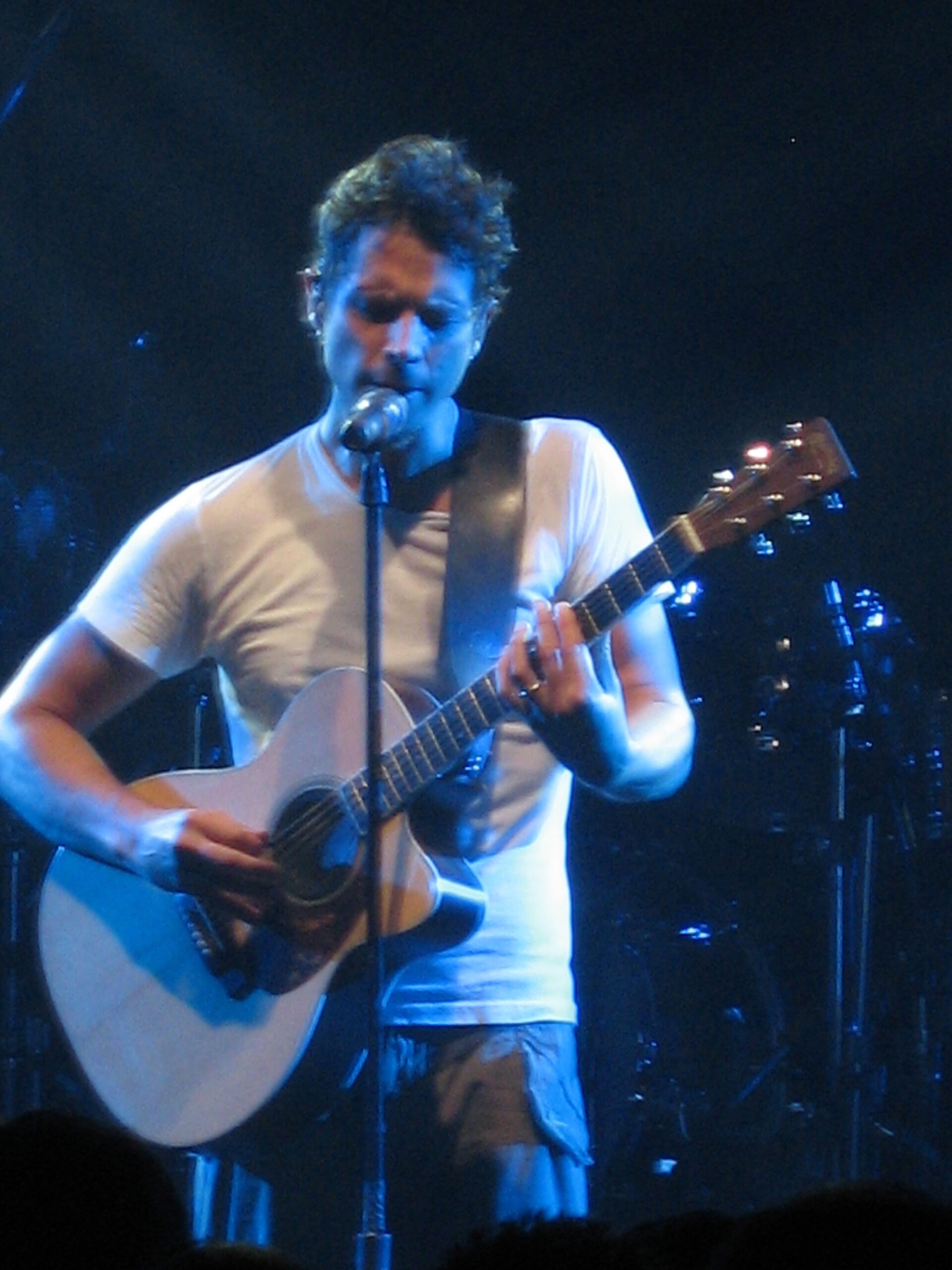
Cover Photo Credit “Chris Cornell Montreux Jazz Festival 2005” by Simon Jacquier from Vernayaz (near Martigny, Valais), Switzerland is licensed under CC BY-SA 2.0