Welcome back to Guitardoor.com, where we pay tribute to the seminal figures whose influence echoes through generations of players. Today, we explore the legacy of a quiet giant, a true “guitarist’s guitarist” and a foundational pillar of the 1960s British folk revival: the legendary Bert Jansch. Though he never achieved stadium-level fame, his innovative fingerstyle technique and dark, introspective songwriting created a ripple effect that directly inspired a staggering list of rock and folk royalty, from Jimmy Page and Neil Young to Johnny Marr.
The Folk Baroque Sound
Bert Jansch’s musical style was a complex and potent synthesis of American blues, traditional English folk song, and the sophisticated harmonies of jazz and classical music. This unique blend, often dubbed “folk baroque,” was a revolutionary sound in the early 60s. His songwriting was equally distinctive, often delving into dark, melancholic, and deeply personal themes that stood in stark contrast to the more topical or romantic folk of the era. His music was raw, emotionally honest, and possessed a haunting, timeless quality.
His influence was amplified through his role as a founding member of the pioneering folk-jazz supergroup, Pentangle. Alongside fellow guitar virtuoso John Renbourn, bassist Danny Thompson, vocalist Jacqui McShee, and drummer Terry Cox, Pentangle pushed the boundaries of acoustic music, seamlessly blending folk, blues, and jazz improvisation into a sophisticated and intricate sound that was unlike anything before it. This period showcased Jansch’s incredible ability to weave his complex guitar parts into a dynamic, improvisational ensemble.
Anatomy of a Fingerstyle Master
The core of Bert Jansch’s legendary status lies in his unique and aggressive right-hand fingerstyle technique. He developed a powerful “clawhammer” approach where his thumb would lay down a driving, independent, alternating bass line while his fingers would simultaneously pluck out sharp, syncopated melodies. This created the stunning illusion of two guitarists playing at once. Unlike the delicate touch of many folk players, Jansch often attacked the strings with force, creating a percussive snap that became a signature part of his raw, dynamic sound.
He was a pioneer in the use of alternate tunings, with his use of Dropped D and D-A-D-G-A-D tunings becoming so influential that they are now staples of the folk guitar vernacular. These tunings opened up new harmonic possibilities, allowing him to create the droning, moody, and often dissonant chord voicings that perfectly suited his introspective music. His sound was never about expensive gear; it was about the raw, honest, and unadorned tone of a steel-string acoustic guitar played by masterful hands.
The London folk scene of the mid-60s was a small, collaborative world, and Jansch’s influence spread rapidly through personal connections. A perfect example of this is his relationship with a young Donovan. The Scottish pop-folk troubadour was a huge admirer of Jansch and learned his signature D-A-D-G-A-D tuning and “clawhammer” technique directly from him. Donovan would then use this very technique to write and record some of his biggest international hits, including “Sunshine Superman” and “Hurdy Gurdy Man.” This connection beautifully illustrates how Jansch’s groundbreaking but “underground” innovations reached a massive global audience, becoming part of the very sound of the era.
Essential Jansch: The Fingerstyle Canon
Bert Jansch’s body of work is a foundational text for any student of acoustic fingerstyle guitar. To understand his profound impact as both a player and a songwriter, these three pieces are essential listening.
“Angie” (or “Anji”
Angie,” or more accurately “Anji,” is a highly influential acoustic guitar instrumental most famously arranged and performed by the Scottish folk musician Bert Jansch. Although originally composed by another pivotal figure of the British folk revival, Davy Graham, in 1961, it was Jansch’s 1965 recording on his self-titled debut album that solidified the piece as a cornerstone of the folk-baroque style. Jansch’s version, noted for its intricate fingerpicking and a characteristic descending bassline in A minor, became a benchmark and a “rite of passage” for aspiring acoustic guitarists. Its complex, blues- and folk-infused melody helped define a new, sophisticated approach to the steel-string guitar and went on to directly influence countless musicians, including Paul Simon (who covered it on the Simon & Garfunkel album Sounds of Silence) and Jimmy Page.
“Needle of Death”
“Needle of Death” is one of the most significant and starkly poignant songs by the acclaimed Scottish folk musician Bert Jansch, released on his 1965 eponymous debut album. The song is a powerful and sorrowful anti-drugs lament, inspired by the death of Jansch’s friend and fellow folk singer Buck Polly, who died from a heroin overdose. Sung over Jansch’s signature, intricate acoustic guitar playing, the spare yet deeply resonant lyrics offer a haunting narrative and a cautionary warning about the dangers of drug addiction. Its honest and raw depiction of loss made it a key track in the burgeoning British folk revival scene and a major influence on artists like Neil Young, who cited it as an inspiration for his own songs like “The Needle and the Damage Done” and “Ambulance Blues.” The track remains a definitive example of Jansch’s profound songwriting and unique guitar style.
“Light Flight”
“Light Flight” is the signature track from the folk-jazz group Pentangle, featured on their hugely successful 1969 album, Basket of Light. Written by all five members of the band—Bert Jansch, John Renbourn, Jacqui McShee, Danny Thompson, and Terry Cox—the song is a technical and lyrical masterpiece that perfectly embodies the band’s innovative folk-jazz fusion. Lyrically, the song is an enchanting call to escape the frantic “city’s race” for a more tranquil, reflective experience, evoking surreal imagery of cosmic travel and the swift passage of time. Musically, it is instantly recognizable for its thrilling use of unconventional time signatures, primarily mixing 5/4 and 7/4, driven by Danny Thompson’s phenomenal jazz-influenced double bass work and Jacqui McShee’s soaring, clear vocals. “Light Flight” achieved significant popularity when it was used as the memorable theme music for the BBC’s groundbreaking 1969 color drama series, Take Three Girls, establishing Pentangle as one of the most creatively adventurous bands of the era.
As you have listened to Bert Jansch now you know he was a true quiet revolutionary. Jansch was an artist of uncompromising integrity whose innovations created a new, richer vocabulary for the acoustic guitar. While his name may not be as widely known as those he influenced, his legacy is everywhere even in the complex acoustic passages of Led Zeppelin, the introspective folk of Neil Young, and the chiming arpeggios of The Smiths. He is, without question, one of the most important and influential acoustic guitarists of the 20th century.
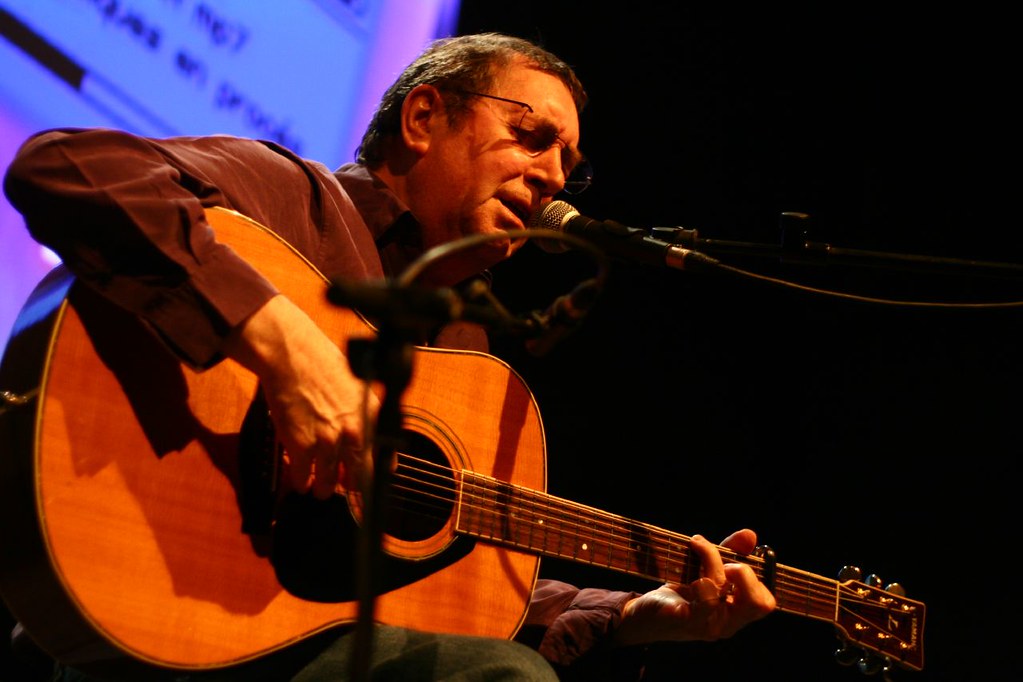
Cover Photo Credit “bert jansch” by Dani Canto is licensed under CC BY-NC 2.0