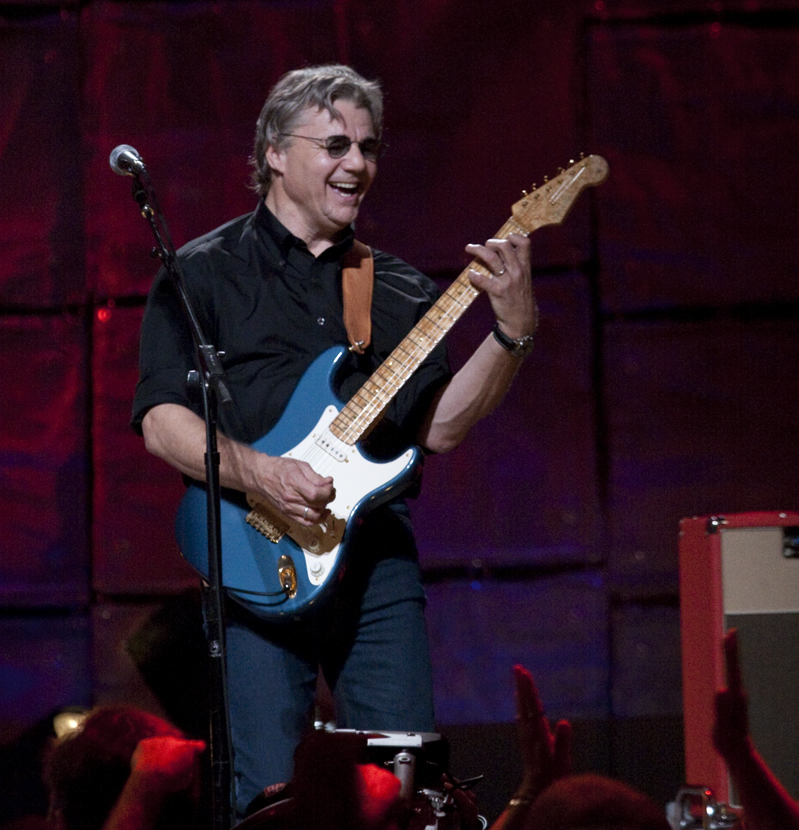
Few American bandleaders have bridged raw Chicago blues heritage and arena-filling classic rock hooks as seamlessly as Steve Miller. As the vocalist, songwriter, and lead guitarist behind the Steve Miller Band, he evolved from a fiery San Francisco psychedelic blues-rocker into one of the defining hitmakers of the 1970s—anchoring timeless anthems with singing Stratocaster melodies, hypnotic tape-delay textures, and unmistakable groove.
From Chicago Blues Roots to the Stratosphere
Steve Miller’s musical foundation was built directly alongside American guitar royalty. Growing up in Milwaukee and Texas, he learned his first chords from his godfather, electric guitar pioneer Les Paul, and soaked up the jump-blues phrasing of family friend T-Bone Walker. After cutting his teeth in Chicago’s blues clubs alongside Paul Butterfield and Barry Goldberg, Miller relocated to San Francisco in the late 1960s, becoming a fixture of the city’s psychedelic blues-rock scene.
By the mid-1970s, Miller sharpened his focus, stripping back extended psychedelic jams in favor of tight, groove-driven pop-rock built around instantly memorable guitar riffs. That formula produced a run of multi-platinum classics that turned him into a permanent cornerstone of classic rock radio.
Anatomy of a Joker: Phrasing, Riffs & Cosmic Tone
Steve Miller’s playing is a masterclass in restraint, melody, and studio craft. Rather than relying on high-speed shred, he treats every solo and rhythm hook as an essential vocal counterpoint.
Vocal-Like Lead Phrasing: Miller’s solos are concise, lyrical, and carefully constructed to serve the song. Using vocal-style string bends, subtle slide inflections, and a relaxed, behind-the-beat pocket, he crafts lead lines that listeners can hum just as easily as his vocal choruses.
The Economy of the Hook: Miller excels at writing simple, authoritative single-note riffs and open-chord grooves that carry an entire track. Songs like “The Joker” and “Rock’n Me” prove that two or three well-placed notes played with conviction carry more weight than complex technical runs.
Stratocasters, Tape Delay & Clean Headroom: Miller is closely associated with the Fender Stratocaster—most famously his custom-painted “Psychedelic” Stratocaster alongside vintage late-1960s and 1970s models. Running through high-headroom Fender Twin Reverb (and later Dumble) amplifiers, he shaped his signature smooth lead tone using subtle compression, an MXR Phase 90, and a Maestro Echoplex EP-3 tape delay—giving his notes the lush, floating sustain heard across his cosmic space-rock recordings.
3 Essential Tracks: The Steve Miller Masterclass
To hear how Miller balanced blues-rooted touch, studio atmosphere, and pure rock ‘n’ roll punch, these three landmark tracks capture his style at its peak.
“The Joker”
Built over an unhurried, loping groove, “The Joker” showcases Miller’s gift for infectious simplicity. His clean, compressed Stratocaster riff locks directly into the bassline, punctuated by vocal-like slide licks and playful harmonic accents that give the track its effortless swagger.
“Fly Like an Eagle”
A benchmark of 1970s studio production, this track pairs swirling synthesizer textures with a hypnotic funk-rock pocket. Miller’s guitar solo floats effortlessly over the mix—drenched in warm tape delay and built on sustained, singing bends that showcase his total control of space and tone.
“Rock’n Me”
A high-energy, straight-ahead rock and roll anthem driven by one of Miller’s punchiest opening riffs. With crisp double-stops, tight rhythmic drive, and a concise, blues-inflected lead break, it highlights the raw band energy behind his polished studio hits.
An Enduring Classic Rock Legacy
Steve Miller’s enduring appeal lies in his ability to unite deep American blues roots with unmistakable melodic craftsmanship. Like fellow champions of tasteful simplicity, he proved that great tone, solid groove, and a memorable melody never go out of style.
Cover Photo Credit “Steve Miller Press 2010” by Tim Brown is licensed under CC BY-SA 4.0