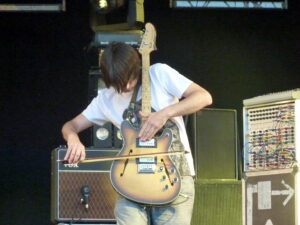
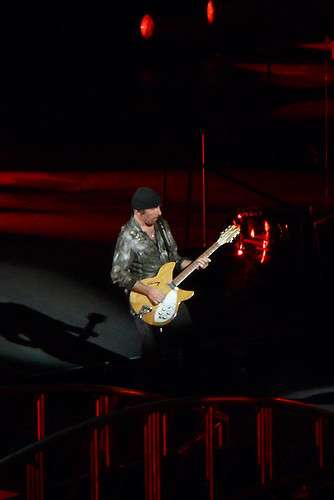
The Edge, born David Howell Evans in 1961, is far more than a guitarist; he’s a sonic architect who has profoundly shaped the landscape of the rock band U2. His journey began at Mount Temple Comprehensive school in Dublin, a crucible of creativity where he, alongside Bono, Larry Mullen Jr., and Adam Clayton, discovered their shared musical passion. This formative period laid the groundwork for a band that would not only achieve global success but also redefine the boundaries of rock music.
The Edge’s Unique Sonic Signature
From the outset, David Howell Evans demonstrated a unique musical sensibility, a willingness to explore beyond conventional guitar techniques. Beyond his signature guitar style, he delved into the interplay of piano and guitar, adding layers of texture and depth to U2’s sonic palette. This exploration is evident in various tracks, showcasing his versatility as a musician. His instantly recognizable guitar sound, characterized by its shimmering, ethereal quality, emerged from a masterful command of delay, echo, alternate tunings, and intricate arpeggios. This sonic signature became integral to U2’s early albums, such as album Boy, which captured the raw energy of their youth, and later, landmark recordings like The Unforgettable Fire, with its atmospheric soundscapes, and the globally acclaimed Joshua Tree. The Joshua Tree in particular, with its vast, cinematic sound, became a defining moment for the band, solidifying their status as global icons.
Technological Innovation and Live Performances
The Edge’s innovative embrace of technology has been transformative. As an early adopter of digital effects and samplers, he expanded the guitar’s expressive range, crafting the complex textures and atmospheric layers that define U2’s sound. This technological exploration was vividly displayed during groundbreaking tours like the Zoo TV Tour, which boldly integrated avant-garde music video elements into live performances, pushing the boundaries of what a rock concert could be. His expertise with effects pedals and innovative use of delay and echo created a distinct sonic landscape, especially evident during the record-breaking 360° Tour, where the sheer scale of the production amplified his sonic innovations.
Songwriting and Musical Legacy
His songwriting contributions are essential to U2’s enduring legacy. From the soaring majesty of “Where the Streets Have No Name” (from The Joshua Tree), with its iconic arpeggiated intro and powerful guitar solos, to the poignant emotional depth of “With or Without You,” his guitar work elevates U2’s music to extraordinary heights. These songs, along with his general ability to craft memorable guitar hooks and breathtaking melodies, are a testament to his musical genius, helping to create some of the most emotionally resonant songs in rock history.
Beyond Music: Philanthropy and Personal Life
Beyond his musical achievements, The Edge is a dedicated philanthropist, championing human rights, poverty alleviation, and environmental sustainability. He leverages his platform to drive positive change through various charitable organizations, demonstrating a commitment to making a difference beyond the realm of music. Delving into his personal life, The Edge’s journey includes significant chapters. His marriage to Aislinn O’Sullivan produced three daughters, but they later divorced. He found lasting love with Morleigh Steinberg, a talented dancer and choreographer who contributed to U2’s Zoo TV tour, adding a unique artistic dimension to the band’s live performances. Their union has brought him further joy, and shows a connection to other artistic expressions, highlighting his multifaceted nature.
Key Career Moments and Lasting Influence
Key moments in his career include the band’s performance at Live Aid in 1985, where his powerful guitar riff during “Sunday Bloody Sunday” left an indelible mark, and the previously mentioned 360° tour, which showcased the evolution of his sound and stagecraft.