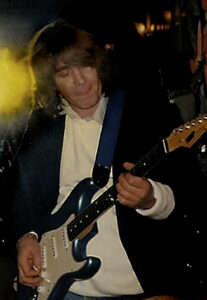
Today, we enter the highly disciplined and intellectually boundless world of Robert Fripp. As the founder, sole constant member, and conceptual architect of the legendary progressive rock band King Crimson, Fripp is more than a guitarist; he is a composer, a philosopher, an inventor, and a teacher. For over half a century, he has relentlessly pushed the boundaries of what a guitar can be and what a musician should be, treating the instrument not as a tool for rock stardom, but as a vehicle for personal discipline and sonic exploration.
A Style of Mind and Discipline
Robert Fripp’s musical style cannot be separated from his rigorous intellectual and philosophical approach to music. Unlike almost any other rock guitarist, his playing is not rooted in the blues or traditional rock and roll. Instead, it is a complex and often startling amalgamation of European classical traditions, avant-garde atonality, and intricate rhythmic structures. As the leader of King Crimson, he has guided the band through numerous incarnations, each one a new exploration of sonic territory, from the proto-metal chaos of their debut to the interlocking polyrhythms of their 80s lineup and the industrial textures of their later work.
His playing is characterized by its rhythmic precision and harmonic adventurousness. He is a master of rapid-fire, machine-like alternate and cross-picking, often weaving complex, arpeggiated lines that defy conventional rock phrasing. Harmonically, he eschews standard chords and scales in favor of dissonant intervals and unusual voicings, creating textures that can be beautiful, unsettling, and sublime all at once. For Fripp, the goal is not to deliver a simple, memorable lick, but to create a piece of a larger, intricate sonic tapestry. His entire career has been a testament to his belief that music is a discipline, a craft, and a way of making contact with something beyond the mundane.

The Alchemist’s Toolkit: Technique, Technology, and Tone
The sound of Robert Fripp is the result of a completely unique technical approach and a pioneering use of technology. Perhaps the most fundamental aspect of his technique is his “New Standard Tuning” (NST), which he developed in the early 1980s. Tuned C-G-D-A-E-G (from low to high), it is based on intervals of a perfect fifth, similar to a cello or violin, with a minor third at the very top. This tuning completely reconfigures the fretboard, forcing a departure from standard chord shapes and scale patterns and facilitating the wide, orchestral voicings he favors. To play with the required precision, he sits on a stool, holding the guitar at a specific angle, allowing for maximum efficiency in his picking hand.
Fripp is also a true pioneer of looping technology. In the early 1970s, collaborating with Brian Eno, he developed a system using two reel-to-reel tape recorders to create long, evolving delay loops. Dubbed “Frippertronics,” this system allowed him to build up complex layers of guitar in real-time. In the 1990s, he evolved this concept with digital technology, creating what he calls “Soundscapes”—vast, ambient, and often beautiful sonic environments created solely from his processed guitar signal.
His gear has always been a mix of classic and cutting-edge. His most iconic guitars are vintage Gibson Les Pauls from the late 1950s, prized for their sustain and tonal quality. He has always been a proponent of a clean, powerful core tone, often achieved through Hiwatt amplifiers. This clean signal then becomes the source for his complex effects rig, which has included everything from classic fuzz pedals to sophisticated guitar synthesizers and the digital processors required for his Soundscapes. Central to his teachings and philosophy is the “Guitar Craft,” a series of residential courses he began in 1985, teaching students his unique tuning, picking technique, and overall approach to music as a discipline.
Essential Fripp: A Glimpse into the Crimson King’s Court
Robert Fripp’s body of work is immense and challenging. To begin to understand his multifaceted contributions to music, these three pieces serve as crucial reference points.
“21st Century Schizoid Man”
“Starless”
Robert Fripp – Radiophonics (1995 Soundscapes Volume 1 – Live In Argentina)
Robert Fripp is a singular figure in the history of the guitar. He is the ultimate anti-rock star—a disciplined intellectual who has consistently prioritized artistic exploration over commercial compromise. He fundamentally altered the perception of the guitar’s role, transforming it from a simple blues-based voice into a limitless orchestra and a tool for profound personal and musical discovery. His influence is immeasurable, not just on the guitarists who have tried to emulate his technique, but on any musician who believes in pushing boundaries and pursuing a unique artistic vision.
Cover Photo Credit “ROBERT FRIPP GOD SAVE THE QUEEN MEMORABILIA MUSIC COLLECTOR 80s-early 90s A&R Promo Handbill for artists Record Label Music Publisher Concert Venue All original, not a repro, sent to a College Radio Station” by UpNorth Memories – Don Harrison is licensed under CC BY-NC-ND 2.0