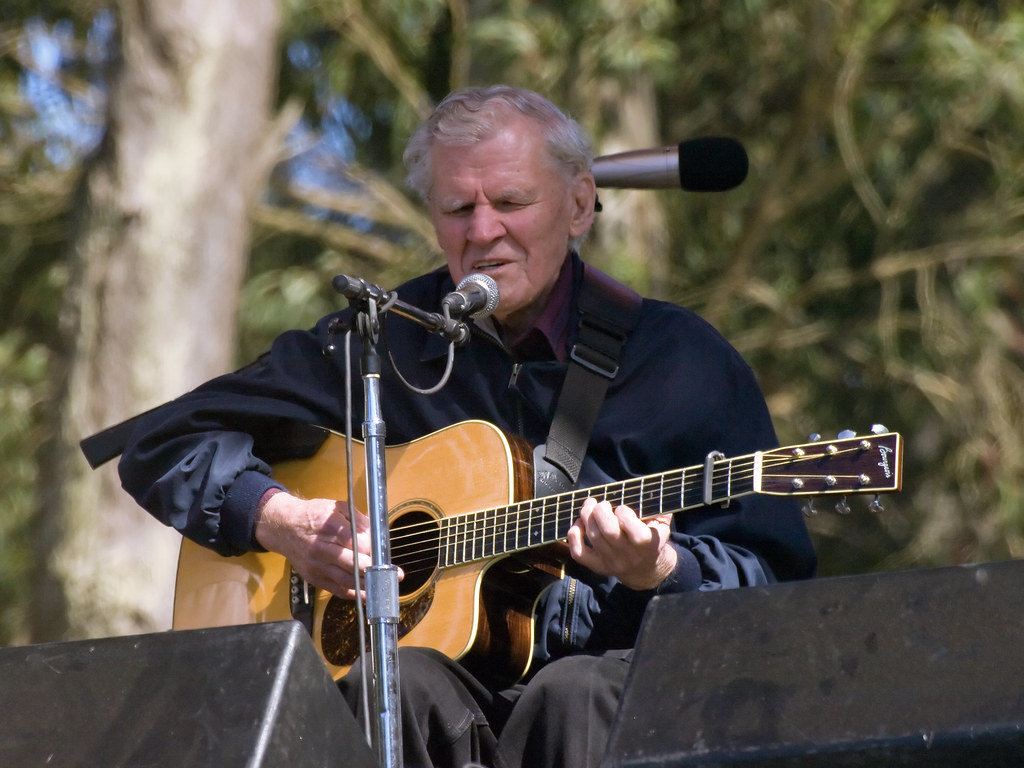
Welcome back to Guitardoor.com, where we honor the true cornerstones of American music. Today, we sit on the front porch and listen to the stories of a national treasure and one of the most influential acoustic musicians of all time: the legendary Arthel “Doc” Watson. Hailing from the Blue Ridge Mountains of North Carolina, Doc was more than just a singer or a guitarist; he was a living archive of American song. A warm, soulful vocalist and a revolutionary instrumentalist, he almost single-handedly elevated the acoustic guitar from a simple rhythm tool to a powerful lead voice in traditional music, forever changing its role and inspiring generations of players.
The Voice of the Mountains
Doc Watson’s musical style was as deep and authentic as the Appalachian hills he called home. His repertoire was a breathtaking encyclopedia of American vernacular music. With a warm, honest baritone that felt like a conversation with an old friend, he sang ancient folk ballads passed down through generations, heartfelt gospel hymns, classic country tunes, and gritty, down-home blues. He was a preservationist at heart, a vital link to a vanishing rural past, yet he performed this music with a vitality and presence that made it feel immediate and timeless.
His most profound and revolutionary contribution, however, was to the art of guitar playing. Before Doc, the acoustic guitar in old-time and bluegrass ensembles was primarily a rhythm instrument, used for strumming chords in the background. Doc changed everything. Inspired by the fiddle and banjo players around him, he began to adapt their complex, lightning-fast melody lines to the guitar. Using a simple flatpick, he played fiddle tunes with a speed, clarity, and melodic grace that was simply unheard of at the time. This innovation, known as lead flatpicking, created a powerful new role for the guitar and became a foundational element of modern bluegrass and folk music.
The Flatpicker’s Handbook: Technique and Tone

To understand Doc Watson’s technique is to understand the very essence of modern flatpicking. His style was built on a foundation of incredible precision, timing, and a deep understanding of melody. Using a standard plectrum, he could articulate complex, single-note runs at blistering tempos, navigating the intricate melodies of fiddle tunes like “Black Mountain Rag” or “Beaumont Rag” with an apparently effortless grace. His right hand was a marvel of efficiency, seamlessly switching between playing lead lines and strumming rhythm chords without ever losing the groove. He was also a master of crosspicking, a technique that uses a continuous, rolling pick stroke across three strings to mimic the sound of a banjo roll, adding a shimmering texture to his playing.
But Doc was far from a one-dimensional player. He was also a deeply soulful and highly accomplished fingerstyle guitarist. Often on his blues and gospel numbers, he would put the pick down and play with his bare fingers, revealing an intricate and equally masterful technique. His fingerpicking on songs like “Deep River Blues” was a testament to his versatility and his deep connection to all forms of American roots music.
His choice of gear was as honest and unadorned as his music. His name is forever linked with Gallagher Guitars, a small, family-owned company from Tennessee. His main instrument for many years was a Gallagher G-50 model that he affectionately nicknamed “Ol’ Hoss.” This guitar was his trusted companion, and its balanced, clear, and powerful voice was the perfect vehicle for his playing. Doc Watson’s tone wasn’t derived from effects or amplification; it was drawn directly from the wood of the instrument through his masterful hands. His sound was pure, organic, and a direct reflection of the man himself.
Essential Doc: A Journey into American Song
Doc Watson’s discography is a treasure trove of American heritage. To begin to appreciate his monumental talent as both a singer and a revolutionary guitarist, these three recordings are the perfect place to start.
“Black Mountain Rag”
“Deep River Blues”
“Tennessee Stud”
Doc Watson was a true patriarch of American music. His influence extends far beyond the world of folk and bluegrass; it can be heard in the playing of countless guitarists across rock, country, and acoustic music. He was a generous spirit, a master storyteller, and an instrumental innovator of the highest order. He didn’t just play the music; he lived it, and in doing so, he preserved its past while creating a vibrant future for the acoustic guitar.
Cover Photo Credit “Doc Watson 3” by armadilo60 is licensed under CC BY-SA 2.0