Welcome back to Guitardoor.com, where we celebrate the true sonic innovators who dared to redefine the electric guitar. Today, we focus on the genius and musical intellect behind one of the most influential bands of the modern era: Radiohead guitarist, keyboardist, and composer, Jonny Greenwood. More than just a guitarist, Greenwood is a complete musical auteur, using the instrument not for traditional solos, but as a tool for creating vast, atmospheric soundscapes, jagged noise, and moments of sublime, often dissonant, beauty. His work is the very blueprint for modern experimental rock.
The Sound of the Avant-Garde
The sound of Radiohead, particularly from OK Computer onward, is defined by its ceaseless evolution, blending rock with electronic music, jazz, and modern classical composition. Jonny Greenwood is the primary agent of this experimentation. He is the master of musical tension and release, often deliberately using notes and tones that clash with the song’s primary key to create a sense of unease and intrigue. His parts are not accessories; they are structural components, often sounding less like guitar and more like a synthesized orchestra or a sputtering machine. He is known for playing what the song needs—which is often the exact opposite of what a traditional rock guitarist would play.
Anatomy of an Experimental Composer
Jonny Greenwood’s unique musical voice stems from his formal training in music theory and his boundless creativity, which he applies to his instrument with almost aggressive physicality.
The Telecaster Disruptor: Greenwood’s signature guitar is the Fender Telecaster Plus (V1 with Lace Sensor pickups). He loves the Telecaster’s bright, articulate, and unforgiving “glass” tone, which cuts through any mix—perfect for his sharp, rhythmic, and often dissonant lines.
The Aggressive Attack: Greenwood famously plays with immense physical intensity, sometimes seen wearing a wrist brace due to the hard, smashing attack of his right hand. This aggressive technique gives his playing a unique percussive impact and raw energy, essential for tracks like “Bodysnatchers.”
The Kill Switch Auteur: He famously utilizes the kill switch on his Telecaster (or an external pedal like a stutter switch) in conjunction with high-gain distortion (often from a discontinued Marshall ShredMaster pedal) to create a rhythmic, stuttering, machine-gun noise, notably heard in “Paranoid Android” and “Airbag.”
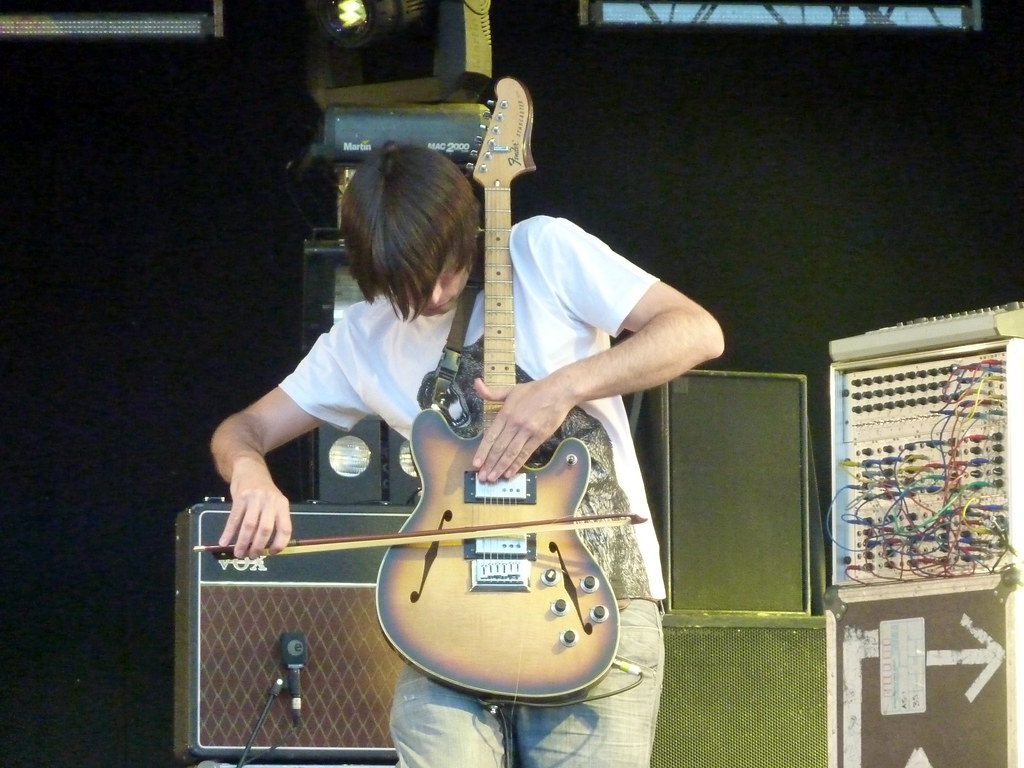
The Sonic Wizard: Greenwood is a master of non-traditional techniques. He uses the DigiTech Whammy pedal to create glitchy, octave-shifting licks (“My Iron Lung”), bows his Fender Starcaster to produce ethereal, cello-like textures (“Pyramid Song”), and even uses objects like a coin or a finger massager on the strings for unique sonic effects.
The Composer’s Mind: His later work sees him blending his roles. He frequently uses the Ondes Martenot (an early electronic instrument) and composes complex string arrangements (e.g., A Moon Shaped Pool), blurring the lines between the rock band and the orchestra.
The Essential Sound Sculptures
Jonny Greenwood’s parts are iconic. To understand his mastery of noise, atmosphere, and controlled chaos, these three tracks are essential.
Creep
This is the moment that cemented his early, destructive signature. To approach playing the famous “noise burst” before the chorus, the key is the sheer brutality and attack. It’s not a clean bend; it’s a frantic, scraping, power-chord-fueled, and heavily distorted eruption of noise, often achieved by aggressive bending and muting, designed to sabotage the song’s delicate verse. It’s the ultimate anti-guitar hero statement.
Paranoid Android
This multi-section epic is a showcase for his dynamics. To play his three most famous parts, you need versatility:
The Intro Riff: A dry, angular, slightly dissonant line that cuts through the mix.
The Heaviest Riff: A crushingly heavy, simple, distorted, and palm-muted power-chord riff (often played in drop D).
The Solo: A frantic, high-register, angular lead that uses the wah pedal as an aggressive, rhythmic tone filter rather than a melodic tool. The key is to convey a sense of frantic anxiety and impending collapse.
Idioteque
This track highlights his post-rock, electronic influence. While the main sound is electronic, his live role is often to add textured, angular, and rhythmic noise. The approach here is not to play notes, but to create atmosphere using effects like delay and looping, often playing high, ringing, or distorted notes that weave in and out of the rhythmic grid. It is the ultimate expression of the guitar as a textural element.
In the end, Jonny Greenwood is a towering figure in modern music. He dismantled the traditional role of the lead guitarist, rejecting the tired blues clichés of rock for the boundless sonic possibilities of noise, electronics, and composition. He proved that the electric guitar, when wielded with an uncompromising artistic vision, can be a tool of profound sonic alchemy, making him one of the most innovative and respected musicians of the 21st century.
Cover Photo Credit “Jonny Greenwood” by wonker is licensed under CC BY 2.0