
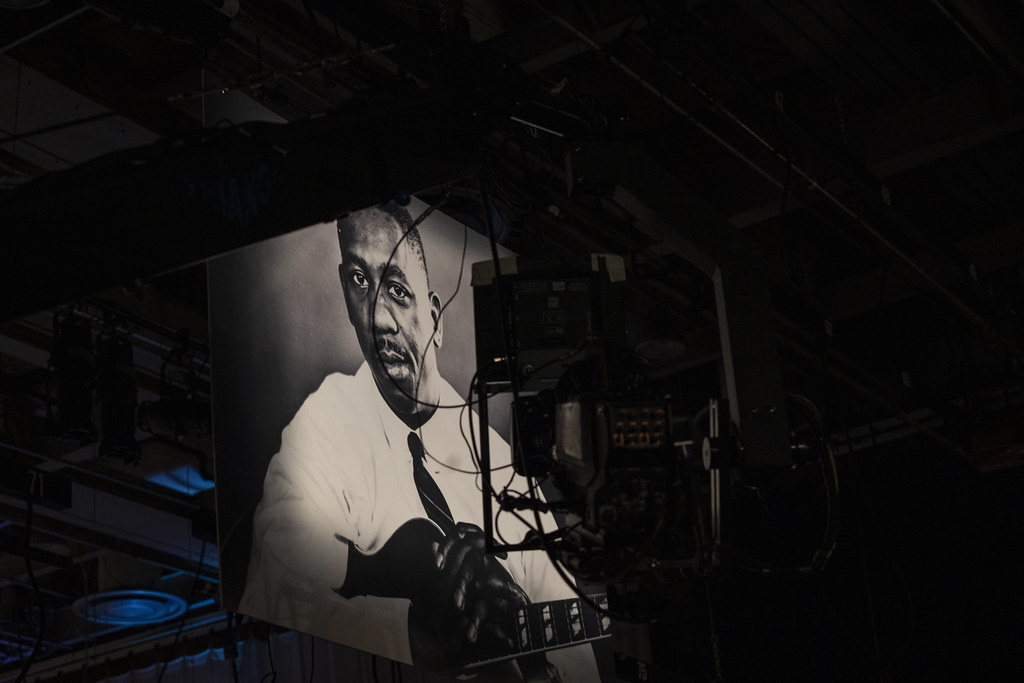
Welcome back to Guitardoor.com, where we pay tribute to the foundational pillars of the guitar. Today, we celebrate one of the most important, innovative, and influential guitarists in the history of music: the gentle giant of jazz, Wes Montgomery. With a revolutionary technique, an impossibly warm tone, and a deep, soulful sense of swing, Wes elevated the guitar from a rhythm section instrument to a premier solo voice in jazz, on par with the saxophone or piano, influencing virtually every jazz guitarist who followed.
The Soul of the Swing
The musical style of Wes Montgomery is the epitome of cool, melodic, and soulful jazz. His playing was incredibly accessible, even at its most complex, possessed of a natural, blues-infused lyricism and an unshakeable rhythmic drive. He was a crucial bridge figure, taking the torch from the early swing-era pioneer Charlie Christian and carrying it forward, infusing it with the more complex harmonic language of bebop and hard bop, all while retaining an innate, earthy soulfulness.
One of the most brilliant aspects of his playing was his masterful approach to structuring his improvised solos. He would often build his solos in three distinct, ascending tiers of intensity: starting with graceful, horn-like single-note lines, then building tension by doubling those lines in his signature octaves, and finally, reaching a powerful climax with rhythmically charged, harmonically dense block-chord solos. This compositional approach gave his improvisations a logical and compelling arc that was both brilliant and beautiful.
Anatomy of a Jazz Giant: Technique and Tone
The sound of Wes Montgomery is inextricably linked to his completely unique and revolutionary technique. The most famous and foundational element of his style was that he played exclusively with the fleshy part of his right thumb, forgoing a pick entirely. This “golden thumb” technique was the secret to his signature tone—a sound that was incredibly warm, round, and mellow, completely free of the sharp, percussive attack of a plectrum. This allowed his notes to bloom with a soft, pure, and incredibly vocal quality.
Building on this unique foundation, he perfected two other techniques that became his trademarks:
Octave Playing: Wes was the undisputed master of playing solos in octaves. He could play fast, intricate melodic guitar lines on two strings exactly an octave apart with flawless precision. This created a rich, full, and instantly recognizable sound that has been emulated by countless guitarists, including George Benson.
Chord Soloing: As a climax to his solos, he would improvise using block chords, moving entire chord shapes up and down the neck to create harmonically rich and rhythmically powerful statements.
His choice of gear was as classic and elegant as his playing. His most iconic instrument was the Gibson L-5 CES, a full-depth, carved-top archtop guitar. This quintessential jazz box was the perfect vehicle for his style, producing a rich, warm, and acoustically resonant tone that was beautifully captured by its humbucking pickups. To amplify this magnificent instrument, Wes relied on a simple and pure signal chain. He favored clean, warm tube amplifiers like the Fender Super Reverb, with no effects pedals in between. His entire legendary tone was generated from the organic combination of his masterful thumb technique and the pure, unadulterated sound of his Gibson L-5.
Essential Wes: The Riverside and Verve Years
Wes Montgomery’s discography is a foundational library for any student of jazz guitar. To grasp his genius as both a pure jazz improviser and a crossover star, these recordings are absolutely essential.
“Four on Six”
“Smokin’ at the Half Note”
“Goin’ Out of My Head”
Wes Montgomery is a true giant of 20th-century music, one of a handful of players who fundamentally changed how their instrument is played. His innovative technique, his unparalleled melodicism, and his warm, soulful tone created a new standard for jazz guitar. His influence is immeasurable, extending far beyond the world of jazz and touching any musician who values taste, tone, and pure, swinging musicality.
Cover Photo Credit “Wes Montgomery Jazz Tribute” by Indiana Public Media is licensed under CC BY-NC 2.0