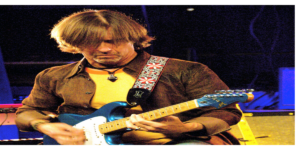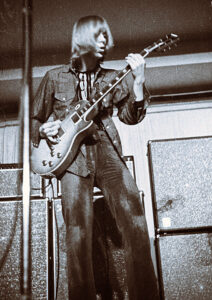
Freddie Stone is an American musician and songwriter best known as the co-founder and guitarist for Sly and the Family Stone, one of the most influential bands in the history of popular music. As the brother of Sly Stone, Freddie was a primary architect of the group’s revolutionary “psychedelic soul” sound. He provided the rhythmic backbone that allowed the band to seamlessly blend funk, rock, R&B, and pop. His playing was essential in shifting the role of the guitar in soul music from a background instrument to a driving, syncopated force that interacted directly with the bass and drums.
The Signature Stone Style: Syncopation and the “Chank”
Freddie Stone’s signature style is defined by a rigorous, percussive approach to rhythm guitar often referred to as “the chank.” Unlike rock guitarists who focused on long, distorted solos, Freddie focused on tight, interlocking rhythmic patterns that acted as a second percussion instrument. He utilized a clean, sharp tone often played on a hollow-body Gibson or a Fender Telecaster—to ensure his staccato chord stabs cut through the band’s dense arrangements. His playing was characterised by heavy syncopation and a masterful use of space, knowing exactly when to stay silent to let Larry Graham’s slap-bass or the horn section take the lead. This “rhythm-first” philosophy became the blueprint for the funk guitar style later popularised by artists like Prince and Nile Rodgers.
Three Essential Tracks to Hear His Genius
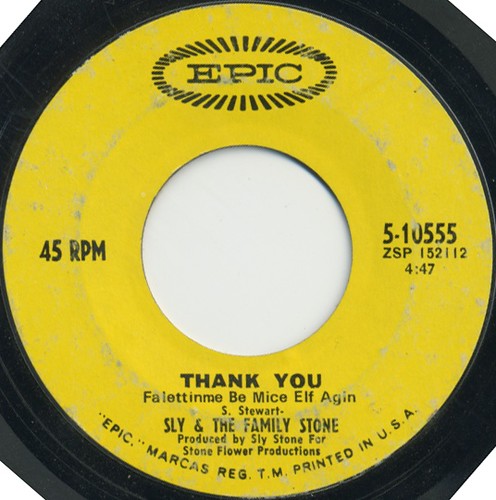
To appreciate the foundational role Freddie Stone played in the birth of funk-rock, three tracks stand out as essential listening. First is “Thank You (Falettinme Be Mice Elf Agin)” (1969). This track is a masterclass in funk orchestration. Freddie’s guitar provides a relentless, scratchy rhythm that perfectly offsets the iconic thumb-slapping bassline, creating a groove that feels both mechanical and deeply soulful.
Next, listen to “Dance to the Music” (1968). This song serves as an introduction to the band’s individual components, and Freddie’s contribution is a bright, driving riff that pushes the energy of the track upward. His ability to maintain a high-energy pocket while the rest of the band engages in vocal and instrumental call-and-response is the engine that makes the song work.
Finally, explore “I Want to Take You Higher” (1969). This track demonstrates his ability to blend rock aggression with gospel fervor. His guitar work here is heavier and more distorted than his usual style, featuring a repetitive, blues-based riff that builds into a psychedelic frenzy. It proves that while he was a rhythm specialist, he possessed the power to lead a high-octane rock performance when the song demanded it.
The Ultimate Rolodex: The Family Connection
The career of Freddie Stone is inseparable from the collective genius of Sly and the Family Stone. He worked in perfect synchronisation with his brother Sly Stone, who handled the visionary production and songwriting, and his sister Rose Stone, whose gospel-influenced keyboards and vocals added a layer of soulful depth. Perhaps his most important musical partnership was with bassist Larry Graham. Together, they re imagined the “engine room” of a band, moving away from simple walking basslines to a complex, interlocking rhythmic grid that redefined the sound of the 1970’s. Beyond the Family Stone, Freddie’s influence can be heard in the work of almost every funk and disco guitarist who followed in his wake.
Conclusion: The Quiet Force of a Revolution
Freddie Stone was a modest performer who never sought the spotlight, yet his technical innovations changed the trajectory of modern guitar. By prioritizing the groove over the solo, he helped create a musical language that broke down the barriers between R&B and rock. His legacy lives on in the tight, syncopated rhythms that define funk and hip-hop to this day. Freddie Stone remains the ultimate “player’s player,” a musician who understood that the greatest power of the guitar lies in its ability to make people dance.