Welcome back to Guitardoor.com, where we celebrate the artists who not only master a style but embody it completely. Today, we’re shining up our boots and slicking back our hair to pay tribute to the undisputed king of modern rockabilly and swing: the phenomenal Brian Setzer. As the frontman for the trailblazing Stray Cats and the leader of his own swinging big band, Setzer didn’t just revive a genre; he supercharged it with punk rock energy and virtuosic musicianship, making it cool, dangerous, and thrilling for a whole new generation.
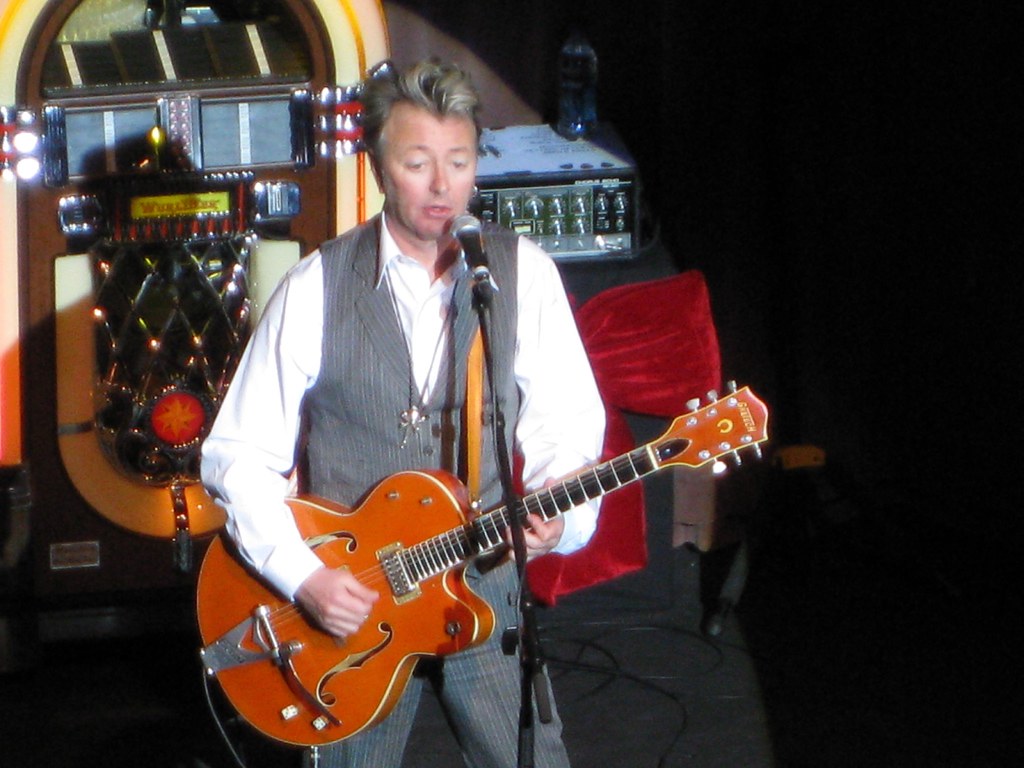
Cover Photo Credit “Brian Setzer Orchestra – Milwaukee December 2007” by purpleslog is licensed under CC BY 2.0
Gretsch, Swing, and Rock and Roll
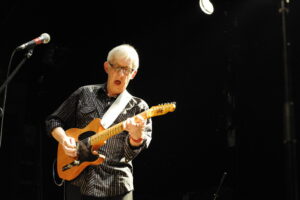
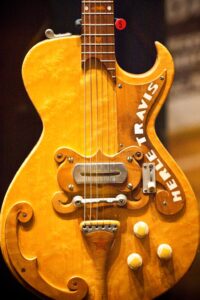
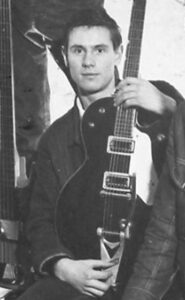
Brian Setzer’s musical style is a joyous and explosive cocktail of 1950s American music, filtered through a modern, high-energy lens. His playing is built on the holy trinity of early rock and roll guitar: the raw, slap-back-drenched rockabilly of players like Cliff Gallup and Scotty Moore, the sophisticated “country jazz” of Chet Atkins and Merle Travis, and the swinging rhythm of jump blues. He took these foundational elements and injected them with the raw, aggressive energy of punk rock, creating the signature sound of the Stray Cats.
With his 18-piece big band, The Brian Setzer Orchestra, he took this vision to a whole new level, seamlessly blending his rockabilly guitar pyrotechnics with the power and sophistication of a full horn section. He is a master arranger, able to write intricate horn charts that perfectly complement his guitar work, creating a sound that is both nostalgic and incredibly vibrant. Whether he’s leading a tight three-piece trio or a full-blown orchestra, his playing is always at the forefront—a perfect blend of technical brilliance and pure, unadulterated fun.
The Anatomy of a Stray Cat: Technique and Tone
To understand Brian Setzer’s playing is to appreciate a deep and versatile command of American guitar styles. The core of his technique is a masterful blend of fingerpicking and flatpicking. He often uses a thumbpick to anchor the rhythm and basslines, while his fingers fly across the strings, playing intricate melodies and chord fragments in the style of his hero, Chet Atkins. This is combined with a precise and powerful flatpicking style for his lightning-fast rockabilly runs. He is also a master of using the Bigsby vibrato arm, not for dive bombs, but for adding a subtle, expressive shimmer to his chords and notes.
His harmonic vocabulary is far more advanced than typical rock and roll. He has a deep understanding of jazz harmony, frequently incorporating complex chord voicings, diminished runs, and chromatic passing tones that give his playing its signature sophistication and swing.
His choice of gear is arguably the most iconic in the history of rockabilly. His name is synonymous with vintage Gretsch hollow-body guitars, particularly the 1959 Gretsch 6120 model. The “Gretsch sound”—with its bright, clear Filter’Tron pickups and resonant hollow body—is the absolute cornerstone of his tone. To amplify this classic sound, Setzer has famously relied on 1963 Fender Bassman amplifiers (with the 6G6-B circuit). He prizes these amps for their warm, rich clean tone and the smooth, natural overdrive they produce when cranked. The final, crucial ingredient in his sonic recipe is a Roland RE-301 Space Echo tape delay unit, which provides his signature slap-back echo, the rhythmic effect that is the very heartbeat of rockabilly. This simple, classic setup—a Gretsch into a tape echo into a Fender amp—is the formula for one of the most timeless and recognizable tones in music.
Essential Setzer: The Modern Rockabilly Songbook
Brian Setzer’s career is a masterclass in style and substance. To truly appreciate his impact as a guitarist, arranger, and bandleader, these three tracks are the perfect place to start.
“Stray Cat Strut”
“Rock This Town”
“Jump, Jive an’ Wail”
Brian Setzer is more than just a guitarist; he is a preserver and an innovator, a true American original. He single-handedly brought rockabilly back from the brink of obscurity and made it relevant and exciting for a new era. With his incredible technique, his impeccable style, and a boundless passion for the music, he has cemented his legacy as the undisputed king of rockabilly cool and a true guitar hero for the ages.