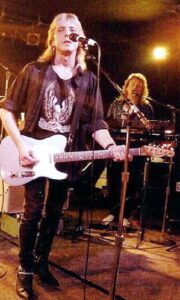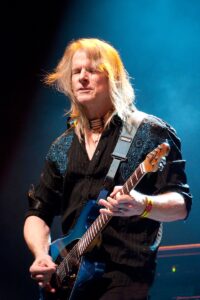
Welcome back to Guitardoor.com, where we celebrate the players who broke the rules and created a sound all their own. Today, we explore the intricate and highly influential work of one of rock’s most unique and unconventional players: the legendary Bob Weir. As the rhythm guitarist, singer, and co-founder of the Grateful Dead, Weir deliberately eschewed the traditional role of an accompanist, instead forging a complex style of harmonic and rhythmic counterpoint that was absolutely essential to the band’s sprawling, improvisational soundscapes.
The Art of Counterpoint
To understand Bob Weir’s style is to unlearn everything you know about rhythm guitar. He was the definitive “anti-rhythm” guitarist. Instead of anchoring the band with simple chords or a steady backbeat, Weir played around the rhythm, weaving a complex tapestry of sound that filled the spaces between Jerry Garcia’s soaring lead lines and Phil Lesh’s melodic, exploratory bass. He rarely played a standard “cowboy chord” in its root position, instead opting for a vast vocabulary of intricate inversions, partial chords, and unique voicings played all over the neck.
Drawing inspiration not from other rock guitarists, but from the harmonically sophisticated piano playing of jazz giant McCoy Tyner, Weir approached the guitar as a textural and contrapuntal instrument. He was a master of listening, reacting in real-time to the musical conversation happening around him. During the Grateful Dead’s legendary improvisational jams, he would add colour, tension, and harmonic direction, often with a percussive, stabbing chord or a shimmering, arpeggiated line that could push the entire band into new and unexpected territory. He was not the anchor; he was the weaver, the navigator, and the secret ingredient in the Dead’s magical musical stew.
The Alchemist’s Rig: Technique and Tone
Bob Weir’s unique style required a specific technique and a tonal philosophy built on clarity. His fretting hand is in perpetual motion, sliding up and down the neck to find those unorthodox chord shapes and inversions that define his sound. He frequently uses his thumb to fret bass notes, freeing up his other fingers for more complex harmonic work. His right hand is equally dynamic, employing a mix of precise picking and intricate fingerstyle patterns to articulate his complex parts.
His gear choices over the years have reflected his need for a versatile and articulate voice. In the Grateful Dead’s early years, he often used Gibson semi-hollow bodies like the ES-335. However, his most iconic era in the late ’70s and ’80s is defined by his collaboration with Ibanez on a series of custom and “Cowboy Fancy” models, such as the 2680. These were often complex, semi-hollow instruments with advanced electronics that gave him a wide palette of sounds. In the modern era with Dead & Company, he is most associated with his signature model guitars from D’Angelico, continuing his preference for versatile, high-quality instruments.
His tone has always been built on a foundation of clean, trebly articulation. In a dense musical mix with two drummers, a wandering bassist, and a lead guitarist, Weir needed a sound that could slice through and be heard clearly. He has long favoured powerful Fender amplifiers, particularly the Twin Reverb, for their loud, clean headroom. His rig was often a complex affair, sometimes involving bi-amping (sending different frequencies to different amps) and a sophisticated rack of effects. He used tools like phasers, envelope filters, and delays not as gimmicks, but as textural colours to add shimmer and movement to his intricate playing.
Essential Weir: Weaving the Grateful Dead Sound
Because his playing was so interactive and woven into the fabric of the band, a great way to hear Bob Weir’s contribution is within the context of the Grateful Dead’s improvisational journeys. These tracks are fantastic starting points.
“Playing in the Band”
“The Other One”
“Cassidy”
Bob Weir is one of the most innovative and criminally underrated guitarists in the history of rock music. He completely redefined the job description for a rhythm guitarist, elevating it from a simple supportive role to a dynamic, compositional, and interactive art form. He proved that the most powerful statements can be made by listening intently and playing with intelligence, taste, and a spirit of endless adventure.
Cover Photo Credit “Bob Weir playing with Ratdog, PNC Bank Arts Center” by jgullo from NYC, USA is licensed under CC BY 2.0