
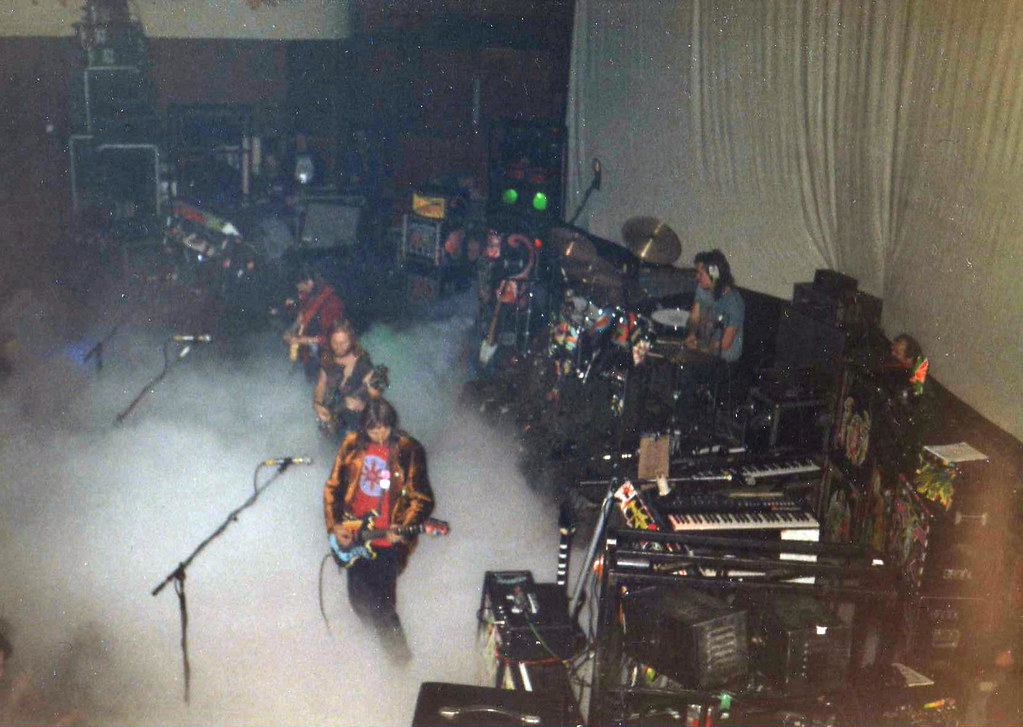
With over 30 studio albums, 11 live albums, and more than 15 compilation albums, one could talk for weeks about Hawkwind as an entity. Secondary to that wealth of material are the numerous releases from ex-members who moved from Masters to Bandits, notably Nik Turner and Robert Calvert. In this piece, I want to touch on certain periods and projects that were seeds planted, often blossoming years later.

🌌 The Masters of the Universe Era
Many bands cite Hawkwind as their direct inspiration, and countless others show their influence, perhaps without even realizing it. The band’s sound was atmospheric in varied ways. To quote Lemmy, there were the days of the “Black Nightmare”—a feeling in keeping with tracks like “Born to Go,” “Brainstorm,” and the sci-fi spoken-word pieces like “Sonic Attack” and “In the Egg,” roles handled by the likes of Michael Moorcock, Robert Calvert, and Nik Turner.
The legendary “Space Ritual” is the best document of this era, but it is not the only one. Bootlegs and compilations like “Bring me the Head of Yuri Gagarin,” though often not of great sound quality, nonetheless reached the dedicated listener.
My first experiences were hearing the Flicknife record compilation “Masters of the Universe” and the live album “This is Hawkwind Do Not Panic,” recorded at the Solstice at Stonehenge and a second performance at The Lewisham Odeon. Behind the drum kit for the latter was no less than Ginger Baker. I would have been content if these two albums were the only Hawkwind releases ever, as they have been in my rotation now for 37 years. However, new gems were waiting to be discovered, albeit out of the timeline or by random chance.
🌟 The Importance of the Fan Network
I would be remiss not to mention Mr. Brian Tawn. While not a band member, his importance to the fans, especially in the US, cannot be overstated. During my time of discovery, Hawkwind still had a strong cult following, particularly in Appalachian areas. I would have to special-order projects and wait a month or more for records to come into our local shop.
I discovered Brian wrote “HawkFan,” a fanzine in the UK that served as a major promotional tool. We began a long-distance friendship. I would send him a relative amount of currency that may or may not have covered his costs, and I would wait for what Mr. Tawn termed “The Post Awful” to eventually place a small brown envelope in my mailbox. He would go the extra mile, photocopying his own copies for me so I had something very close to the original. Thanks to Mr. Tawn, I had Christmas several times a year. Even now, in 2021, we exchange a “Nudge Nudge wink wink say no more” via Facebook. He remains a gentleman.
🎸 Discovering the Calvert/Langton Years
Somehow, through my random huntings, I missed a large portion of the band’s progress post-Lemmy, meaning I did not initially catch much of Robert Calvert’s time stepping up to the plate. This would take a turn that I will bring to light in a future writing.
I eventually began finding albums like “Out and Intake,” leading me to increasingly appreciate the value of guitarist Huw Lloyd-Langton. His stellar lead guitar work cannot be compared to anyone, and with this album, he brought his own songs, such as “Waiting for Tomorrow.” I was spending time on these records; they were lived with on the turntable as part of my everyday life. This was a slow discovery, but it led to the deepest appreciation and study.
👽 The Bandits Emerge
1988 brought the first time I caught up to a record the year it was released: “The Xenon Codex.” Not only does it boast some of the most awesome album art and packaging—an astounding visual—it also brings a new atmosphere.

“The War I Survived” opens the album with a post-punk, not exactly pop, sensibility. It’s a five-and-a-half-minute enigma that is part retro and part futuristic.
The larger picture announces itself in track two, “Wastelands of Sleep,” which, combined with a few other tracks, features Hawkwind trance that is more ethereal and relaxing.
The album can, however, lead the listener into the alarm of dystopian tracks like “Mutation Zone” and “E.M.C.” These sounds, in conjunction with the ingestion of certain botanicals, have prompted, on more than one occasion, fevered screams of “Shut it OFF, MAN!” Think Benicio del Toro in Fear and Loathing—you took too much!
1990 brought “Space Bandits” with the new vocal genius of Bridget Wishart. This was proof that no doors were closed to exploration and that this was a group that was never going to rest on their laurels. Three more studio albums followed, and by 1995’s “Alien 4” album, with new frontman Ron Tree—arguably one of the best ever—it leads us to Part 3 of this article: “Hawkwind Live,” which holds no shortage of tales of the weird and glorious.
📝 To be continued…