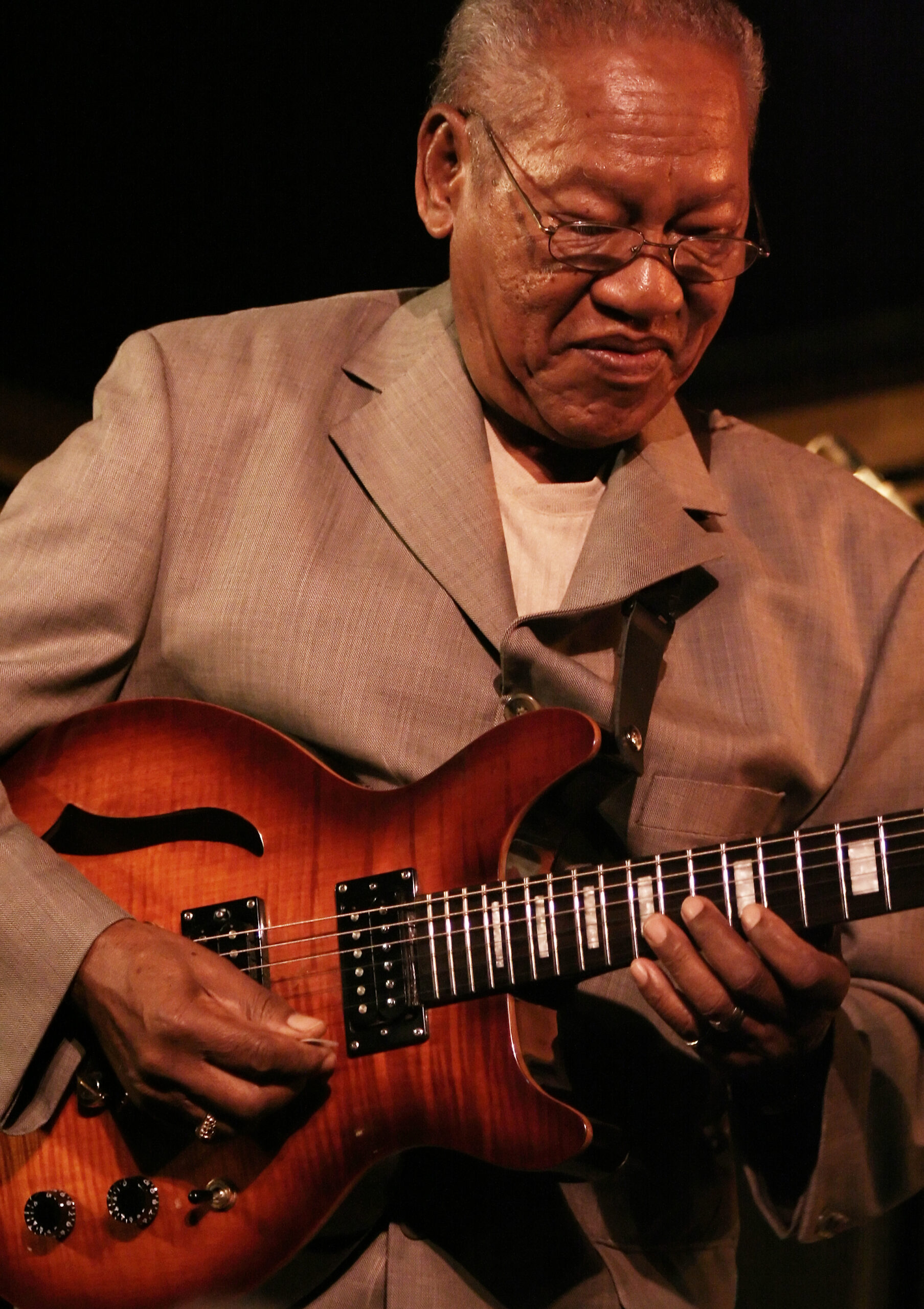
Ernest Ranglin is one of the most vital figures in 20th-century music, acting not just as a visionary player, but as a genuine musical inventor. This living legend didn’t just play on classic records; he drew up the rhythmic blueprint that made Ska, Rocksteady, and Reggae instantly recognizable across the globe. His style remains a brilliant hybrid, executing phrases with the high-brow intellect of a New York jazz virtuoso while driving the music forward with the infectious, undeniable street-level groove of Kingston.
The Signature Ranglin Riff: High-Brow Jazz Meets Low-Down Skank
Ranglin achieved longevity by mastering two distinct roles: that of the sophisticated jazz virtuoso and the foundational rhythmic pioneer. He channels the smooth, articulate single-note phrasing of pre-bebop giants like Charlie Christian. When he solos, his lines are fluid, harmonically rich, and delivered with a warm, mellow tone. Much like how blues icons laid down structural foundations across the Atlantic, Ranglin’s role as a rhythmic architect is highly comparable to figures like Jimmy Rogers: The Architect of Chicago Rhythm.
His definitive contribution to global music is the Jamaican Pulse, universally known as the “skank.” Ranglin figured out how to make the guitar function as a percussion instrument by striking sharp, heavily muted chords strictly on the upbeats (the “and” of every beat). This syncopated engine became the driving force behind the early Wailers sessions, the entire 2 Tone ska revival, and decades of international reggae sound systems. It is an approach that fundamentally altered how modern guitarists view timekeeping, heavily impacting the development of funk, R&B, and the art of original blues-rock composition and dynamic tone control.
Three Tracks That Prove His Legendary Status
To fully grasp the scope of the Ranglin magic, these three landmark recordings trace his evolution from a session innovator to an international standard-bearer.
“Wranglin’” (1964)
Released during the commercial peak of first-wave Ska, “Wranglin’” is an absolute clinic in dual-role guitar playing. On this foundational instrumental track, Ranglin acts as both the rhythmic anchor and the primary melodic voice. He lays down the furious, syncopated ska rhythm before breaking away into a show-stopping, fully improvised jazz solo directly over the top of the upbeat groove. It remains a masterclass in tension and release, proving that street-level dance music could accommodate sophisticated jazz theory.
“Congo Man” (1977)
Moving into his influential Roots Reggae era, Ranglin’s work on “Congo Man” from The Congos’ seminal album Heart of the Congos shifts away from upfront soloing toward pure texture and sonic atmosphere. Here, his understated guitar lines act as an ambient counter-melody, weaving high-pitched, interlocking phrases around the heavy bassline. This specific style of roots tracking shows a deep understanding of mood and spatial awareness—an approach to regional tone and cultural storytelling highly mirrored in American roots lineages like the bloodline of the bayou and how Kenny Neal modernized swamp blues.
“Below the Bassline” (1996)
For a complete look at his late-career style and jazz mastery, “Below the Bassline” stands as his modern masterpiece. Ranglin takes a relaxed, classic Rocksteady groove and elevates it into a sophisticated instrumental showcase. Rather than relying on simple pentatonic licks, he populates the arrangement with complex, moving chord-melodies that highlight his comprehensive knowledge of jazz harmony. It is the sound of an elder statesman completely at home with his legacy, showing how a lifetime of discipline can make the complex sound entirely effortless.
The Ultimate Session Ace: A Historical Rolodex
If a foundational record emerged from Kingston between 1958 and 1975, Ernest Ranglin was almost certainly in the room. He was a cornerstone of the early Jamaican music industry, playing guitar on Bob Marley & The Wailers’ initial Coxsone Dodd recordings and helping assemble the studio lineup that would become the Skatalites. He orchestrated crucial international breakthrough moments, arranging and performing the infectious hooks on Millie Small’s 1964 smash “My Boy Lollipop”—the track that single-handedly introduced ska to the British and American pop charts. As an indispensable studio guitarist, he shaped the distinct production styles of rival sonic architects like Duke Reid and Lee “Scratch” Perry.
Ranglin’s cross-genre collaborative spirit eventual turned him into a global traveler. His historical weight within Jamaican music parallels the raw, unpolished blues innovators across the Atlantic, such as Smokey Hogg: the erratic genius of post-war country blues. Yet Ranglin’s jazz fluency allowed him to jump borders seamlessly, maintaining a decades-long partnership with jazz pianist Monty Alexander, cutting tracks with Afrobeat pioneer Tony Allen, and earning the respect of modern jazz-inflected blues giants like Thorbjørn Risager: the deep-voiced engine of modern European blues.
Conclusion: The Lasting Legacy of the Syncopated Pulse
Ernest Ranglin’s genius lies in his ability to make highly complex musical ideas feel entirely natural on the dancefloor. He provided Jamaican music with its permanent rhythmic heartbeat, proving that Caribbean regional styles could stand toe-to-toe with the world’s most sophisticated harmonic traditions. Decades after he first muted his strings to create the “skank,” his precision remains a definitive cornerstone of modern guitar history.