Welcome back to Guitardoor.com, where we celebrate the sonic extremists who set the world on fire. Today, we plug in and brace for impact as we explore the legacy of one of the most ferocious, dangerous, and influential guitarists of all time: the one and only James Williamson. When Ron Asheton’s fuzzed-out, primitive groove on the first two Stooges albums laid the foundation for punk, it was Williamson who seized that foundation and built a skyscraper of pure, high-voltage chaos on top of it. As the co-writer and sole guitarist on the 1973 masterpiece Raw Power, he was the sound of a switchblade, a player who redefined rock guitar with a “take no prisoners” aggression and a searing, high-gain tone.
The Sound of a New Danger
The sound of James Williamson was a radical and violent departure from what came before. He was a different beast entirely from his predecessor, Ron Asheton (who, in a legendary move, was relegated to bass). While Asheton’s genius was in his hypnotic, fuzzed-out, and primitive riffs, Williamson’s was the sound of a technically proficient and highly intelligent player choosing to weaponize his instrument. His playing was a high-speed, high-energy assault, full of slashing, angular riffs and lead solos that sounded less like a blues jam and more like a high-speed car crash. It was the perfect, terrifying soundtrack for Iggy Pop’s “search and destroy” lyrical warfare, a sound that was angular, demonic, and profoundly influential.
Anatomy of the Raw Power Assault
The guitar playing of James Williamson is a masterclass in pure, unadulterated aggression. It is not the sound of a musician politely taking a solo; it is the sound of a man trying to tear a hole in the universe with his bare hands. He played with a relentless, down-stroking right hand that gave his riffs a visceral, machine-gun-like attack. His solos were a brilliant, chaotic, and almost atonal storm of notes, full of wild, screaming bends, jarring melodic leaps, and a feeling of being constantly on the verge of complete and total collapse. He was a technical player who chose to use his powers for evil, creating a sound that was as smart as it was savage.
The Searing Riffage: Williamson’s riffs were not the groovy, monolithic drones of Ron Asheton. They were jagged, complex, and full of a nervous, high-speed energy, forming the very backbone of anthems like “Search and Destroy” and “Shake Appeal.”
The “Take No Prisoners” Solo: His solos were pure, chaotic expressions. They were a violent blur of high-speed licks, feedback, and raw, screaming noise, played with a “go for the throat” abandon that was a world away from the melodic solos of his rock contemporaries.
The ’69 Les Paul Custom: His image and sound are forever linked to his iconic 1969 Gibson Les Paul Custom (nicknamed “Leopard Lady”). This guitar, plugged into a Vox AC30 amplifier, was the source of his legendary tone—a sound that was searing, bright, and full of a crunchy, treble-heavy saturation that cut like a razor.
The Intellectual Brute: Despite the chaos, his playing was incredibly precise. He had the technical ability of a more “schooled” player, but he channeled it into pure, emotional, and violent expression. As Johnny Marr of The Smiths famously said, Williamson had “the technical ability of Jimmy Page without being as studious, and the swagger of Keith Richards without being as sloppy.”
The Essential Raw Power Blueprints
James Williamson’s work on Raw Power is his definitive and immortal statement. To understand his groundbreaking and ferocious style, these three tracks are absolutely essential.
Search and Destroy
This is it. The ultimate proto-punk anthem, and it’s built on Williamson’s relentless, slashing guitar. To approach playing this, the key is the main, three-chord riff, which must be played with pure, aggressive downstrokes for maximum attack. The solo is a masterclass in his “controlled chaos” style—a fast, searing, and almost unhinged flurry of notes that perfectly matches the song’s nihilistic energy.
Raw Power
The title track is a hypnotic, driving, and menacing monster built on a brilliantly repetitive riff. The approach here is to lock into that main riff with a driving, relentless, and almost robotic precision. The solo is a brilliant example of his use of noise and texture, a screaming, feedback-drenched assault that sounds less like a guitar and more like a live power line whipping around on the street.
Shake Appeal
This is Williamson at his most frantic and unhinged—a pure, two-minute blast of rock and roll adrenaline. To play this, you have to play fast and hard. The main riff is a blur of high-speed power chords. The solo is pure, white-knuckle chaos, a blistering, atonal, and “falling-down-the-stairs” burst of energy that still sounds absolutely terrifying today.
In the end, James Williamson’s legacy is that of the ultimate sonic extremist. With one album, he drew a line in the sand, creating a sound so aggressive, raw, and powerful that it became a primary influence for virtually every punk and hard rock guitarist that followed. He was the architect of Raw Power, a true “guitar anti-hero” whose ferocious and brilliant playing will forever be the benchmark for pure, rock and roll danger.
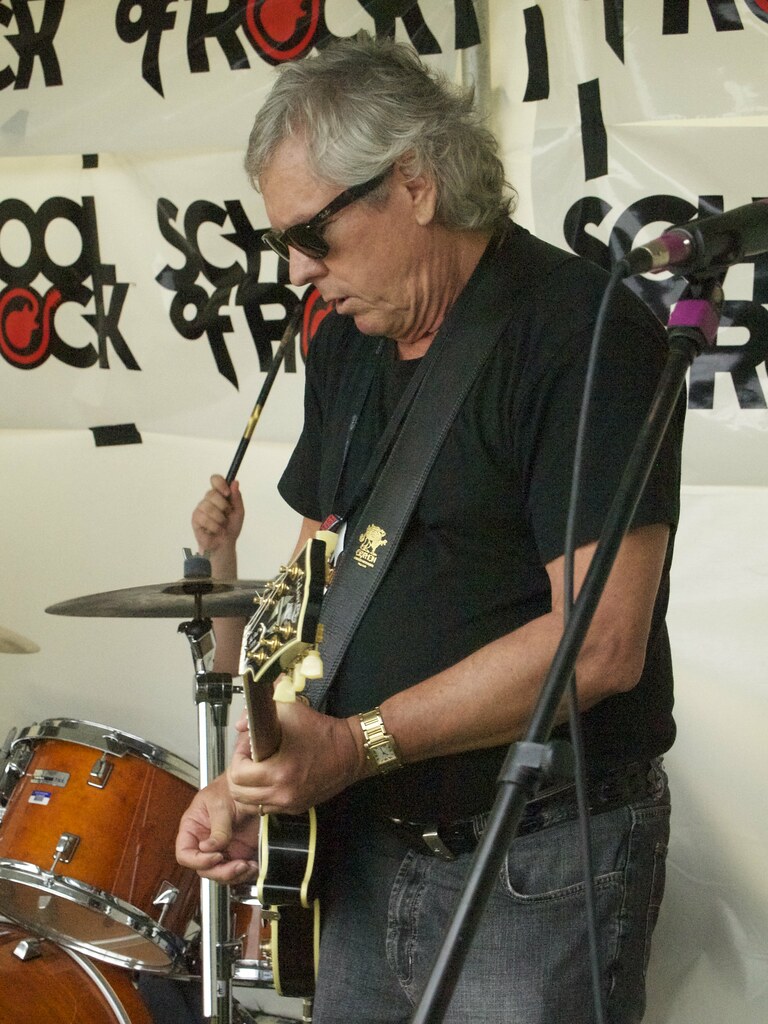
Cover Photo Credit “James Williamson and Austin’s School of Rock” by annainaustin is licensed under CC BY 2.0