
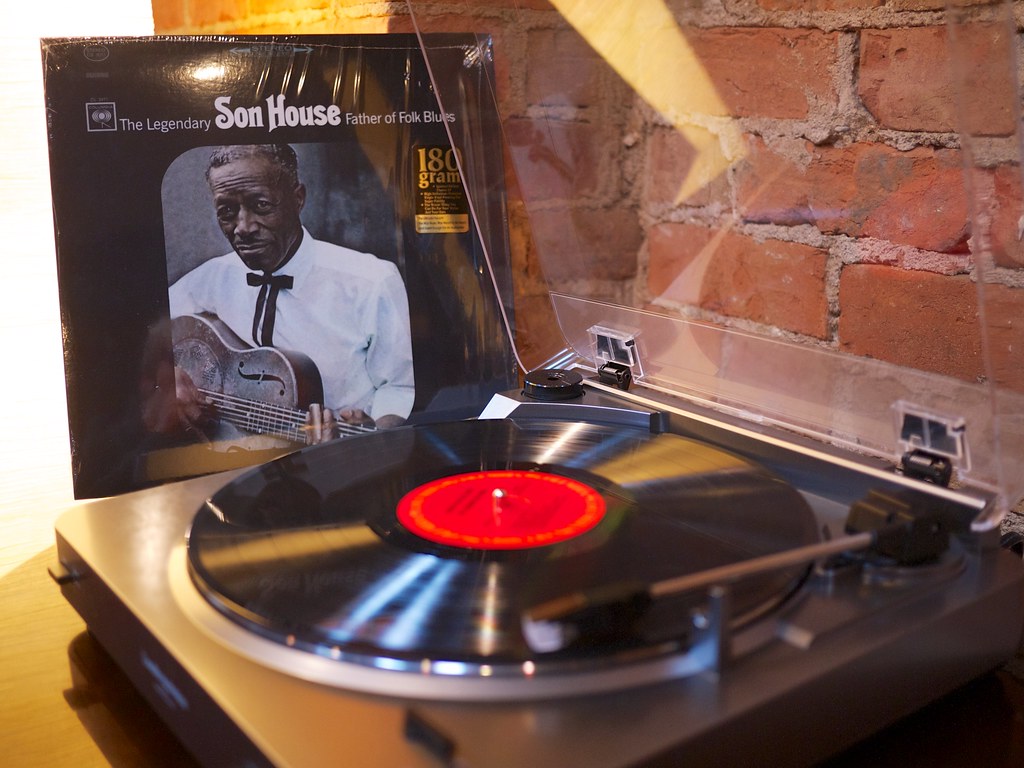
Edward James “Son” House, Jr. (1902–1988) is widely recognized as one of the most intense and pivotal figures in the history of Delta blues, embodying the raw, spiritual power of the genre. Born in Mississippi, his early life was marked by a deep conflict between the sacred and the secular. Initially, he aspired to be a Baptist preacher, even beginning his ministry at age fifteen, which led him to fiercely reject the blues, labeling it “the devil’s music.” This profound religious influence, however, never truly left his music, lending his powerful vocal style a searing, sermon-like quality that set him apart from his peers. Around the age of 25, upon witnessing a friend playing slide guitar, House experienced an instantaneous conversion to the blues. He quickly acquired a guitar and developed a style of playing that was as emotional and uncompromising as his preaching. He soon found himself playing alongside the legendary Charley Patton in the late 1920s and early 1930s, becoming part of the core group that defined the Delta sound before he faded from public view, only to be “rediscovered” decades later during the folk revival. This early period, however, cemented his legacy as a foundational influence on the greatest Delta bluesmen who followed.
🛠️ The House Technique: Slide, Snap, and Stomp
Son House’s demanding guitar style is instantly recognisable for its percussive force and emotional depth, designed for maximum impact in noisy barrelhouses. His technique is built upon the foundation of open tunings, primarily Open G (D-G-D-G-B-D) and Open D (D-A-D-F#-A-D), which facilitated his groundbreaking slide work. He favored the distinct sound of a National Resonator guitar, often a Duolian model, which provided the volume necessary to cut through the din of a crowd. His signature slide approach involved wearing a bottleneck on his third finger and holding it at a severe angle, allowing him to create his trademark vocal-like wails and glissando effects. This raw approach often resulted in notes that intentionally existed “in the cracks,” slightly outside of perfect pitch, amplifying the music’s deeply emotive aesthetics. Crucially, his rhythm hand developed extraordinary independence, characterized by the “string snap,” where he would aggressively pop the low strings with his thumb or a thumbpick. This relentless, driving rhythmic foundation, combined with the wailing slide melody above it, created the illusion of a full band, a powerful, multi-layered sound that provided the blueprint for the Delta style.
🎶 Three Essential Songs and How to Approach Them
For guitarists seeking to understand House’s genius, three essential recordings provide a comprehensive lesson in his technique and emotional range.
“Death Letter”
The track most associated with his rediscovery era is “Death Letter,” a harrowing narrative delivered over a relentless, hypnotic rhythm in Open G tuning. To master this piece, the student must first achieve absolute rhythmic stability in the bass line, often featuring the aggressive string-snap on the low notes, while simultaneously executing sharp, high-register slide phrases, frequently utilizing the 12th fret. The rhythmic drive must be constant and unforgiving.
“Preachin’ The Blues”
The early recording “Preachin’ The Blues” (1930) is key, as it showcases the trance-like, driving rhythmic intensity of his juke joint performances. The guitar work here focuses on repeating I-IV-V chord movements played with heavy, pounding strums, punctuated by sharp, high-pitched slide moans. The difficulty lies in maintaining the visceral intensity of the strumming for the entire track without losing rhythmic clarity.
“Grinnin’ In Your Face”
Finally, “Grinnin’ In Your Face” is instructional because it features no guitar at all, relying solely on House’s a cappella singing and clapping. This omission underscores the primary lesson of Son House: the intensity, feeling, and tone are more critical than any technical flourish, serving as a mandate for the guitarist to infuse their own playing with the same raw, uncompromising passion found in his voice.
📜 Legacy and Enduring Influence
Son House’s impact on 20th-century music is incalculable, establishing a profound lineage that extended from the Mississippi Delta to the British rock scene. During his initial period in the 1930s, he was a key figure and direct mentor to a young Robert Johnson, whose own style closely resembled House’s, particularly his mastery of the slide and powerful singing. House’s recordings also served as a cornerstone for Muddy Waters, who translated the acoustic drive and intensity of House’s work directly into the electric Chicago blues sound, thus laying the groundwork for rock and roll.
His career was revitalized during the 1960s folk revival when he was sought out by young aficionados and recorded the album Father of Folk Blues (1965). This new exposure brought his raw power to a global audience, directly influencing rock legends like Eric Clapton and the Grateful Dead. More recently, artists like Jack White (The White Stripes) have championed House, covering “Death Letter” and ensuring his uncompromising, primal sound continues to resonate, confirming his status as an eternal wellspring of the blues tradition.
Cover Photo Credit “Son House” by Travis Estell is licensed under CC BY-NC-SA 2.0