Welcome back to Guitardoor.com, where we celebrate the players who pushed the instrument to its absolute limits and beyond. Today, we focus on a legendary, almost mythical figure in the guitar community—a man widely regarded by those in the know as arguably the most technically gifted guitarist who ever lived: the phenomenal Shawn Lane. A true prodigy who joined bands and toured as a teenager, Lane was a musician’s musician whose breathtaking speed, precision, and deep musicality made him a revered icon for virtuosos around the world.
The Guitar Work: Beyond Fusion
Shawn Lane’s musical style is best described as a hyper-advanced form of fusion, but even that label feels insufficient. His guitar work was a brilliant and seamless synthesis of the high-gain power of rock, the deep harmonic knowledge and improvisational freedom of jazz, the soul of the blues, and the complex rhythmic and melodic structures of world music, particularly Carnatic music from Southern India. He was a true innovator who saw no boundaries between genres, only new avenues for expression.
His compositions and improvisations were incredibly complex, yet often possessed a deep, soulful, and melodic core. He was not a “shredder” in the 80s rock sense; he was a complete musician who used his otherworldly technique to articulate sophisticated musical ideas. His playing has often been compared to saxophonist John Coltrane’s famous “sheets of sound”—a torrent of notes so fast and fluid that they create a texture and emotional effect all their own. To listen to Shawn Lane is to hear a mind and a pair of hands operating at a level of fluency that few have ever achieved, transforming the guitar into a vehicle for pure, high-velocity expression.
The Anatomy of a Phenomenon: Technique and Tone
The main focus of Shawn Lane’s legacy is his jaw-dropping, revolutionary guitar technique. He possessed a level of command that expanded the known limits of what was physically possible on the instrument.
The “Sheets of Sound” Technique: His legendary speed was the most famous aspect of his playing. It was built on several perfectly honed components that he could blend seamlessly:
- Alternate Picking: His alternate picking was astonishingly fast, clean, and precise. He could play long, complex runs at blistering tempos with a clarity where every single note was perfectly articulated.
- Legato: His legato technique was exceptionally fluid, allowing him to play smooth, “liquid” lines that flowed like water. He could transition from picked passages to legato runs without any perceptible change in momentum or feel.
- Hybrid Picking & Wide-Interval Leaps: He was a master of using his pick and fingers in combination. This allowed him to execute wide, seemingly impossible interval leaps across the fretboard with grace and precision, a technique that was central to his unique phrasing and harmonic approach.
Harmonic Mastery: Crucially, Lane’s brain was as fast as his hands. He possessed a profound understanding of music theory, harmony, and improvisation, allowing him to navigate incredibly complex chord changes and create sophisticated melodic lines on the fly. He wasn’t just playing fast; he was thinking and hearing music at an incredible velocity.
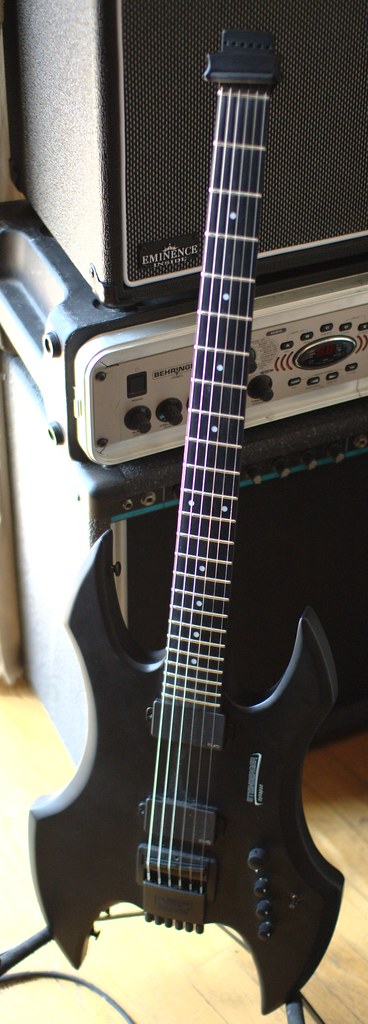
His gear was chosen for performance and precision. He used a variety of high-performance guitars throughout his career, including Charvel models in his early instructional video era and, most famously, headless Steinberger guitars, whose stability and fast necks were perfect for his demanding technique. His tone was as unique as his playing. He favored a smooth, vocal-like, high-gain lead tone that was articulate and singing rather than raw or gritty. This was often achieved with a relatively simple setup, famously using a solid-state Holmes Mississippi Blues King amplifier with a distortion pedal, which provided the clarity and sustain he needed to make his “sheets of sound” audible.
Essential Lane: A Showcase of Virtuosity
Shawn Lane’s solo albums and collaborations are a deep dive into the outer limits of guitar playing. To begin to comprehend his phenomenal talent, these three pieces are essential listening.
“Powers of Ten”
Released in 1992, Shawn Lane’s debut album, Powers of Ten, is widely hailed as a watershed moment in instrumental rock and jazz fusion, showcasing a level of technical mastery and theoretical depth rarely matched in the genre. Unlike many contemporary guitar-hero albums, Lane demonstrated that his prodigious speed was simply a tool for expressing complex musical ideas, not an end in itself; he famously performed all the instruments—guitar, piano, keyboards, and programmed drums—on most of the tracks, making it a true solo effort. The album is characterized by its dramatic stylistic shifts, blending intricate, high-speed guitar shredding (as heard on “Get You Back” and “Illusions”) with classical composition, sophisticated jazz voicings, and lengthy, challenging piano-centric suites that reveal his deep background as a keyboardist. While sometimes criticized for its early 90s digital production and use of synthesized orchestral sounds, Powers of Ten remains an essential record for its boundary-pushing virtuosity, securing Lane’s legendary status among musicians for his innovative use of odd rhythmic groupings, wide interval leaps, and seemingly impossible legato technique.
“Gray Pianos Flying”
“Gray Pianos Flying” is one of the shortest but most intense tracks on Shawn Lane’s Powers of Ten (1992), serving as a concentrated showcase of his unrivaled speed and complex phrasing outside of a prolonged jazz fusion structure. The piece is built on a melancholic, slightly cinematic harmonic foundation that features layers of keyboards and programmed rhythm. The title itself suggests the piece’s somewhat surreal and uplifted emotional quality.
“Temporal Analogues of Paradise”
“Gray Pianos Flying” is one of the shortest but most intense tracks on Shawn Lane’s Powers of Ten (1992), serving as a concentrated showcase of his unrivaled speed and complex phrasing outside of a prolonged jazz fusion structure. The piece is built on a melancholic, slightly cinematic harmonic foundation that features layers of keyboards and programmed rhythm. The title itself suggests the piece’s somewhat surreal and uplifted emotional quality.
Shawn Lane remains a figure of immense and profound influence within the virtuoso guitar community. He is the ultimate benchmark for technical excellence—the player that other world-class players speak of with a unique sense of awe. Though he is no longer with us, his recordings remain as a testament to his genius, forever documenting a musician who didn’t just play the guitar, but transcended it, expanding its language and inspiring all who followed to reach for the impossible.
Cover Photo Credit “Shawn Lane” by armadilo60 is licensed under CC BY-SA 2.0