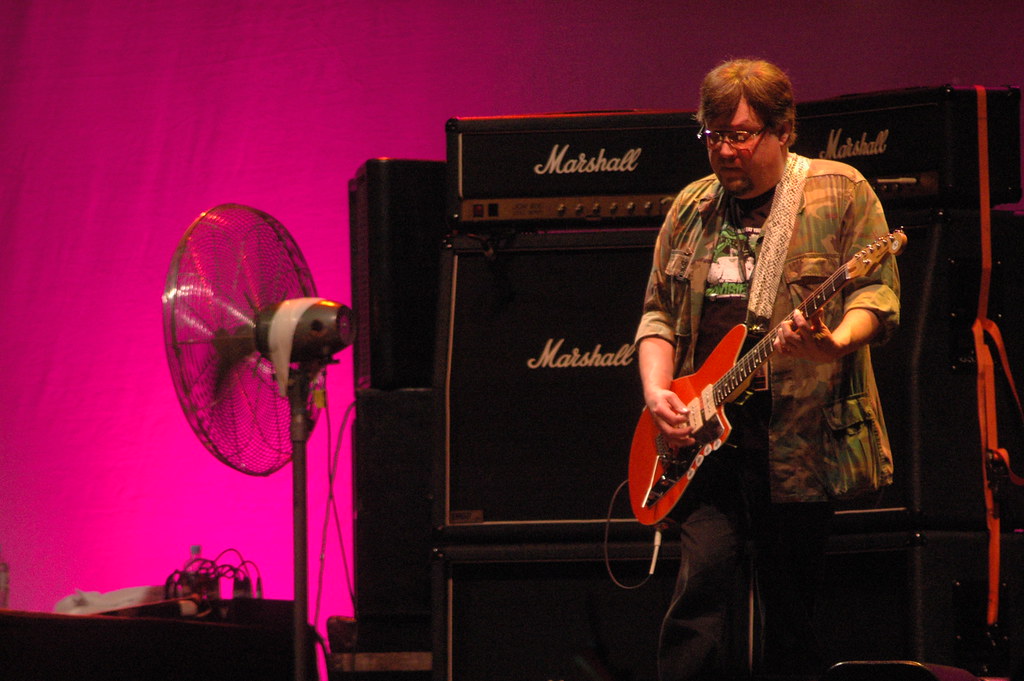
Welcome back to Guitardoor.com, where we celebrate the true anti-heroes who tore up the rulebook and created a new language for the guitar. Today, we plug in, turn up the fuzz, and pay tribute to the man who built the very foundation of punk rock: the legendary, one-and-only Ron Asheton. As the founding guitarist for the most dangerous and influential proto-punk band of all time, The Stooges, Asheton was a true revolutionary. He was the ultimate anti-guitar-hero, a player who rejected the virtuosic, blues-based solos of his era in favor of a raw, primitive, and fuzzed-out wall of sound that was as brutal, hypnotic, and powerful as a wrecking ball.
The Sound of Ann Arbor Burning
The sound of Ron Asheton was a direct and violent reaction to the peace-and-love psychedelia and the technical mastery of the late 1960s. While the guitar gods of the era were exploring 20-minute blues jams, Asheton—alongside the primal force of nature that was Iggy Pop—was crafting something far more visceral. His was the sound of industrial decay, teenage angst, and pure, unfiltered aggression. His genius was not in playing a lot of notes; it was in playing the right three chords, over and over, with a hypnotic, monolithic power. He was a pioneer of the “brutalist” approach to guitar, creating a terrifyingly raw and hypnotic drone that would become the sacred text for punk, grunge, and noise rock.
Anatomy of a Proto-Punk God
The guitar playing of Ron Asheton is a masterclass in the power of minimalism and the sheer, unadulterated glory of a cranked amplifier. His technique was all about raw feeling, not “correct” theory. He was a master of the monolithic riff, often built on just two or three power chords, repeated with a relentless, driving, and almost tribal energy. His solos were the opposite of the melodic, composed solos of his contemporaries; they were chaotic, atonal, and brilliant assaults of noise, feedback, and pure, unhinged aggression. His legendary sound was the product of a holy trinity: a Gibson guitar (like his iconic Flying V), a Marshall amplifier cranked to the absolute breaking point, and, most importantly, a fuzz pedal (like a Vox Tone Bender or Fuzz-Face). He also brilliantly used a wah-wah pedal not for a “wacka-wacka” funk effect, but as a parked tonal filter, cocking it in a certain position to get his signature searing, nasal, and ferocious lead tone.
The Essential Fuzz
Ron Asheton’s guitar work with The Stooges is the very blueprint for punk rock. To understand his raw power and his genius for the primitive riff, these three tracks are absolutely essential.
I Wanna Be Your Dog
This is it. The riff that arguably started it all. A simple, descending, three-chord (G-F#-E) monster that is the very definition of “dumb” in the most brilliant way possible. To approach playing it, the key is 100% attitude. Use a raging fuzz pedal, play with all downstrokes, and let the notes ring into each other with a slow, menacing, and beautifully “sloppy” power. The solo is not a melody; it’s a single, repeating note played with a wah pedal, a perfect example of his hypnotic, anti-solo genius.
1969
This is the sound of a bad trip at the end of a bad decade, and it’s a masterpiece of percussive, hypnotic guitar. To approach this, the key is the main “bo-diddley-ish” groove on the E chord, which should be heavily palm-muted and drenched in fuzz to create a driving, chugging rhythm. The song’s iconic “wroaw-wroaw” sound is all Asheton, using his wah and whammy bar to create a disorienting, siren-like texture that is pure, sonic anarchy.
Down on the Street
The opening track from the legendary Fun House album, this is Asheton at his most driving and “rock and roll.” It’s a pure, locomotive, and incredibly powerful riff. The approach here is to be a rhythm machine. Use tight, aggressive palm-muting on the low E string to create the “chugga-chugga” pulse, and then explode into the G-F#-E power chords with pure, downstroke force. It is a masterclass in using the guitar as a powerful, rhythmic engine.
In the end, Ron Asheton’s legacy is that of a true giant and the ultimate anti-hero. He is the godfather of punk, grunge, and alternative rock, a man whose influence is measured not in the number of notes he played, but in the sheer power of his sound and his attitude. He tore down the walls of virtuosity and proved that three chords, a fuzz pedal, and a bad attitude could be more powerful, more honest, and more inspiring than all the technical training in the world.
Cover Photo Credit “A round of applause for the underappreciated Ron Asheton” by manthatcooks is licensed under CC BY-NC 2.0