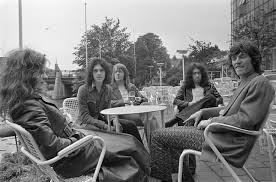
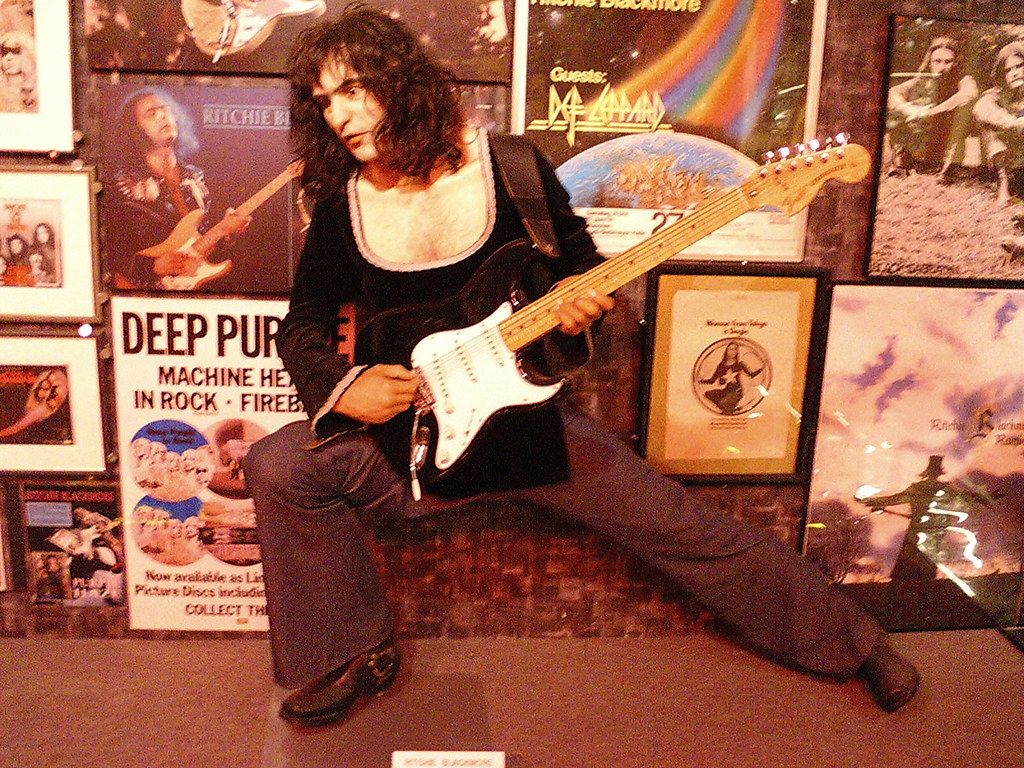
Welcome back to Guitardoor.com, where we delve into the stories of the players who carved the path of rock music. Today, we enter the shadowy and brilliant world of the “Man in Black” himself, Ritchie Blackmore. As the formidable founder and leader of Deep Purple and Rainbow, Blackmore was a true sorcerer of the Stratocaster—an enigmatic and fiercely original guitarist whose fusion of blues-rock power and classical sophistication created a bold new language for the instrument and laid a cornerstone for both hard rock and heavy metal.
The Classical-Blues Collision
Ritchie Blackmore’s musical style was a dramatic and powerful collision of worlds. He emerged from the same 1960s British scene as his peers Page, Beck, and Clapton, with a strong foundation in blues and early rock and roll. But where many of his contemporaries dug deeper into the blues, Blackmore looked to the concert hall. He was one of the very first rock guitarists to systematically and seamlessly integrate the melodic structures, scales, and arpeggios of European classical music—particularly the drama of the Baroque era—into a high-volume rock context.
This fusion created a sound that was entirely new. His solos were not just bluesy wails; they were fiery, theatrical compositions, full of aggressive, rapid-fire picking, dramatic phrasing, and the use of modes like the harmonic minor to create a dark, exotic, and unmistakably classical flavour. He was also, without question, one of the greatest riff writers of all time. From the primal simplicity of “Smoke on the Water” to the driving velocity of “Highway Star,” his riffs were powerful, memorable, and became the very foundation of the songs themselves. On stage, he was an unpredictable force, known for long, intense, and brilliant improvisations that cemented his reputation as one of rock’s most formidable and exciting live performers.
Forging the Hard Rock Sound: Technique and Tone
The thunderous and articulate sound of Ritchie Blackmore was the result of an aggressive technique and a very specific, high-powered gear setup. His playing was defined by a powerful picking hand, an intensely expressive fretting hand, and a signature vibrato that was both wide and rapid. He was a master of bending strings to their breaking point and could unleash torrents of notes with incredible speed and precision.
His instrument of choice is one of the most iconic pairings in rock history: a Fender Stratocaster plugged into a wall of Marshall stacks. He almost exclusively played Stratocasters, favouring 1970s models with large headstocks and, often, maple fretboards. In his later career, he became known for scalloping his fretboards, a process where wood is scooped out between the frets, allowing for a lighter touch, better string grip for bends, and more expressive vibrato.
The other half of his sound came from sheer, unadulterated volume. He was a famous user of 200-watt Marshall Major heads, amplifiers known for their immense power and massive clean headroom. To get his signature searing, distorted lead tone long before modern high-gain amps existed, he employed a secret weapon: a modified reel-to-reel tape recorder. He used the machine’s preamp circuit as a powerful treble booster, slamming the front end of the Marshalls to create a thick, singing, and harmonically rich overdrive that could cut through any mix. This Strat-into-boosted-Marshall formula became the gold standard for hard rock guitar tone for years to come.
Essential Blackmore: The Cornerstones of Hard Rock
Ritchie Blackmore’s discography with Deep Purple and Rainbow is a foundational text for any student of rock guitar. To understand his immense impact as a riff-writer and a soloist, these three tracks are absolutely essential.
“Smoke on the Water”
Ritchie Blackmore’s contribution to “Smoke on the Water” is foundational, centered entirely on the instantly recognizable main riff—arguably the most famous four-note sequence in rock history. Played on his Fender Stratocaster, the riff is a masterful blend of heavy blues and classical influence, written in G minor but uniquely harmonized in parallel fourths, a technique Blackmore credited to his interest in medieval music and, semi-jokingly, a reversed interpretation of Beethoven’s Fifth Symphony. Crucially, he performed this riff using a finger pluck instead of a pick, which contributed to its dark, percussive sound, and his subsequent guitar solo seamlessly extended the song’s energy, blending his signature blues-rock phrasing with sophisticated modal shifts, cementing the track as a definitive showcase of his guitar virtuosity.
“Highway Star”
Ritchie Blackmore’s work on “Highway Star” is a landmark in the history of rock guitar, most notably for its groundbreaking solo that seamlessly merged classical precision with hard-rock velocity. For the album’s fastest-tempo track, Blackmore consciously sought a “Bach-like sound,” meticulously composing his solo note-for-note—a rare practice for him—over a four-chord progression inspired by the Baroque composer. The resulting solo is a blistering showcase of arpeggios and rapid-fire alternate picking, directly influencing the neo-classical style that would later define shred guitarists. Beyond the solo, Blackmore’s tight, driving rhythm guitar provides the song’s relentless, high-octane thrust, defining the sound of early heavy metal.
“Stargazer” (by Rainbow)
The guitar work on Rainbow’s “Stargazer” represents a major evolution for Ritchie Blackmore, moving from the structured neo-classical rock of Deep Purple toward a grander, more mythical hard rock sound. The epic track’s mood is set by a powerful, exotic riff which Blackmore originally composed on a cello while learning the instrument. In his extended solo, he uses the Phrygian Dominant scale—a choice that gives the music its distinct Middle Eastern or ancient flair—while employing a slide bar to achieve a wailing, vocal-like tone. This solo is not a purely technical exercise; it’s a dramatic, carefully phrased centerpiece that builds tension and features soaring bends, perfectly aligning Blackmore’s classical influences with the epic scope of Ronnie James Dio’s lyrical saga.
Ritchie Blackmore is a true giant of the guitar, a player whose influence is immeasurable. He created the blueprint for the neo-classical rock guitarist and penned some of the most enduring riffs in history. His journey, which eventually led him to form Blackmore’s Night and fully embrace the renaissance and folk music that had always inspired him, shows a musician of unwavering artistic conviction. He is, and always will be, one of rock’s most brilliant, influential, and enigmatic figures.