

Every legendary guitarist started in the exact same place: the first few frets of the neck. Open chords so named because they utilize “open” strings that aren’t pressed down. They are the building blocks of rock, folk, blues, and country.
Understanding these chords isn’t just about finger placement; it’s about understanding the “flavour” each chord brings to a song and how to pair them to tell a story.
The “Big Five” Major Chords
Major chords are generally perceived as happy, stable, and bright. Here is the emotional profile of the most common open major chords:
C Major: Open, honest, and pure. It’s the “neutral” ground of music.
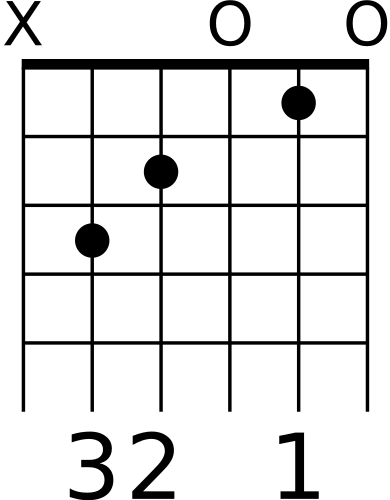
Image by https://commons.wikimedia.org/w/index.php?title=User:Ashaio, CC BY-SA 4.0 https://creativecommons.org/licenses/by-sa/4.0, via Wikimedia Commons
A Major: Bright, celebratory, and powerful. Great for high-energy rock.
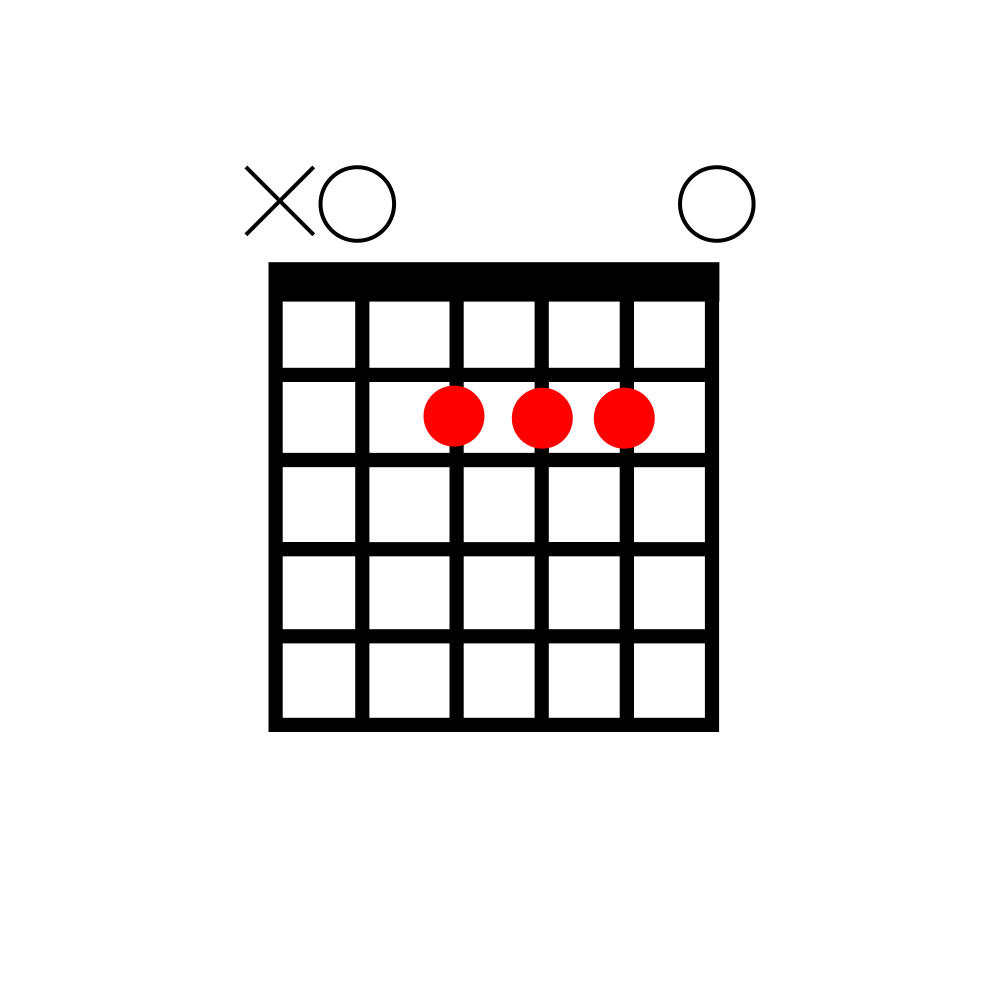
Hariadhi, CC BY-SA 4.0 https://creativecommons.org/licenses/by-sa/4.0, via Wikimedia Commons
G Major: Earthy, “big,” and resonant. The staple of folk and country.
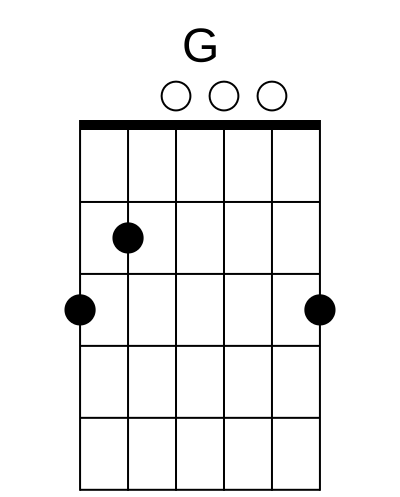
Diagram by Kitsuney, CC BY-SA 4.0 https://creativecommons.org/licenses/by-sa/4.0, via Wikimedia Commons
E Major: Strong, heavy, and foundational. It feels “grand.”
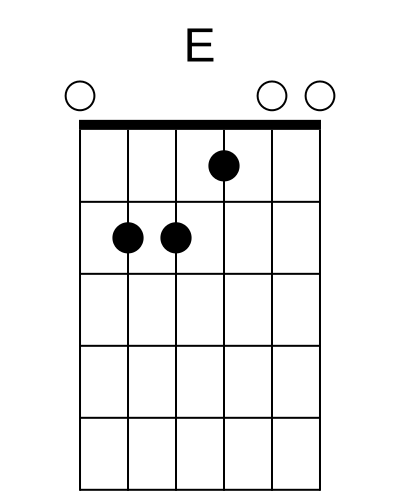
D Major: Sweet, triumphant, and singing. Often used in pop and soft rock.

The “Essential” Minor Chords
Minor chords introduce tension, sadness, or introspection.
- A Minor (Am): Gentle sadness or “wistful” longing.
- E Minor (Em): Dark, moody, and deep. It’s the “heaviest” sounding open chord.
- D Minor (Dm): Intensely melancholic or dramatic.
Which Chords Work Together?
In music theory, chords are often grouped into “keys.” If you play chords from the same key, they will naturally sound “correct” together. Here are the most common “chord families” used in thousands of hit songs:
| Key | Primary Chords (The “Core”) | The Relative Minor (The “Sad” Alternative) |
| Key of G | G, C, D | E Minor (Em) |
| Key of C | C, F, G | A Minor (Am) |
| Key of D | D, G, A | B Minor (Bm)* |
| Key of E | E, A, B7 | C# Minor (C#m)* |
Pro Tip: If you are playing a G Major, try moving to a D Major and then a C Major. This “I-V-IV” progression is the backbone of classic rock and roll.
Mapping the Emotion of a Progression
Music isn’t just about the chords; it’s about the movement between them. By mixing major and minor, you control the emotional narrative:
- The “Happy Ending” (G → C → D): Purely major. It feels resolved, optimistic, and straightforward.
- The “Bittersweet” (G → D → Em → C): This starts bright but dips into the E Minor, adding a touch of soul-searching before returning to the “safety” of C.
- The “Moody Walk” (Am → F → C → G): A classic “epic” progression (think stadium rock). It feels like a journey through struggle toward a resolution.
How to Practice
Don’t just memorize the shapes; listen to the vibration.
- Strum once and let it ring: How does the E Major feel compared to the E Minor?
- The 2-Chord Switch: Pick two chords (like G and C) and switch between them for 2 minutes straight.
- Hum along: Try to hum a melody that fits the “mood” of the chord you are playing.
Open chords are your gateway to the instrument. Once you master these shapes, you aren’t just playing strings—you’re playing feelings.
Cover Photo Credit “160/365. My Favourite Chord.” by Anant N S is licensed under CC BY-NC-ND 2.0