Welcome back to Guitardoor.com, where we celebrate the true “secret weapon” guitarists whose playing changed the game. Today, we’re diving deep into the New Orleans groove to celebrate one of the most important, influential, and flat-out funkiest guitarists of all time: the legendary Leo Nocentelli. As the lead guitarist and a primary songwriter for the groundbreaking funk architects The Meters, Nocentelli was a true revolutionary. He was the man who took the guitar and turned it into a lean, mean, rhythm machine, creating a syncopated, staccato, and utterly unique style that became the very blueprint for funk guitar.
The Sound of the Second Line
The sound of The Meters was a complete reinvention of R&B. While James Brown’s guitarist Jimmy Nolen was inventing the tight, percussive “chicken scratch” in one corner, Nocentelli and his bandmates in New Orleans were creating a different kind of funk—a looser, greasier, and more syncopated sound built on the “second-line” polyrhythms of their hometown. In this incredible musical gumbo, Leo Nocentelli’s guitar was the razor-sharp, melodic, and rhythmic core. He wasn’t a traditional soloist; he was a master of the perfect, minimalist part. His genius was in his incredible sense of space and his ability to craft single-note lines and two-note stabs that were as infectious and memorable as any vocal hook.
Anatomy of the Funk Maestro
The guitar playing of Leo Nocentelli is the very definition of “less is more.” It’s a style built not on power chords or blistering solos, but on precision, syncopation, and an unshakable, deep-in-the-pocket groove. To listen to Nocentelli is to hear a master of rhythm who used his guitar like a percussion instrument, a melodic drum that could sting and sing all at once. His playing was a masterclass in taste, crafting intricate, interlocking parts that wove in and out of the bass and drums to create an irresistible, funky tapestry.
The Staccato Stab: Nocentelli’s signature is his use of sharp, clean, and incredibly precise single-note lines. He would often play these in a staccato (short and detached) fashion, creating a percussive “popping” sound.
The Polyrhythmic Pocket: His style is deeply syncopated, meaning he would often play off the main beat, creating a brilliant rhythmic tension and a feel that was impossible not to move to.
The Fender Tone: While he started on a Gibson ES-175 (which he used on “Cissy Strut”), his most iconic sound came from a Fender Starcaster, a rare semi-hollow body guitar. He plugged this into a clean Fender Twin Reverb with the treble turned up, giving him that classic, bright, and cutting tone that could slice through any mix.
The Jazz Influence: Underneath all that funk is the mind of a jazz musician. Nocentelli was heavily influenced by players like Kenny Burrell and Charlie Christian, and his sophisticated note choices and melodic ideas are what elevate his playing from simple funk to true musical art.
The Essential Grooves
Leo Nocentelli’s guitar parts are the songs. To learn his style is to learn the very language of funk. These three tracks are the foundational texts.
Cissy Strut
This is it. The most iconic funk instrumental of all time, and it’s all built on Nocentelli’s brilliant guitar line. To approach playing it, the key is to learn that main single-note riff with absolute precision. The magic is in the 16th-note syncopation and the clean, staccato attack. Use your pick and your fretting hand to mute the notes almost as soon as you play them, creating that sharp, “popping” sound. The solo is a masterclass in melodic, bluesy phrasing; it’s less about speed and more about taste and swagger.
Look-Ka Py Py
A masterpiece of polyrhythmic funk, this track showcases Nocentelli as a pure rhythm machine. The main guitar part is a deceptively simple, two-note stab that is pure, unadulterated groove. To play this, the approach is 100% about timing and feel. The part is incredibly sparse, so every note must be perfectly in the pocket, locked in with the bass and drums. This is a lesson in the power of silence; the space between the notes is just as funky as the notes themselves.
Hey Pocky A-Way
This joyous, second-line anthem is pure New Orleans. Nocentelli’s guitar part is a brilliant, sliding, and melodic riff that is incredibly fun to play. To approach this, the key is to master the clean, slippery slides between the two-note chord fragments. It should have a relaxed, “greasy” feel, but the timing must remain razor-sharp. This is a perfect example of his ability to create a guitar part that is both a rhythm and a lead melody at the same time.
In the end, Leo Nocentelli’s legacy is that of a true architect. He is one of a handful of players who invented a completely new way to play the guitar, creating a vocabulary that has been studied, copied, and sampled by countless guitarists, hip-hop producers, and musicians of all genres. He is the undisputed king of New Orleans funk guitar, a true master of the groove whose influence is as deep and undeniable as the Mississippi River itself.
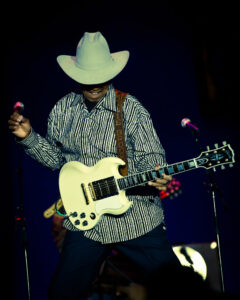
Cover Photo Credit “Leo Nocentelli (Doug Wimbush)” by HammHawk is licensed under CC BY-NC-SA 2.0