Jesse Fuller was an American singer, composer, and multi-instrumentalist who stands as one of the great innovators of the acoustic blues tradition. Active from the 1920s through the folk revival of the 1960s, Fuller became famous for his captivating and unique one-man band setup. He successfully blended traditional Delta blues, work songs, ragtime, and folk into a highly personalized style. His tireless energy, genial personality, and, above all, his inventive musical contraption ensured his place as a beloved and enduring figure in American music.
The Signature Fuller Style: The Fotdella’s Invention
Fuller’s signature was the Fotdella, a distinctive, homemade instrument that he invented and operated with his feet. Inspired by the bass pedals of an organ, the Fotdella was essentially a large box with six or eight heavy-gauge strings that produced a deep, rhythmic bassline when Fuller depressed the pedals. This allowed him to maintain a driving rhythm section while simultaneously playing acoustic guitar, singing, and operating a “sock cymbal” (hi-hat) attached to a shoulder harness. This ingenious setup—the combination of his dynamic fingerpicking and the steady, resonant pulse of the Fotdella—made him a mesmerizing live performer, capable of delivering the complexity of a full ensemble all by himself.
Three Essential Tracks to Hear His Genius
To appreciate the infectious joy and unique complexity of Fuller’s music, these three tracks are essential listening:
First and most famous is “San Francisco Bay Blues” (1954). This signature tune perfectly captures his lighthearted, ragtime-infused folk-blues style and is recognized worldwide. It became a folk standard, covered by major artists across generations, from the folk revival to Eric Clapton. The original recording showcases his melodic fingerpicking and the charming, conversational quality of his vocals.
Next, listen to “The Monkey and the Engineer” (1961), a lively song that features his signature one-man band setup in full swing. This track highlights the rhythmic interplay between his guitar and the Fotdella, which provides the driving, locomotive pace of the song. This piece is a perfect example of the sheer physical and musical coordination required to pull off his unique performance style.
Finally, explore “John Henry” (1955), which leans heavily into the heroic, raw, and powerful traditions of the American folk-blues canon. Fuller’s rendition is a masterclass in his one-man band execution, using the Fotdella to provide the hammering, mechanical rhythm that represents the steel driver himself. This powerful performance showcases his ability to convey immense dramatic scope and intensity using only his unique multi-instrumental setup.
The Ultimate Rolodex: Inspiring the Folk Revival
Jesse Fuller’s tireless touring and unique act made him a pivotal bridge between the early blues pioneers and the 1960s folk revival. His influence was widespread, most famously on a young Bob Dylan, who covered “San Francisco Bay Blues” and credited Fuller as a crucial inspiration for his early material. Fuller performed at numerous folk festivals and clubs alongside artists like Joan Baez and Grateful Dead, becoming a living legend who proved that traditional blues could be innovative and entertaining. His self-made instrument was a visual testament to the ingenuity and resourcefulness of early blues musicians, a characteristic that resonated deeply with the counterculture artists who revered him.
Conclusion: The Man Who Was His Own Band
Jesse Fuller’s legacy extends far beyond his famous compositions. He solved the problem of economic touring by creating a complete orchestra in one person, driven by his feet, hands, and voice. He preserved and popularized the traditions of the blues and ragtime for a new generation while simultaneously inventing an instrument that remains an icon of musical ingenuity. Fuller was the ultimate acoustic showman—a reminder that in music, creativity is often the ultimate key.
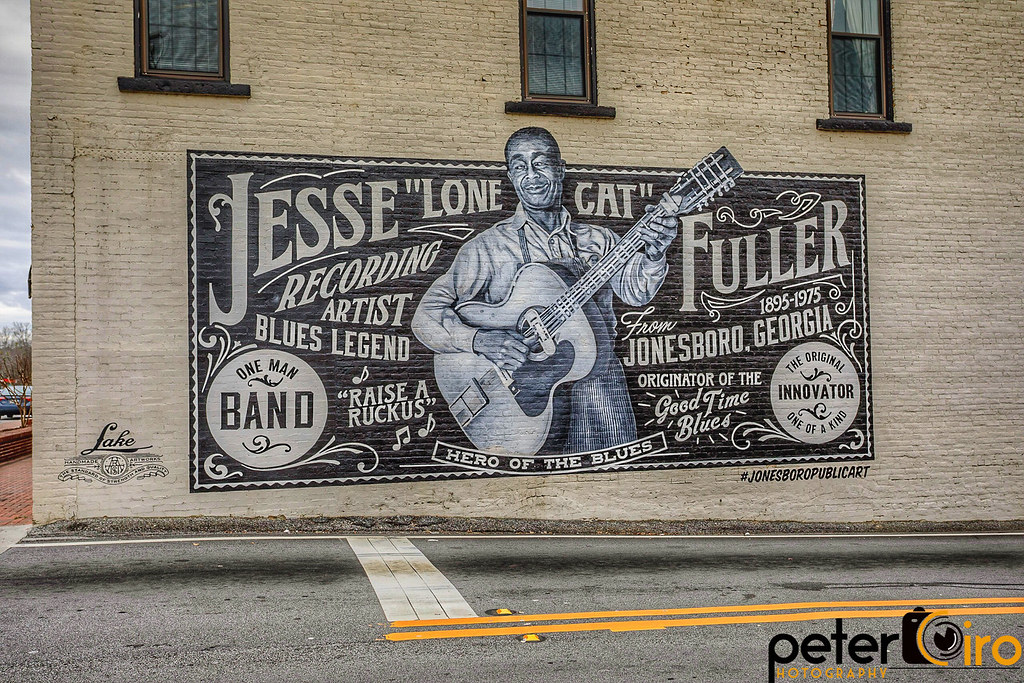
Cover Photo Credit “Jesse Lone Cat Fuller Mural in Jonesboro, Georgia” by Peter Ciro Photography is licensed under CC BY-NC-ND 2.0