
Few tracks capture the soaring energy of classic rock quite like Journey’s “Don’t Stop Believin’.” Driven by Jonathan Cain’s iconic piano line and Neal Schon’s brilliant, singing guitar work, the song is an absolute crowd-pleaser and a masterclass in building emotional momentum through chord voicings and melodic lead accents.
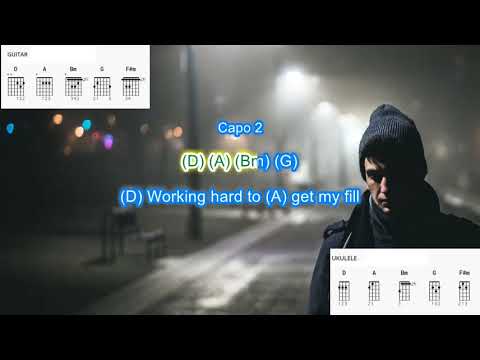
Using the play-along video above as a practical rhythm guide, this lesson breaks down the exact capo setup, chord voicings, rhythm dynamics, and Neal Schon-inspired tone tips to play the anthem from front to back.
1. Required Chords & Tuning
To match the original recording while keeping open-position fingerings smooth and accessible, set your guitar to standard tuning (E A D G B E) and place a capo on the 2nd fret. Note that all chord names and fret positions below are relative to the capo.
Core Chord Shapes Needed
D Major (xx0232): The home tonal anchor and opening bass driver that sets the entire harmonic foundation of the track.
A Major (x02220): Provides bright, ringing movement in both the verse and chorus sequences.
Bm (x24432): A standard 2nd-fret barre chord adding essential minor-key depth and emotional contrast.
G Major (320003): Delivers the soaring transitional lift that pulls the progression toward the chorus.
F#m (244222): A full barre chord used to navigate the atmospheric variations during the verses.
2. Quick Reference Chart
| Chord Name | Fret Diagram (Rel. to Capo) | Difficulty | Role in Song |
| D | x x 0 2 3 2 | Easy | Home Key / Tonic Anchor |
| A | x 0 2 2 2 0 | Easy | Harmonic Progression Step |
| Bm | x 2 4 4 3 2 | Intermediate | Minor-Key Contrast |
| G | 3 2 0 0 0 3 | Easy | Transitional Build |
| F#m | 2 4 4 2 2 2 | Intermediate | Verse Movement |
3. Step-by-Step Song Lesson
Step 1: Lock in the Rhythm & Drive. Maintain a steady, driving pulse across 8th-note strums. The energy of “Don’t Stop Believin'” relies entirely on unstoppable momentum. Practice a steady, driving strumming pattern (Down-Down-Up-Up-Down-Up) that keeps the beat moving without dragging. Avoid heavy, muddy low-string strumming; keep your pick focused on the middle and treble strings during the verses to leave space for the piano line and vocals.
Step 2: Master the Verse Progressions (D – A – Bm – G and D – A – F#m – G). The verses alternate between two slight variations of the core 4-chord sequence. Focus on clean transitions between the open D, A, and G shapes. When hitting the Bm and F#m barre chords, ensure your index finger applies firm, even pressure across all strings so notes don’t buzz or choke out.
Step 3: Incorporate Neal Schon’s Guitar Style. Beyond holding down the chord progression, Neal Schon’s playing relies heavily on fluid melodic fill-ins, pinch harmonics, and sustained, vocal-like lead lines. Throughout the verses and pre-chorus, Neal injects sharp, syncopated chord stabs and sliding double-stops that counterbalance Jonathan Cain’s piano pattern. When playing lead fills over the rhythm, use wide, controlled finger vibrato and let key notes sustain fully to mimic Schon’s fluid, legato approach.
Step 4: Execute the Anthem Climax. Build tension through the pre-chorus and release into the anthem. As the song builds toward the main refrain, gradually increase your picking intensity. Open up your strumming to full down-and-up sweeps across all six strings, accentuating beat 1 of each measure to mirror the driving drums and soaring chorus.
4. Tone & Gear Breakdown: Channeling Neal Schon
Neal Schon’s tone on Escape is legendary for its clarity, sustain, and smooth high-end response. To get close with your own rig, focus on three key areas.
Guitar & Pickups: Use a humbucker-equipped guitar (like a Les Paul or dual-humbucker setup) using the bridge pickup for rhythmic bite, or switch to the neck pickup for warm, singing lead phrases.
Amp & Gain Setup: Set your amp or overdrive pedal to a mid-gain classic rock crunch. You want enough gain for smooth sustain without losing chord definition or note separation.
Effects: Add a stereo delay (or analog delay with slight modulation) and mid-to-high spring or hall reverb to achieve that massive 1980s arena atmosphere.
Outro: The Power of Persistent Simplicity
“Don’t Stop Believin'” remains a masterclass in arena-rock songwriting. Neal Schon and Journey proved that accessible open chords, when paired with rock-solid timing and melodic phrasing, can create a track that resonates across generations.
Jam along with the scrolling play-along video above to lock in your timing, and you’ll have a timeless classic locked into your playing repertoire.