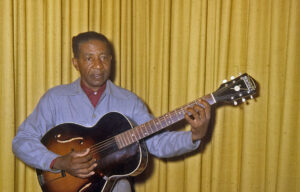
Charley Patton was the most influential figure in the early development of the Mississippi Delta blues, often referred to as the “Father of the Delta Blues.” Born in the late 19th century, Patton possessed a gravelly, commanding voice and a rhythmic, percussive guitar style that laid the groundwork for almost every bluesman who followed, from Robert Johnson to Howlin’ Wolf. He was a flamboyant entertainer whose life and music embodied the raw, unfiltered spirit of the Delta bl, performing with a fierce intensity that could fill a room without any amplification.
The Signature Patton Style: Polyrhythms and Showmanship
Patton’s signature style was characterized by a heavy, driving pulse that functioned as much as percussion as it did melody. He was a master of the “snap-and-slap” technique, where he would pull the guitar strings so hard they snapped against the fretboard, creating a sharp, rhythmic crack. This was often paired with him physically beating the body of his guitar like a drum. His slide work was equally primitive and powerful, often using a knife or a bottleneck to produce eerie, vocal-like cries. Patton was also a legendary showman; long before Jimi Hendrix, Patton was known for playing the guitar behind his back, between his legs, and throwing it into the air, all while maintaining a steady, hypnotic groove.
Three Essential Tracks to Hear His Genius
To understand the foundational power of Charley Patton, three recordings from his 1929 sessions are essential listening. First is “Pony Blues” (1929), his most famous composition and a template for the Delta sound. The track features his characteristic rhythmic drive and a vocal delivery that feels urgent and elemental. It became a standard that nearly every subsequent Delta blues guitarist studied and eventually recorded.
Next, listen to “High Water Everywhere” (1929), a two-part masterpiece documenting the devastating Great Mississippi Flood of 1927. This track showcases Patton’s ability to be a musical journalist, using his guitar to mimic the chaos of the rising waters. His playing here is dense and atmospheric, shifting between frantic picking and somber, heavy chords to convey the scale of the tragedy.
Finally, explore “Spoonful Blues” (1929). This track highlights his sophisticated use of the slide guitar. On this recording, the guitar actually “answers” his vocal lines, effectively acting as a second voice in a conversation. It is a haunting example of the “call and response” technique that would become a cornerstone of both blues and rock music.
The Ultimate Rolodex: The Dockery Plantation Circle
The career of Charley Patton was centred around Dockery Plantation, a massive farm in Mississippi that became a literal breeding ground for the blues. It was here that Patton influenced and taught a younger generation of musicians, including Howlin’ Wolf, who credited Patton with teaching him his distinctive vocal growl and stage presence. He also performed and travelled with Son House and Willie Brown, creating a powerful trio of performers who defined the sound of the region in the late 1920s. His influence even extended to Robert Johnson, who followed in Patton’s footsteps by turning the Delta blues into a more complex, individualised art form.
Conclusion: The Source of the River
Charley Patton was a bridge between the oral traditions of the 19th century and the recorded music era. His voice was a force of nature, and his guitar playing provided the rhythmic DNA for the entire genre of the blues. While his recordings are scratchy and nearly a century old, the power and charisma in his performances remain undeniable. Patton proved that the blues was not just a way to express sorrow, but a high-energy form of entertainment that could captivate an audience through technical skill, rhythmic innovation, and sheer personality.
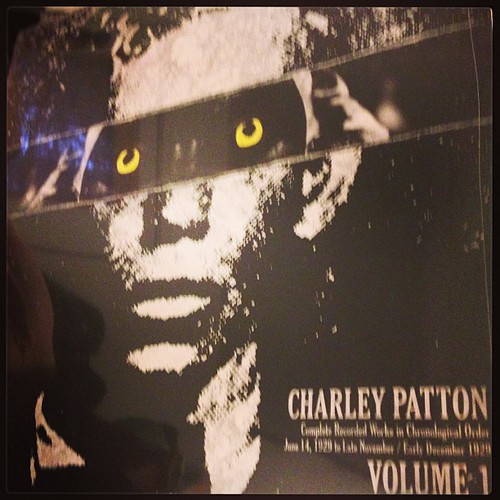
Cover Photo Credit “Got this today too. Charley Patton Complete Recorded Works Vol. 1 #vinyl #charleypatton #thirdmanrecords #thirdman” by itsbeach is licensed under CC BY 2.0