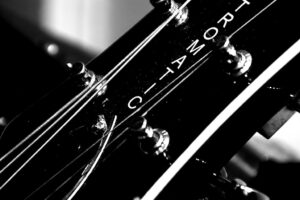

Bob Mould is a seminal figure in alternative rock, serving as the bridge between the blistering hardcore of the 1980s and the melodic alternative boom of the 1990s. After the dissolution of the pioneering trio Hüsker Dü, Mould spent the early 90s fronting Sugar, a band that took his signature “buzzsaw” guitar sound and polished it into a stadium-ready powerhouse. While Hüsker Dü was about raw, frantic energy, Sugar was about the “Wall of Sound”—a massive, layered, and chorus-drenched guitar assault that proved you could be incredibly loud while remaining profoundly melodic.
With the massive news of Sugar’s 2026 reunion tour, interest in Mould’s unique approach to the instrument has reached a new fever pitch.
Signature Style: Granular Distortion and Piston-Like Rhythm
Bob Mould’s guitar style is defined by a relentless, percussive right-hand technique. He often plays with a “piston-like” motion, down-strumming with extreme speed to create a solid, driving wall of rhythm. His tone is legendary: a combination of high-gain distortion and heavy stereo chorus, which gives the guitar a “granular” texture—it sounds like a swarm of bees singing in perfect harmony.
Unlike many of his contemporaries, Mould rarely played traditional “solos.” Instead, he used his Ibanez Rocket Roll II (a Flying V style) to create atmospheric leads that were woven directly into the rhythm tracks. By layering multiple guitars in the studio, he created a sonic density that made Sugar sound like a ten-piece orchestra rather than a three-piece rock band.
Top 3 Song Showcases
1. “If I Can’t Change Your Mind”
Though Bob Mould is known for his high-decibel electric work, “If I Can’t Change Your Mind” stands as one of his greatest achievements in pure pop craftsmanship. The track is built on a foundation of shimmering, jangling acoustic 12-string guitars that recall the classic 1960s sound of The Byrds or The Beatles. However, beneath that “sunny” surface lies Mould’s signature driving rhythm. He uses the acoustic guitar as a percussive instrument, strumming with such intensity that it provides the song’s primary momentum.
For a guitarist, this track is a lesson in layering. Mould subtly weaves in electric tracks that provide a “halo” around the acoustic core, adding sustain and depth without overpowering the melody. The song became Sugar’s biggest hit, proving that Mould’s ear for a “hook” was just as sharp as his appetite for volume. It remains a definitive example of how to write a perfect radio-friendly track while maintaining the structural integrity of alternative rock.
2. “A Good Idea”
“A Good Idea” is perhaps the best example of the “Sugar sound” in its most aggressive, yet disciplined, form. The track pays a clear stylistic debt to Pixies-era “loud-quiet-loud” dynamics, but with Mould’s own high-velocity spin. The song starts with a brooding bassline before exploding into a massive, distorted guitar riff that feels like a physical wave. Mould’s use of the Boss Super Chorus pedal here is vital; it widens the guitar signal, making it sound twice as large as a standard distorted track.
The rhythmic interplay between Mould and the rhythm section is surgical. He avoids the “messiness” often associated with grunge, opting instead for tight, palm-muted chords that transition into wide-open power chords during the chorus. This track highlights his ability to create a “menacing” atmosphere through tone alone. The guitar doesn’t just play the notes; it provides a textural landscape that perfectly mirrors the song’s dark, narrative lyrics. For players interested in the “Wall of Sound” technique, “A Good Idea” is the primary blueprint for how to fill every corner of a frequency range using just one guitar
3. “Hoover Dam”
“Hoover Dam” is the centrepiece of the album Copper Blue, showcasing Mould’s ability to blend psychedelic textures with hard-hitting rock. The song opens with an organ-like guitar part, achieved through a combination of heavy effects and specific chord voicings that emphasise the higher strings. As the song builds, Mould introduces his signature “buzzsaw” rhythm something that Johnny Raymonne also used to get his signature sound, but he keeps it secondary to the swirling, atmospheric lead lines that float over the top.
The complexity of “Hoover Dam” lies in its arrangement. Mould layers guitars to create a “symphonic” effect, where different tracks are panned to the left and right, each playing a slightly different rhythmic or melodic variation. This creates a sense of “motion” in the sound, as if the guitar is physically moving around the listener. The solo—short, melodic, and drenched in sustain—serves as the emotional peak of the song, proving that in Mould’s hands, the guitar is a tool for building massive, enduring structures of sound.
The Gear: The Ibanez Rocket Roll and the Blue Box
Bob Mould’s primary weapon for years was a vintage Ibanez Rocket Roll II (a Flying V style), which he chose because it allowed him to “fight” the instrument to get the sound he wanted. His pedalboard was notoriously simple but effective: an MXR Distortion+ for his primary grit and an MXR Blue Box for those glitchy, sub-octave “alien” textures. In the Sugar era, he moved toward Fender Stratocasters for their clarity and “snap,” allowing his layered parts to remain distinct even under heavy saturation.
Conclusion: The 2026 Reunion and Legacy
Bob Mould’s work with Sugar remains a high-water mark of 90s alternative rock. He took the lessons of the underground—distortion, speed, and intensity—and combined them with a deep, innate sense of melody. With Sugar’s 2026 reunion tour on the horizon, fans will once again get to experience that precise, meticulously crafted engine of melodic expression in a live setting. Whether he is playing a jangling acoustic or a feedback-drenched Flying V, Bob Mould remains one of the most distinctive and influential guitarists of his generation.
Cover Photo Credit “Bob Mould” by sidmuchrock is licensed under CC BY-NC-ND 2.0