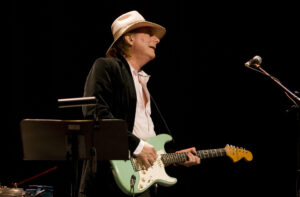
Welcome back to Guitardoor.com, where we celebrate the players whose creativity and musicality define a band’s signature sound. Today, we focus on a versatile and inventive guitarist from the enduring British alternative rock scene: Adrian Oxaal of the beloved band, James. As a key sonic architect for the band since joining in the mid-1990s, Oxaal is a master of texture, melody, and atmosphere, proving that a lead guitarist’s greatest strength can be the ability to create colour and space, crafting parts that elevate anthems to euphoric heights.
The Sound of an Anthem
The musical style of James is famously eclectic, a rich blend of anthemic alternative rock, intimate folk, and sprawling, atmospheric soundscapes. Adrian Oxaal’s guitar work is perfectly suited to this diverse palette. He is not a traditional rock guitarist who deals in heavy riffs or blues-based pyrotechnics. Instead, he is a sonic weaver, a player who uses his instrument to create textures, moods, and memorable melodic hooks that are integral to the song’s emotional fabric.
His approach is highly textural and layered. He masterfully employs effects, volume swells, and repeating, delayed motifs to create a sense of space and movement. In a band known for its rich and often dense arrangements, Oxaal’s genius lies in his ability to find the perfect sonic pockets, adding a shimmering arpeggio or a soaring, delayed lead line that lifts the music without cluttering it. While atmospheric, his playing is also highly melodic. His lead parts and solos are often concise, hook-laden statements that serve as a powerful focal point in a song’s chorus or bridge, designed to be sung back by festival crowds. Adding to his versatility, he is also a skilled cellist, an instrument he has incorporated beautifully into the band’s sound, further enhancing their unique, orchestral quality.1
The Anatomy of Atmosphere: Technique and Tone
Adrian Oxaal’s technique is built around dynamics and the creative use of technology to serve a musical idea. He is a master of using a volume pedal to create beautiful, string-like swells, fading notes and chords in and out to build atmosphere. He uses delay not just as an echo, but as a rhythmic and melodic tool, setting up patterns that his other parts can interact with, creating a hypnotic, layered effect. His playing is a masterclass in subtlety and control, knowing when to be delicate and when to unleash a wall of controlled, musical feedback.
His choice of guitars often leans towards classic instruments known for their warmth and versatility. He is frequently seen playing a Gibson ES-335, a semi-hollow body guitar perfect for his style, as it offers a rich, resonant tone that can also handle the grit and overdrive needed for the band’s more powerful rock moments. A solid-body Gibson Les Paul also often makes an appearance, providing the punch and sustain for more driving tracks.
The heart of Oxaal’s sound-sculpting ability lies in his effects palette. His pedalboard is his toolbox for creating colour and texture. You will always find multiple delay pedals, often set to different timings, to create his signature rhythmic patterns and spacious leads. Reverb is used liberally to enhance the atmospheric quality of his playing. Various overdrive and fuzz pedals provide the different flavours of grit he needs, from a mild crunch to a full-on sonic assault. This is all fed into classic tube amplifiers, likely from brands like Fender or Vox, which provide a robust and characterful clean platform that allows his intricate effects work to be heard with clarity.
Essential Oxaal: The Sound of Modern James
Adrian Oxaal’s inventive guitar work has been a key ingredient in many of James’s most beloved modern anthems. To appreciate his unique, textural, and melodic style, these three tracks are a fantastic starting point.
“She’s a Star”
“Getting Away with It (All Messed Up)”
“Is This Love”
Adrian Oxaal is a perfect example of the modern, creative rock guitarist. His legacy with James is one of serving the song with immense creativity, proving that the most powerful guitar parts are often not the loudest or the fastest, but the ones that create a mood and capture the imagination. He is a master of texture and a vital part of what makes James one of Britain’s most enduring and beloved bands.