
Welcome back to Guitardoor.com, where we celebrate the true sonic innovators who taught the guitar a completely new language. Today, we plug into the wild, unpredictable, and brilliantly creative world of one of the most original and influential guitarists of all time: the incredible Adrian Belew. From his “stunt guitar” work with Frank Zappa, David Bowie, and Talking Heads to his decades-long tenure as the frontman for the legendary progressive rock titans King Crimson, Belew has been the ultimate musical mad scientist, a player who deconstructed the very idea of what a guitar could do, making it roar like an elephant, squeal like a bird, and scream like a machine.
The Sound of the Uncaged Animal
The sound of Adrian Belew is the sound of pure, unbridled imagination. He is the ultimate “outside the box” player, an artist who has spent his entire career making the guitar sound like anything but a guitar. His musical journey began in the ultimate creative crucible, learning his craft as a featured instrumentalist in Frank Zappa’s band—a role that required not just virtuosic skill but a fearless and open-minded approach to sound. This experience cemented his role as the go-to guitarist for artists who wanted something truly different. When David Bowie needed a layer of chaotic, atonal expression on his Lodger album, he called Belew. When Talking Heads needed a screaming, otherworldly texture to float over the dense polyrhythms of Remain in Light, they called Belew. His role was never to play a standard blues solo; it was to be the agent of chaos, the sonic wildcard, the man who brought the beautiful, exciting noise.
Anatomy of a Mad Scientist
The genius of Adrian Belew’s guitar playing is not found in traditional scales, modes, or established techniques; it is a masterclass in pure sound design. He approaches the guitar less like a stringed instrument and more like a wildly versatile synthesizer or a sound effects generator, with the ultimate goal of coaxing new, unheard-of noises from its wooden frame. To listen to Belew is to hear an artist who is not just playing notes, but is sculpting sound itself, using his incredible technical facility and a vast array of electronic tools to create a sonic vocabulary that is entirely his own. He is the living embodiment of the “pedalboard as an instrument” philosophy, a player whose effects are as crucial to his voice as the strings themselves.
The Whammy Bar Revolutionary:
He is the undisputed king of radical, expressive, and often violent whammy bar manipulation. He doesn’t just add vibrato; he uses the bar to make the guitar speak, grunt, roar, and cry, creating his signature “animal noises” and otherworldly textures.
The Sound Imitator:
Belew is famous for his uncanny ability to mimic sounds with his guitar. He has a vast arsenal of signature noises, from the trumpeting call of an elephant and the chatter of seagulls to the screech of train brakes, all created through a masterful and highly unorthodox combination of his hands, the whammy bar, and his effects.
The Effects Guru:
His pedalboard is his laboratory. He is inextricably linked with the DigiTech Whammy pedal for its pitch-shifting chaos and was an early pioneer of effects like the Foxx Tone Machine octave fuzz and infinite looping with devices like the Electro-Harmonix 16 Second Digital Delay. He doesn’t just use effects; he plays them.
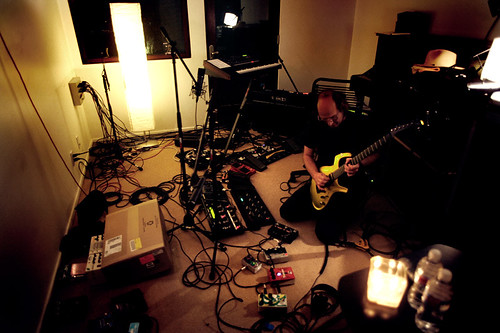
The Tools of Invention: For decades, his primary tool has been a heavily modified Fender Stratocaster. In recent years, he has also famously used the technologically advanced Parker Fly guitars, often with MIDI and sustainer pickups, further expanding his incredible sonic palette.
The Essential Blueprints
To understand the groundbreaking and wildly creative mind of Adrian Belew, you have to hear him in his natural habitat: pushing the boundaries of legendary songs.
Elephant Talk (by King Crimson)
This is the quintessential Belew sound-imitation track and a funky, complex prog-rock masterpiece. To approach playing his iconic part, the key is a pitch-shifting effect like the DigiTech Whammy, combined with a whammy bar. The goal is not to play a scale, but to mimic the sound of an elephant’s trumpeting call. Hit a note and then use the pedal and the bar to make the pitch rise and roar in a vocal, animal-like way. It is a lesson in pure sound imitation.
The Great Curve (by Talking Heads)
On this dense, polyrhythmic funk epic from Remain in Light, Belew’s role is to add a layer of thrilling, sonic anarchy. The solo is a texture, not a melody. To approach this, you need a high-gain fuzz or distortion and a willingness to create chaos. The technique is all about feedback, aggressive whammy bar dive bombs, and screaming, atonal noise. The goal is to create a screaming, out-of-control sound that floats over the top of the incredibly tight groove.
Big Electric Cat (by Adrian Belew)
A brilliant and catchy track from his solo career, this song showcases his ability to blend his experimental tendencies with a great pop sensibility. To play this, the key is to use a looper or a delay pedal to create the repeating, rhythmic foundation. The lead lines are pure Belew—a masterclass in using the whammy bar for smooth, vocal-like phrases, combined with quirky string bends and the creative use of controlled feedback as a melodic tool.
In the end, Adrian Belew’s legacy is that of one of the guitar’s great, fearless innovators. He is a true artist who completely redefined the role of the lead guitarist, transforming it from that of a soloist to that of a sonic sculptor. His profound influence can be heard in generations of alternative, industrial, and experimental players, from Tom Morello to St. Vincent, who were inspired by his boundless creativity and his revolutionary idea that the most exciting sound a guitar can make is the one you’ve never heard before.
Cover Photo Credit “Adrian Belew live 20160224b” by Paolo51janssen is licensed under CC BY-SA 4.0