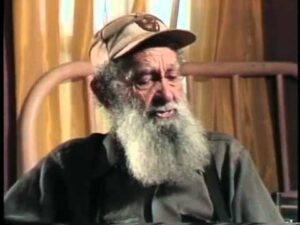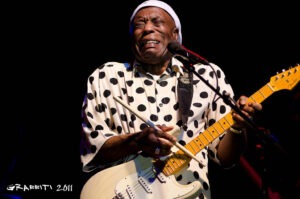
If the Mississippi Delta had a rhythmic heartbeat that spanned both the juke joint and the pulpit, it belonged to Boyd Rivers. Born in Madison County in 1934, Rivers was a master of the “Gospel Blues”—a style that maintained the raw, percussive intensity of the Delta tradition while dedicating its lyrical soul to the spiritual.
Rivers remained a largely regional treasure until the legendary musicologist Alan Lomax captured him on film and tape in the late 1970s. These recordings revealed a guitarist who didn’t just play songs; he conducted a one-man congregation with a grit-filled electric guitar. His ability to drive a rhythm with relentless energy makes him a spiritual cousin to the percussive masters found in our guide to Mick Clarke: The Relentless Engine of British Blues.
You Got to Take Sick and Die
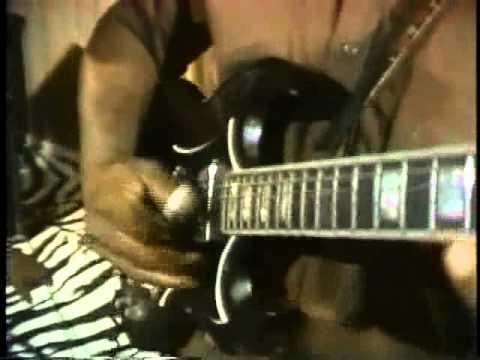
In this track, Rivers demonstrates a primal, “steady-thumb” technique. Much like the early Delta masters, his thumb acts as a metronome, thumping out a heavy bass line that never wavers. On the higher strings, he employs sharp, snapping notes that create a percussive dialogue with his vocals. This style turns the guitar into a rhythmic engine, providing a sense of urgency that feels like a warning from the pulpit.
Fire in My Bones
“Fire in My Bones” is a masterclass in tension and release. Rivers uses rapid, rhythmic chord stabs and sliding double-stops to build a “shouting” energy. The guitar literally vibrates, mimicking the intensity of a preacher caught in the spirit. This vocal-like expressiveness on the fretboard is a technique found in many greats who blend soul with technical precision, such as Steve Winwood: The Soulful Virtuoso.
I Done Died One Time
This track is a haunting atmospheric duet featuring Boyd’s wife, Ruth May Rivers. Here, Boyd steps back from the aggressive thump to focus on space and sustained notes. His narrow, intense vibrato gives the song an “otherworldly” quality, allowing Ruth May’s piercing vocals to take centre stage. It’s a beautiful example of the “vocalist” approach to the instrument, a concept explored in our profile on Chris Buck: The Vocalist of the Fretboard.
The Legacy of the “Sky Songs”
Boyd Rivers’ music was deeply communal. Whether performing at the Mississippi Delta Blues Festival alongside titans like Willie Dixon or recording in his home for Alan Lomax, he represented the bridge between the rural origins of the blues and the modern era.
He proved that the “Sacred Thump” was more than just a technique, it was a survival mechanism. His work reminds us that the blues isn’t just a genre; it’s an engine of human expression.