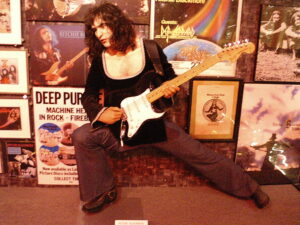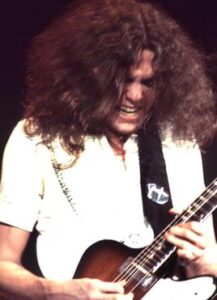

Wilko Johnson (1947–2022) was the uncompromising guitarist and founding member of the influential pub rock band Dr. Feelgood. His guitar playing style was instantly recognisable, defining the raw, energetic R&B sound that directly inspired the UK punk movement.
The Wilko Johnson Technique: Attack Without a Pick
Johnson’s signature sound stemmed from his radical approach to the electric guitar, which focused intensely on rhythm and attack.
Fingerstyle Attack: Johnson almost exclusively rejected the use of a guitar pick (plectrum). Instead, he used the thumb and forefinger of his right hand to pluck, snap, and rake the strings. This technique gave him a unique percussive tone and allowed him to transition seamlessly between rhythm and lead.
Rhythm and Lead Fusion: His most distinctive innovation was his ability to play a driving rhythm part on the lower strings while simultaneously playing short, sharp, single-note lead breaks on the higher strings. This gave the illusion of two guitarists playing at once, a necessity in the early Dr. Feelgood lineup which famously lacked a second rhythm guitarist. This dense, non-stop flow is often described as a “choppy, machine-gun attack.”
Tone and Instrument: He almost exclusively used a black Fender Telecaster (often with a custom mirror pickguard), plugged directly into a single amplifier (like a Hiwatt or Marshall) with minimal effects. His sound was clean, raw, and full of mid-range aggression, prioritizing clarity and percussive impact over distortion or sustain.
🎵 Essential Songs and How to Play Them
Here are three essential Dr. Feelgood tracks, co-written and defined by Johnson’s style, with notes on how a guitarist can approach playing them.
“She Does It Right” (1975)
This song is the blueprint for the Wilko Johnson sound. To play it, the focus is entirely on the right-hand technique and staying locked into the rhythm section.
Rhythm Focus: The song is driven by an ultra-fast, eighth-note rhythm pattern (a standard I-IV-V blues progression in the key of E). You must use your fingers to achieve the sharp, slightly muted staccato sound on the low E and A strings (the rhythm base).
The Lead Break: Johnson often uses the high B and E strings to add quick, single-note fills (or “answer licks”) in between the vocal phrases. These licks are short, sharp blasts using notes from the E minor pentatonic scale, executed with his aggressive finger-picking. The key is to keep the rhythm churning underneath the lead flashes.
“Back in the Night” (1975)
This track is faster and more frantic than “She Does It Right,” demanding relentless energy and a commitment to the downbeat.
Pacing and Power: The tempo is punishingly fast. The guitarist must maintain a furious, non-stop strum or rake pattern, often with heavy reliance on open chords mixed with barre chords to keep the feel raw.
The Riff: The song is built around a distinctive, frantic R&B riff that sits in the mid-to-high range. This riff requires intense practice to play accurately at speed. Use quick alternating strokes of the thumb and fingers, keeping the chords very short and punchy, almost like a drummer hitting a snare. The overall feel should be tightly wound and aggressive.
“Roxette” (1975)
“Roxette” is a foundational piece that showcases his theatrical on-stage movements as much as his playing.
Harmonic Simplicity: The song uses straightforward, punchy chord changes typical of simple rock and roll. The guitar part needs a clean, bright tone to cut through the mix.
The Run/Movement: While playing, Johnson would often physically run backward and forward across the stage to match the song’s stop/start nature. Musically, this translates to very abrupt stops and dynamic contrasts. The playing must be precise in its syncopation, hitting the strong rhythmic accents (the stops) exactly on time, before immediately launching back into the frantic strumming pattern. The rhythm part is a solid, driving four-to-the-floor beat, leaving no gaps or lazy strumming.
📝 Final Summary of Wilko Johnson’s Music
Wilko Johnson’s musical legacy is defined by his commitment to primal, uncompromising R&B and rock and roll. He stripped the electric guitar of unnecessary ornamentation, effects, and the perceived need for complex soloing, forcing the instrument to serve the rhythm section. His unique fingerstyle, which fused rhythm and lead playing into one continuous soundscape, proved that rhythmic intensity could be far more powerful than melodic complexity.
Johnson’s raw, no-nonsense playing, coupled with his legendary manic stage presence, was a direct and powerful challenge to the bloated rock of the early 1970s and became a crucial, foundational influence on the entire British punk rock movement that followed. Even years after his seminal work with Dr. Feelgood, his influence remained palpable, as seen through the homage paid by those he inspired, such as the work on the track “1975” by collaborators Pete Feenstra and John Simpson (of the Feelgood Band). This continued artistic connection highlights how Johnson’s unique blend of garage rock grit and R&B precision created a timeless, enduring sound.
Cover Photo Credit “Wilko Johnson en 2012” by Mike W is licensed under CC BY-SA 2.0