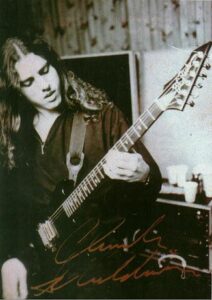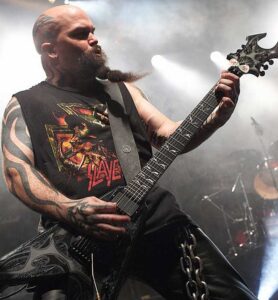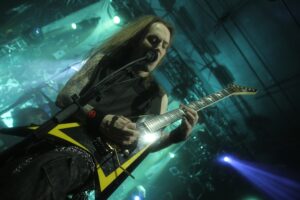

Welcome back to Guitardoor.com, where we delve into the minds of the most extreme and innovative players in music. Today, we descend into the abyss to explore the legacy of a true pioneer and one of the most unique guitar voices in all of metal: the legendary Trey Azagthoth. As the founder, lead guitarist, and primary creative force behind the groundbreaking death metal titans Morbid Angel, Trey is an originator of the genre, a player whose chaotic, otherworldly solos and sludgy, evil-sounding riffs have influenced a generation of extreme musicians.
Conjuring Chaos
The musical style of Trey Azagthoth is a brutal and complex form of death metal that has always stood apart. From the band’s inception, Morbid Angel’s music, driven by Trey’s vision, was defined by non-traditional song structures, frantic blast beats, and a thick, swampy, and incredibly heavy guitar sound. Deeply influenced by the occult, Sumerian mythology, and his own unique spirituality, his compositions feel less like traditional songs and more like chaotic, blasphemous rituals. He was a primary architect in pushing the boundaries of musical extremity, creating a sound that was, and remains, utterly uncompromising.
Anatomy of an Ancient One
Trey Azagthoth’s guitar technique is a masterclass in controlled chaos. He is a player who completely abandoned traditional melodic guitar conventions in favour of pure, abstract, and violent expression.
The “Shredding Chaos” Soloist: A Trey Azagthoth solo is an instantly recognizable sonic meltdown. It is a stream-of-consciousness explosion of sound, characterized by insane and radical whammy bar abuse, blistering and often atonal alternate-picked runs, and complex, unorthodox two-handed tapping. He treats the guitar less like a melodic instrument and more like a tool to channel raw, chaotic energy from another dimension.
The 7-String Pioneer: He was one of the very first and most important pioneers of the 7-string guitar in death metal, using the extended lower range to create his signature sludgy, down-tuned riffs. He is famous for his use of Ibanez 7-string Universe models and various uniquely shaped guitars from B.C. Rich and Dean.
The Saturated Tone: His tone is a thick, saturated, and mid-heavy high-gain sound. For decades, he has relied on the power of Marshall amplifiers (like the JCM900), often boosted with an overdrive pedal and sculpted with an EQ to achieve his signature cutting, yet massive, sound.
Essential Azagthoth: Hymns of the Ancient Ones
Morbid Angel’s discography is a landmark in the history of extreme metal. To understand Trey’s groundbreaking and hugely influential guitar work, these three tracks are essential.
“Chapel of Ghouls”
From their legendary debut album, Altars of Madness, this is a genre-defining classic. The track is a perfect storm of sludgy, evil-sounding riffs and frantic, blasting tempos. Trey’s solo is the centerpiece—a truly unhinged and chaotic explosion of whammy bar squeals, dive bombs, and atonal shredding that set a new standard for extremity in lead guitar.
“Where the Slime Live”
A highlight from their classic Domination album, this track is a masterclass in the heavy, groovy, and suffocatingly sludgy side of Morbid Angel. The main riff is one of the heaviest ever written. Trey’s solo is a perfect example of his signature “sonic meltdown” style, a bizarre and brilliant display of his otherworldly phrasing and whammy bar mastery.
“God of Emptiness”
This strange and epic track showcases Trey’s willingness to experiment far beyond the confines of traditional death metal. Featuring eerie clean tones, a slow, hypnotic groove, and a clean vocal passage, the song is a journey into the bizarre. His solo is appropriately otherworldly, a perfect complement to the song’s dark, psychedelic atmosphere.
Trey Azagthoth is one of the most important and unique guitarists in the history of death metal. He is a true original, an artist who has always followed his own uncompromising path. His profound influence can be heard in countless extreme metal bands who were inspired by his chaotic, “anti-melodic,” and purely expressive approach to the guitar.
Cover Photo Credit “Trey Azagthoth” by Alexandre Cardoso is licensed under CC BY-SA 2.0