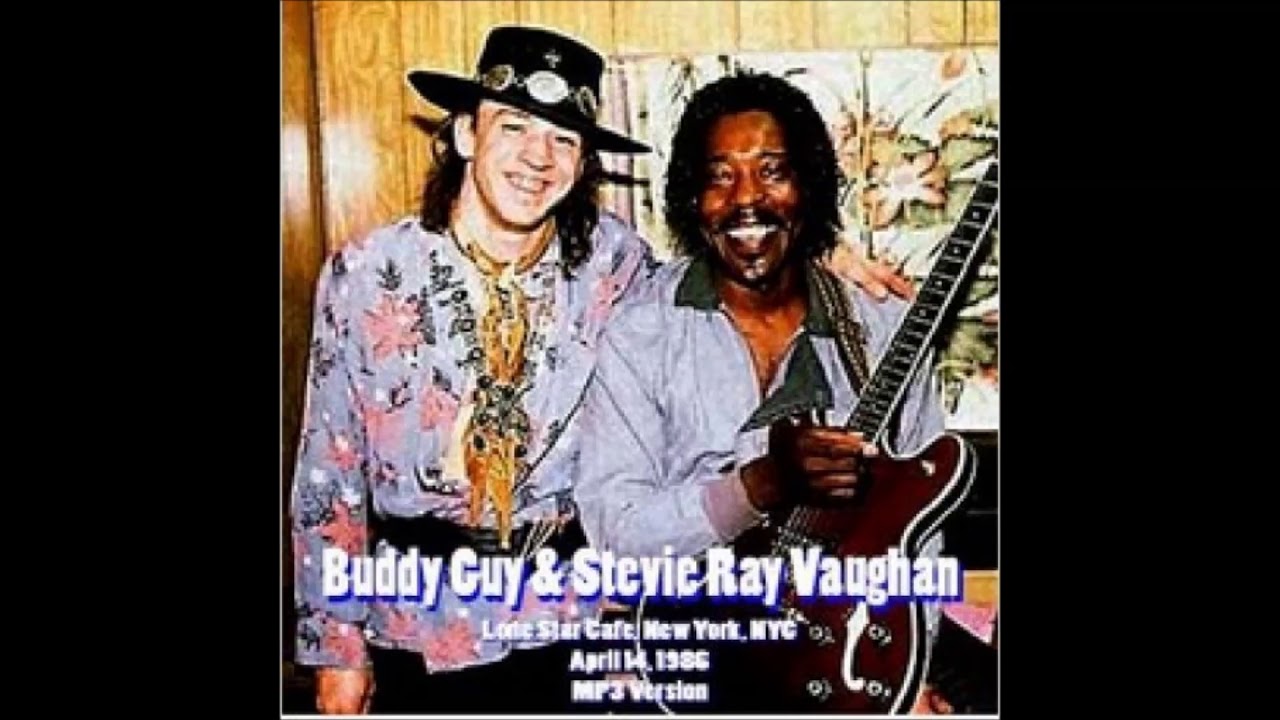
In the history of the blues, there are legendary studio sessions and then there are the raw, unbridled moments that happen only in the dim light of a smoky club. For guitardoor.com, under our Great Guitar Collaborations category, we are highlighting a monumental meeting of fretboard giants: Buddy Guy and Stevie Ray Vaughan (SRV), live at New York City’s iconic Lone Star Cafe in 1986.
The Context: A Torch Being Passed in Real Time
By April 1986, the blues was experiencing a massive resurgence, and Stevie Ray Vaughan was the man leading the charge. But even as the biggest guitar star on the planet, Stevie never forgot his roots. Buddy Guy was his hero he was the man whose wild, distorted, and unpredictable style at Chess Records had paved the way for Hendrix and, subsequently, Stevie himself.
The Lone Star Cafe, with its famous giant iguana on the roof, was the perfect setting for this “clash of the titans.” Buddy Guy was performing his late set when he spotted Stevie in the crowd. In a moment of pure blues spontaneity, Buddy didn’t just invite him up—he challenged him. What followed was not a polite guest appearance, but a high-voltage exchange of soul and skill.
The Gear: Chicago Grit Meets Texas Flood
Visually and sonically, the contrast on stage was a feast for guitar enthusiasts. Buddy Guy, often seen with his signature polka-dot Stratocaster or a classic sunburst model, brought that piercing, aggressive Chicago tone. Buddy’s sound has always been about “the sting”—a sharp, biting treble that can scream one second and whisper the next.
Stevie, appearing on stage with his battered “Number One” Stratocaster, offered the perfect tonal counterpoint. His sound was thick, heavy, and drenched in the “Texas Flood” growl produced by his heavy-gauge strings and cranked Fender and Marshall amps. Hearing Buddy’s lightning-fast, staccato runs up against Stevie’s muscular, rhythmic “raking” style created a sonic texture that defined the mid-80s blues-rock sound.
The Performance: “Mary Had A Little Lamb” and More
While the set featured several blues standards, the standout moment was their take on “Mary Had A Little Lamb.” Though originally a Buddy Guy track from the 1960s, Stevie had popularized it for a new generation on his Texas Flood album.
When they launched into the song, it became a friendly but fierce duel. Buddy’s playing was theatrical—he would often walk into the crowd or play with one hand while Stevie remained locked in, his head down, pouring every ounce of energy into his bends. The mutual admiration was visible; every time Stevie hit a particularly greasy lick, Buddy would let out a laugh or a shout of encouragement. It wasn’t a competition; it was a celebration of the language they both spoke fluently.
The Solos: A Masterclass in Dynamics
The collaboration at the Lone Star Cafe is particularly notable for its use of dynamics. Buddy Guy is a master of the “hush”—bringing the band down to a near-silent whisper before exploding into a flurry of notes. Stevie, usually known for his relentless power, followed Buddy’s lead perfectly.
In their rendition of “Stormy Monday,” the two guitarists engaged in a slow-burn conversation. Buddy’s solos were erratic and full of tension, utilizing sudden leaps in volume and jagged phrasing. Stevie responded with his signature fluid, melodic lines, grounding Buddy’s chaos with a deep, rhythmic pocket. It showcased the two different paths one can take through a 12-bar blues: the wild, unpredictable journey of the veteran and the polished, freight-train power of the protégé.
Why This Collaboration Matters
This 1986 performance at the Lone Star Cafe is essential for the Great Guitar Collaborations archive because it represents the bridge between generations. Buddy Guy has often credited Stevie Ray Vaughan with “saving the blues” during a decade dominated by synthesizers and hair metal. Conversely, Stevie always insisted that without Buddy Guy, there would be no SRV.
At the Lone Star Cafe, you don’t just hear two great guitarists; you hear the lineage of the instrument. You hear the echoes of the South Side of Chicago being amplified by the spirit of Austin, Texas. It was a night of pure, unadulterated “guitar door” magic—where the gate between the old guard and the new was thrown wide open.