Welcome back to Guitardoor.com, where we pay tribute to the undisputed masters who forever changed the voice of the guitar. Today, we celebrate arguably the greatest and most important flamenco guitarist in history, a true revolutionary who took a traditional art form and launched it onto the world stage: the legendary maestro, Paco de Lucía. A breathtaking virtuoso with a deep soul, Paco expanded the harmonic, rhythmic, and technical boundaries of flamenco, and in doing so, became one of the most revered and influential guitarists of all time, regardless of genre.
The New Flamenco
Paco de Lucía’s musical style was born from a deep and profound understanding of pure, traditional flamenco. A child prodigy from Algeciras, Spain, he was immersed in the music from birth. He mastered every palo (flamenco form) with an authenticity that was beyond reproach. But his genius lay in his fearless and brilliant innovations. He was a musical explorer who introduced complex new harmonies and chords drawn from jazz and bossa nova, ideas that were unheard of in the harmonically strict world of traditional flamenco.
He was a master of compás, the intricate and demanding rhythmic cycles that are the heart of flamenco, but he pushed those rhythms to new levels of complexity and fire. His legendary collaborations, most famously with the jazz-fusion guitarists Al Di Meola and John McLaughlin in the Guitar Trio, were a global phenomenon. These performances brought his incredible, fiery playing to a massive international audience and proved that the language of flamenco could communicate with any genre.
Anatomy of a Maestro: Technique and Tone
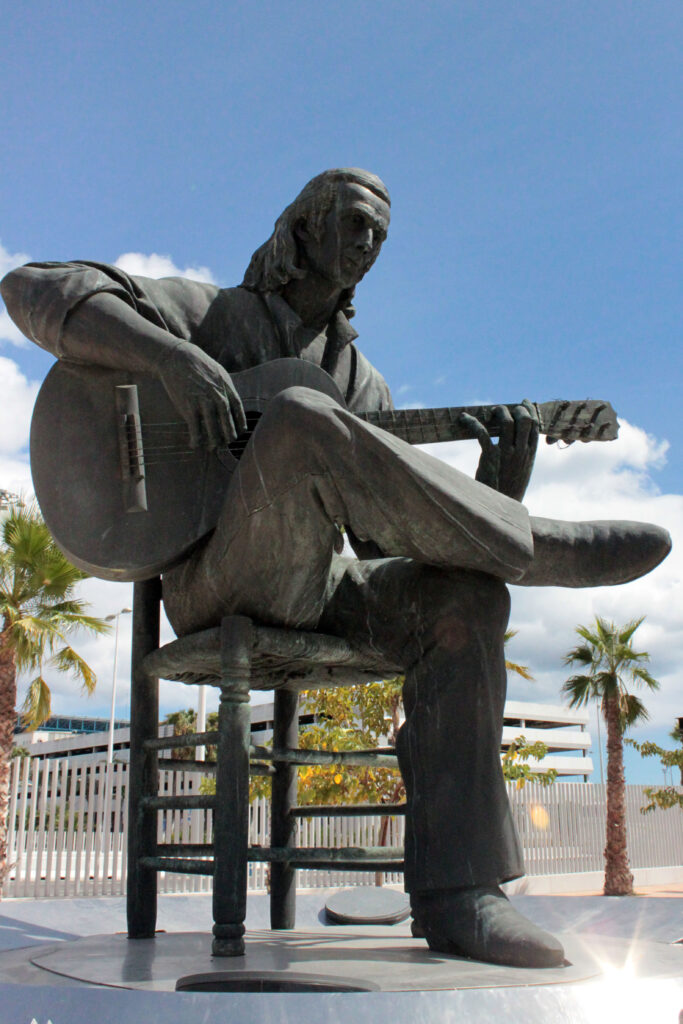
The technique of Paco de Lucía was a stunning display of power, precision, and passionate fire. He redefined the technical limits of the flamenco guitar.
Picado: His single-note scale runs were a blistering torrent of sound. He played with an unmatched level of speed, clarity, and aggressive attack, often using a three-finger (index, middle, ring) technique to achieve his incredible velocity.
Rasgueado: He was a master of the powerful, percussive strumming techniques of flamenco. His rasgueados were executed with a controlled violence and rhythmic complexity that was breathtaking.
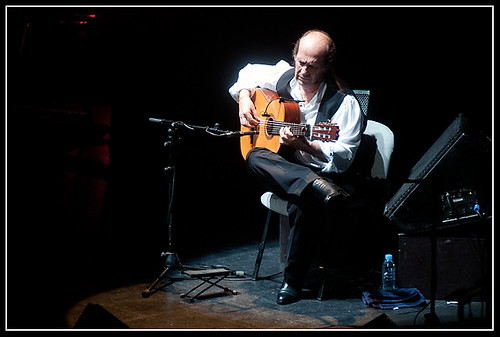
The Posture: He was famous for his unique playing posture, sitting with his legs crossed. He claimed this gave him a better angle of attack and more stability for his demanding physical style, and it became an iconic part of his stage presence.
His instrument was the traditional Spanish flamenco guitar, most often built by legendary Madrid luthiers like Conde Hermanos. It’s important to note that a flamenco guitar is different from a classical guitar; it is lighter in construction, has a lower string action for faster playing, and is built to produce a bright, dry, and highly percussive tone. It is also equipped with a tap plate (golpeador) to protect the top from his percussive finger tapping.
His tone was pure and acoustic, a sound generated entirely by his masterful hands. There were no amplifiers or effects. It was the sound of incredible human technique pushing a traditional wooden instrument to its absolute expressive limits.
Essential Paco: A Masterclass in Flamenco
Paco de Lucía’s discography is a brilliant journey through the heart of flamenco and beyond. To understand his revolutionary impact and his breathtaking virtuosity, these three recordings are absolutely essential.
“Entre Dos Aguas”
This is the track that made Paco a superstar in Spain and changed flamenco forever. A rumba with a hypnotic, groovy bass line and a catchy, improvisational melody, it broke all the rules. It was instrumental, it was funky, and it became a massive hit. It’s the perfect introduction to his innovative spirit and his incredible, fluid playing.
“Mediterranean Sundance” (with Al Di Meola)
Recorded live on the legendary album Friday Night in San Francisco, this is one of the most famous and exhilarating acoustic guitar duels ever captured. The track is a breathtaking exchange of fire and melody between Paco’s flamenco passion and Al Di Meola’s fusion precision. It showcases his incredible speed, his rhythmic genius, and his ability to “speak” the universal language of the guitar.
“Almoraima”
This track is a powerful and complex Bulería that showcases his deep mastery of pure, traditional flamenco, but infused with his own modern harmonic sensibility. It is a stunning display of his incredible picado runs, his powerful rhythmic drive, and his profound understanding of the deep, soulful tradition he would later revolutionize.
Paco de Lucía was the single most important figure in the history of modern flamenco guitar. He was a fearless innovator who respected the tradition he came from but was never bound by it. He elevated the flamenco guitar from a folk instrument to a universally expressive voice, and in doing so, proved himself to be one of the greatest and most important guitarists the world has ever known.
Cover Photo Credit “Paco de Lucía (II)” by El Humilde Fotero del Pánico is licensed under CC BY 2.0