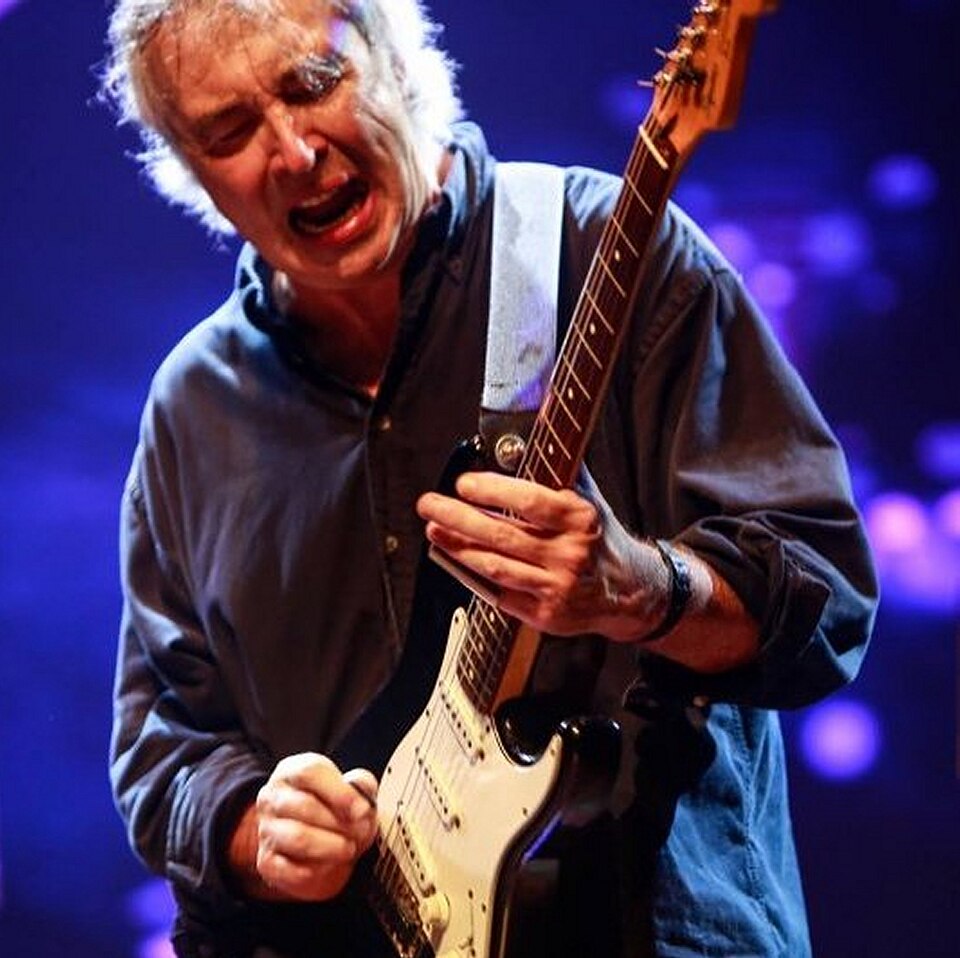
If Stone Gossard and Mike McCready represent the stadium-filling evolution of the blues-rock lineage, Mick Clarke is the man who kept the engine room of that lineage running in the trenches of the British “Blues Boom.” Starting his professional career in 1968, Clarke has spent over five decades as a definitive voice in the UK scene, blending high-energy boogie with a “straight from the wood” guitar tone that earned him the title of “Best International Act” at the Artist Aloud Awards.
The Killing Floor Era
Mick first exploded onto the scene as a founding member of Killing Floor. Named after the iconic Howlin’ Wolf track, the band became a staple of the late 60s London blues circuit. They weren’t just playing clubs; they were the “musician’s musicians,” famously backing Texas legend Freddie King during his UK tours and sharing stages with giants like Howlin’ Wolf, Otis Spann, and Arthur “Big Boy” Crudup. Their self-titled debut is still regarded by Classic Rock Magazine as one of the “20 Greatest British Blues Albums” from that golden 1967–1970 era.
SALT and the Solo Journey
After the initial dissolution of Killing Floor, Clarke co-founded SALT in the mid-70s—a high-voltage blues-rock outfit that became a Marquee Club favorite and once opened for Muddy Waters at his first major London concert. By the early 80s, he transitioned into The Mick Clarke Band, launching a solo career that has produced over 22 albums to date.
His style is a masterclass in “fiery” execution. Whether he’s ripping through a relentless boogie or laying down a soulful slow blues, Clarke’s playing is defined by its grit and lack of pretension. He’s a veteran who stayed true to the roots, recording much of his later work in his own Rockfold Studio in Surrey.
Legacy of the “Two-Headed” Monster
Much like the interplay we see between Stone Gossard and Mike McCready, Clarke’s work often relies on a deep understanding of the “push and pull” of a band. His collaborations with keyboardist Lou Martin (formerly of the Rory Gallagher band) created a “wall of sound” that bridged the gap between traditional Chicago blues and the aggressive rock of the 70s and 80s.
Today, at 75, Clarke remains a relentless force, proving that the blues isn’t just a genre it’s a lifelong commitment to the craft.