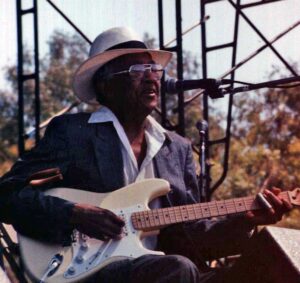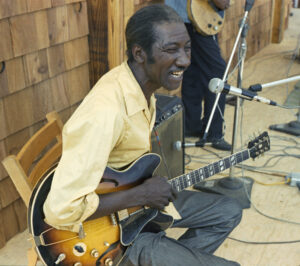

Welcome back to Guitardoor.com, where we pay tribute to the brilliant artists who shaped the sound of the blues. Today, we celebrate one of the most electrifying, innovative, and tragically short-lived titans of the genre: the one and only “Magic Sam” Maghett. A primary architect of the modern, electric “West Side” sound of Chicago blues, Magic Sam was a force of nature, a player known for his high-energy performances, his deeply soulful, gospel-inflected vocals, and a trebly, shimmering guitar style that was entirely his own.
The Soul of the West Side
In the late 1950s and 1960s, a new sound began to emerge from the clubs on Chicago’s West Side, and Magic Sam was at its epicenter. Alongside contemporaries like Otis Rush and Buddy Guy, he pioneered a style that was a stark contrast to the more traditional, Delta-rooted blues of Muddy Waters. The West Side sound was urban, slick, and supercharged, often built on minor-key progressions, horn-like guitar lines, and a new level of amplified ferocity.
Sam was the complete package. His live shows were legendary for their raw, unbridled energy, and he was a phenomenal singer, with a powerful, soaring voice that drew as much from soul singers like Sam Cooke as it did from traditional bluesmen. He took the foundational language of players like B.B. King and injected it with a new, frantic, and deeply personal intensity.
Anatomy of the Magic
Magic Sam’s unique and influential sound was a product of his unorthodox technique and his very specific choice of gear.
The Fingerstyle Attack: Unlike many of his peers who used a pick, Sam played exclusively with his bare fingers. This gave his playing a sharp, snapping, and incredibly percussive attack. He could pull and snap the strings with a dynamic violence that was impossible to replicate with a plectrum, giving his single-note lines a distinctive “pop.”
The Shimmering Tremolo: His most famous and instantly recognizable sonic signature was his masterful use of the tremolo effect. He would drench his chords and lead lines in the shimmering, shaking pulse of his Fender amp’s tremolo circuit, creating a deeply emotional, atmospheric, and almost haunting texture that became a cornerstone of his sound.
The “Ice Pick” Tone: Sam was a devotee of Fender guitars and amps. While he used various guitars, including the Gibson Firebird, he is often associated with the Fender Stratocaster and Jazzmaster. He famously plugged them into a Fender Super Reverb amplifier and cranked it loud. His signature tone was unapologetically bright and trebly—he would often turn the bass control on his amp all the way down and push the treble and reverb to the max. This created a cutting, “ice pick” tone that could slice through any band mix. This raw, treble-heavy approach, pushing a Stratocaster to its absolute limit, can be seen as a direct ancestor to the high-energy tones of modern players like Philip Sayce.
Essential Magic Sam: The West Side Canon
Magic Sam’s recordings for labels like Cobra and Delmark are foundational texts of modern electric blues. To understand his incredible talent and his huge influence, these three tracks are absolutely essential.
“All Your Love”
This is his most famous and influential song, and the definitive West Side blues anthem. From its iconic, stop-time minor-key riff to Sam’s soaring, passionate vocals, the track is pure magic. His guitar work is a masterclass in his signature style, with shimmering, tremolo-soaked chords and sharp, stinging, fingerpicked fills that defined a new sound for Chicago blues.
“Lookin’ Good”
A joyous, high-energy, and incredibly infectious instrumental shuffle, “Lookin’ Good” is a pure showcase of his phenomenal guitar prowess. With no vocals to worry about, Sam lets his fingers fly, delivering a non-stop barrage of his tight, funky, and percussive licks. It’s a perfect example of his electrifying energy and his genius as a bandleader.
“Sam’s Boogie”
Sam’s Boogie is another blistering instrumental, the track demonstrates the incredible speed and dexterity of his fingerstyle technique. It’s a frantic, up-tempo boogie on his guitar that feels like it could fly off the rails at any moment, yet Sam is in complete control. The raw, unadulterated energy in his playing on this track laid a clear blueprint for the high-octane blues-rock that would follow, a spirit that lives on in the playing of modern powerhouses like Eric Gales.
Magic Sam’s career was tragically cut short when he died of a heart attack at just 32 years old, on the cusp of major international stardom. In his short time, however, he became one of the most important innovators in electric blues history. His profound influence can be heard in the playing of countless legends, from Mike Bloomfield and Duane Allman to Stevie Ray Vaughan. Though he left us far too soon, the powerful, shimmering “magic” of his music remains a vital and electrifying part of the blues canon.
Cover Photo Credit “AABF 1969 Magic Sam JT” by Eatonland is licensed under CC BY-SA 4.0