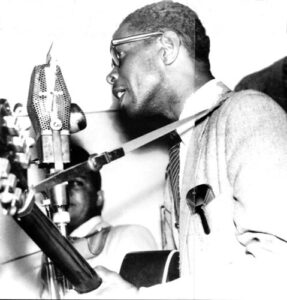
While the Delta blues is often celebrated as a historical relic preserved on scratchy vinyl, Jimmy “Duck” Holmes” stands as a living, breathing defiance against time. Operating out of the tiny town of Bentonia, Mississippi, Holmes is the absolute last practicing practitioner of the “Bentonia Style”—a haunting, minor-key offshoot of the blues that sounds less like a traditional chord progression and more like an ancient, eerie incantation.
He is an indispensable treasure for the roots music community. He doesn’t just play the music; he lives at its geographic center, operating the legendary Blue Front Cafe, the oldest continuously active juke joint in the state of Mississippi.
The Ethereal Open Tuning and Ghostly Drone
To understand the genius of Jimmy “Duck” Holmes, a guitarist must completely throw away standard tuning and the traditional 12-bar major blues scale. The hallmark of the Bentonia style—passed down to Holmes directly from blues icons Henry Stuckey and Jack Owens—is an absolute reliance on Open E Minor tuning ($E-B-E-G-B-E$) or Open D Minor ($D-A-D-F-A-D$), often referred to by old-timers as “cross-note” tuning.
This tuning completely changes the emotional weight of the instrument:
- The Haunting Drone: Holmes utilizes a persistent, driving bass note on the open low strings, creating a dark, meditative wall of sound.
- The Ghostly Highs: Instead of clean, scalar solos, his fingers pluck sharp, microtonal bends on the high strings that clash beautifully against the minor root.
His attack is raw, unpolished, and completely fingerstyle. He coaxes a percussive, clicking texture out of his acoustic and electric guitars, letting the notes vibrate with a skeletal, acoustic resonance. This ability to construct a monolithic wall of sound using an unorthodox tuning and zero digital filler is a creative philosophy we admire across our deep dives into versatile fretboard masters like Stef Burns: The Versatile Virtuoso. Much like the elite session players we break down, including Jefferson Kewley, Holmes relies on raw touch and dynamic control rather than complex harmonic configurations to deliver a profound emotional punch.
3 Essential Jimmy “Duck” Holmes Recordings
1. “Catfish Blues”
The ultimate gateway into the Bentonia soundscape. Featured prominently on his Grammy-nominated 2019 album Cypress Grove (produced by Dan Auerbach of The Black Keys), this track showcases Holmes’s hypnotic, minor-key drone at its absolute peak. His acoustic guitar growls with a swampy, overdriven grit, proving that a single, deeply dug-in groove can be far heavier than a high-speed guitar solo, a high-energy attribute we celebrate heavily across our Blues Guitar Greats network.
2. “Hard Times”
This track highlights the desolate, stark lyricism and sparse arrangement style of the cross-note tradition. Holmes’s guitar mimics his vulnerable, weathered vocal delivery with haunting precision, utilizing subtle, crying slide work that cuts cleanly through the open-string drone. It is an extraordinary masterclass in musical minimalism.
3. “Devil Got My Woman”
Originally made famous by Bentonia pioneer Skip James, Holmes’s interpretation of this standard is deeply reverent yet uniquely his own. His rhythmic right-hand snapping technique creates a percussive drive that pushes the song forward, acting as a great reminder to the GuitarDoor community that an ironclad internal rhythm pocket is the absolute foundation of acoustic performance, an attribute shared by master stage and arena veterans like Pete Friesen.
The Blue Front Cafe: A Living Monument
You cannot separate Holmes’s guitar style from the wooden floors of the Blue Front Cafe. Opened by his parents in 1948, this cinderblock and wood juke joint has served as the social and creative epicenter for the Bentonia blues for nearly eight decades.
When Holmes is not touring international festival stages, he can still be found sitting on a stool at the Blue Front, acoustic guitar in hand, passing the cross-note tuning down to the next generation of players. It is a living piece of musical geography, reminding us of the rare, front-porch sincerity we explore in our historical profiles, such as our look at the raw genius of Clyde Maxwell.
Conclusion: Guarding the Gate of the Cross-Note
Ultimately, Jimmy “Duck” Holmes is much more than a brilliant blues guitarist; he is a historical bridge. In a modern musical landscape dominated by digital quantization, pitch correction, and hyper-polished production templates, his music stands as a monument to raw human instinct, beautiful imperfection, and regional identity.
For the modern guitarist, studying Holmes is a vital reminder that the most compelling music often lies in the shadows between the notes. By mastering the cross-note tuning, embracing the beauty of a minor-key drone, and prioritizing raw emotional vulnerability over clinical speed, you connect directly to the oldest, most mysterious roots of the instrument.
External Resources