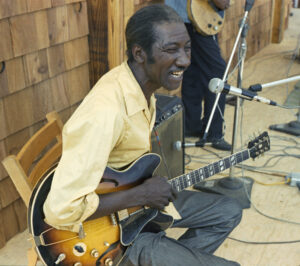
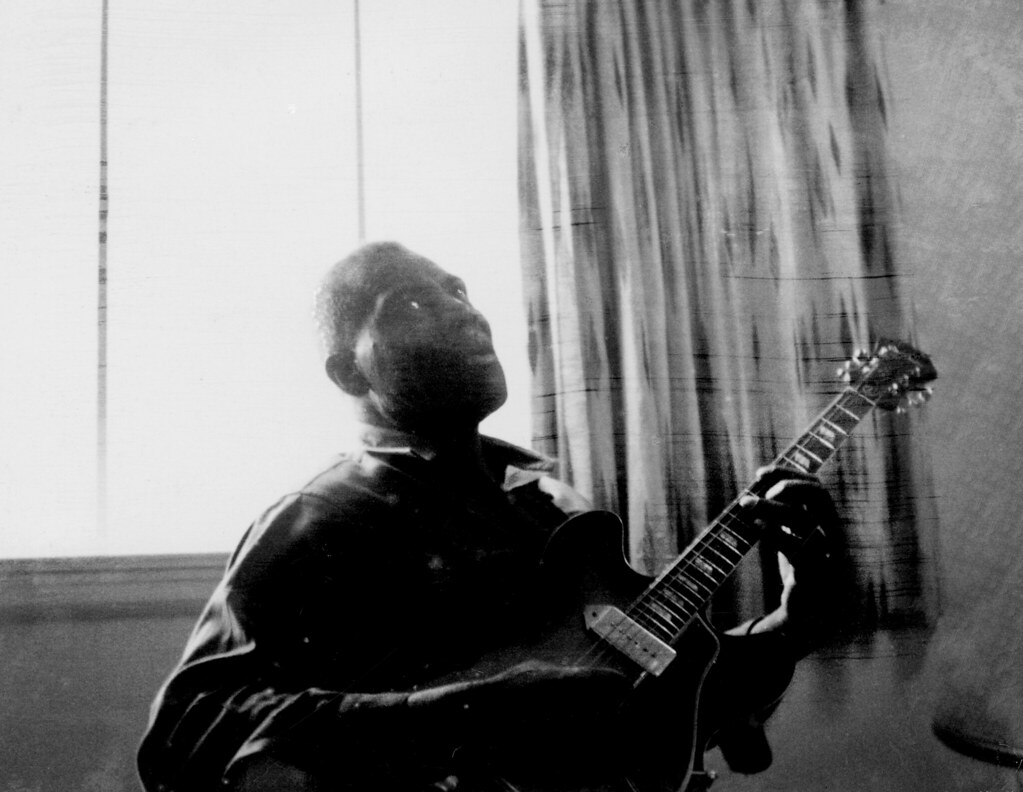
Chester Arthur Burnett (1910–1976), universally known as Howlin’ Wolf, was an imposing and essential figure in electric blues, whose booming voice and fiercely raw guitar style made him one of the most powerful artists to emerge from the post-war Chicago blues scene. Originating in Mississippi, Wolf’s music was the visceral link between the harsh, acoustic Delta blues and the amplified, urban sound of Chicago. His vocal performances—a massive, gravelly voice capable of growls, howls, and roars—were unparalleled in their intensity and were matched only by the deep, primal groove of his guitar work.
🎸 The Wolf Technique: Rhythms That Dominate
Howlin’ Wolf was not a technically fluid soloist like B.B. King or a flashy fingerpicker like Robert Johnson; his greatness on the guitar lay entirely in rhythm, tone, and feel. His technique was simple but devastatingly effective, designed to create a heavy, dominant sonic presence.
Rhythmic Chords: Wolf’s playing focused on powerful, driving chordal accompaniment—mostly simple, open chords played with a raw, percussive attack. He was less concerned with complex runs and more with establishing an unrelenting, hypnotic rhythm that locked in with the drums and bass.
Acoustic Delta Roots: His electric playing maintained the rough, unpolished quality of his Delta roots, using the amplified sound to enhance the brutality and force of the acoustic rhythm, rather than to showcase clean melodies. His guitar served primarily as a second layer of percussion and harmonic foundation.
The Power Trio Approach: Wolf often performed with only a drummer, a bassist, and a second guitarist (most famously, the great Hubert Sumlin). This setup allowed Wolf’s elemental rhythmic chords and Sumlin’s sharp, sparse lead lines to interact, creating a dense, muscular texture that defined the Chess Records sound.
🎶 Three Essential Tracks and How to Approach Playing Them
Three tracks defined Howlin’ Wolf’s dominance and showcase the raw power of his essential rhythmic approach:
“Smokestack Lightnin'” (1956)
This track is the epitome of the hypnotic, trance-like Wolf sound. The guitar approach is deceptively simple, requiring the player to maintain an unwavering, two-chord rhythm that anchors the song. The player must focus on achieving a dirty, thick tone and executing a constant, chugging strum that blends into the rhythm section. Any lead fills should be extremely sparse and atmospheric, complementing the central, massive vocal moan.
“Spoonful” (1960)
Co-written by Willie Dixon, this blues standard features a heavier, almost crushing tempo. To play the rhythm part, the guitarist must use a strong, downstroke-heavy strumming pattern to drive the iconic, slow-churning riff. The key is playing with a visceral weight, making the simple chord progression sound immense. The guitarist’s role is to act as a harmonic locomotive, providing an unstoppable forward motion that supports Wolf’s menacing, low-end vocal delivery.
“Wang Dang Doodle” (1960)
Another Willie Dixon-penned classic, this song is much more upbeat and danceable, showcasing the Chicago blues shuffle. The guitar requires a tight, syncopated rhythm chop to match the energetic bass line. Unlike the monolithic drone of “Smokestack Lightnin’,” this track requires precision in hitting the off-beats to create the signature dance groove. The guitarist should concentrate on a cleaner, slightly more articulated tone to ensure the rhythmic pattern is clear and infectious.
🎉 Conclusion Wrap-up: The Undiminished Power of Wolf
Howlin’ Wolf’s musical legacy is defined by undiluted, primal power. He showed that the essence of the blues was not in instrumental complexity but in raw emotional delivery and an unstoppable rhythmic drive. His booming voice and unrefined, chord-based guitar style provided the elemental core for the early electric Chicago sound. The combination of his massive stage presence and his minimalist, effective guitar work left an indelible mark on music, influencing the first wave of British invasion artists like The Rolling Stones, Eric Clapton, and Led Zeppelin, who recognized that Wolf’s music represented the true, untamed heart of the blues.
Cover Photo Credit “Howlin’ Wolf 1970 (Via Faulty Polaroid)” by Still The Oldie is licensed under CC BY-NC-ND 2.0