Picture this: you just picked up your first guitar, you’re fired up and ready to play your favorite song, and then someone hands you what looks like a grid covered in dots and numbers. Confusing, right? Don’t worry, every guitarist has been exactly where you are right now.
That little grid is called a guitar chord chart, and once you know how to read one, it becomes one of the most powerful tools in your musical journey. Seriously, it’s like unlocking a secret language that opens up thousands of songs for you to play.
In this tutorial, we’re going to break down everything you need to know about reading a guitar chord chart from scratch. No music theory degree required, no prior experience needed. By the time you finish reading, you’ll know exactly what those dots, numbers, and lines mean, and you’ll be able to pick up any chord chart and translate it into real music on your guitar. We’re keeping things simple, practical, and beginner-friendly every step of the way. Let’s dive in.
What Is a Guitar Chord Chart?
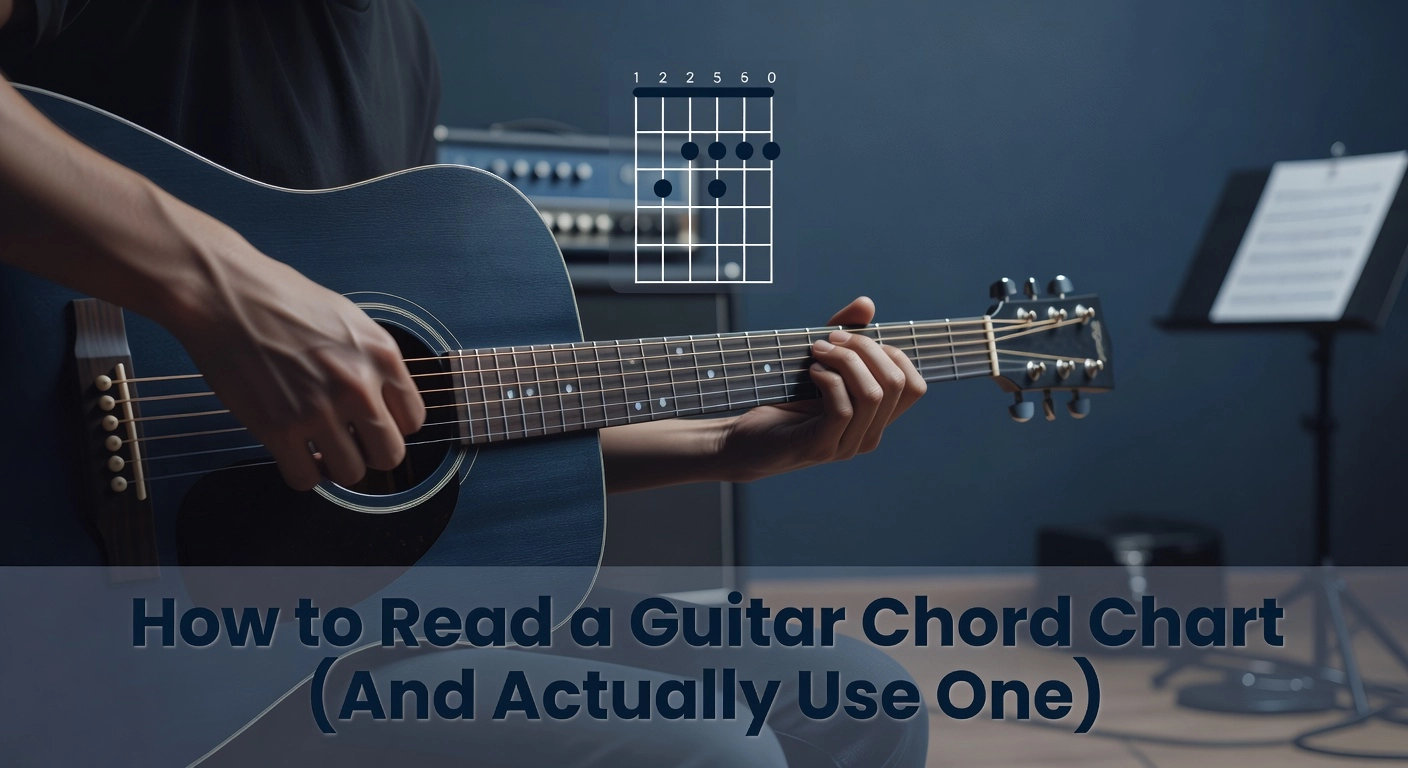
A guitar chord chart is essentially a visual map of your guitar’s neck, showing you exactly where to place your fingers to play a specific chord. Think of it as a little snapshot of the fretboard, designed so you can glance at it and immediately know what to do with your hands. You don’t need to read traditional sheet music or know anything about music theory to use one. That’s a big part of why chord charts are one of the first things we share with anyone just picking up the guitar.
The chart itself is built on a simple grid. The vertical lines represent the six strings on your guitar, and the horizontal lines represent the frets. A thicker bar across the top of the grid usually marks the nut of the guitar, which is your starting reference point. Dots placed on the grid show you which fret and string to press down. The numbers inside those dots tell you which finger to use: 1 is your index finger, 2 is your middle finger, 3 is your ring finger, and 4 is your pinky.
Above the grid, you’ll notice two symbols that are just as important. An X means you should mute or skip that string entirely when you strum. An O means play that string open, without pressing any fret at all. Getting these right makes a real difference in how clean your chord sounds.
One small but handy thing to know: “chord chart” and “chord diagram” mean the exact same thing. Guitar players and communities use both terms interchangeably, so don’t let that trip you up. You can find beautifully illustrated examples over at Fender’s guide to reading chord charts or dig deeper into the details with Liberty Park Music’s chord diagram breakdown. Once you understand the basic layout, every chord chart you come across will start making perfect sense.
How to Read a Guitar Chord Chart Step by Step
Once you know what a guitar chord chart is, the next step is learning to actually read one. The good news? The format is consistent pretty much everywhere, so once it clicks, you can decode any chord chart you come across.
String Orientation: Left to Right
Picture the guitar neck standing upright, headstock pointing to the sky. That’s exactly how a chord chart is drawn. The six vertical lines represent the six strings, and they run left to right from thickest to thinnest. So the low E string (6th string) sits on the far left, followed by A, D, G, and B, with the high E string (1st string) on the far right. The horizontal lines crossing them represent the frets. It feels a little upside down at first, but most players find it natural within minutes. If you want a clear visual breakdown, this guide on how to read guitar chords walks you through the layout really well.
Fret Numbers and the Nut Line
Some charts include a thick bold line across the very top of the grid. That line represents the nut, the small piece at the top of the neck where the headstock meets the fretboard. When you see it, the chord is played in open position, meaning some strings ring out unfretted. Above the nut, you’ll spot “O” symbols for open strings you should strum, and “X” symbols for strings to mute or skip. For chords played further up the neck, the nut line disappears and a number appears to the right of the diagram instead, telling you which fret to start on.
Reading Em as a Worked Example
Let’s put it all together using E minor, one of the friendliest beginner chords around. The chart shows the thick nut line at the top, confirming open position. The low E, G, B, and high E strings all have “O” above them, meaning you strum them open. The A string and D string each have a dot on the 2nd fret, where you place your middle and ring fingers. No fret number appears to the right, so you know you’re sitting right at the bottom of the neck. Strum all six strings and you’ve got Em. As Pickup Music explains, mastering the dots, the X’s, the O’s, and the nut line together is really all you need. And here’s the exciting part: reading one chart correctly means you can read all of them. The same logic applies whether you’re looking at a simple open chord or a barre shape sliding up to the 7th fret. At Guitardoor, we love sharing music that makes this journey feel worthwhile, and it all starts with that first chart clicking into place.
The Essential Open Chords Every Player Learns First
If you’ve made it through reading chord diagrams, the natural next step is putting that knowledge to work with some actual chords. And there’s a pretty clear place to start: open chords.
Open chords use the guitar’s unfretted (open) strings as part of the shape, which does something wonderful for beginners. Those open strings ring out freely, giving you a full, resonant sound without needing to fret every single note. Most open chord shapes only need two to four fingers, and they sit right down in the lower frets where everything is a little more forgiving. Less hand strength required, more rewarding sound right away.
The Six Shapes That Open Everything Up
Six chords form the core of what most players learn first: G major, C major, D major, E minor, A minor, and E major. Here’s a plain-language description of each shape:
- G major (320003): Ring finger on the low E string at the 3rd fret, middle finger on the A string at the 2nd fret, and either your pinky or ring finger on the high e string at the 3rd fret. The middle four strings ring open, giving G its big, bright sound.
- C major (X32010): Skip the low E string entirely. Ring finger on the A string at the 3rd fret, middle on the D string at the 2nd fret, index on the B string at the 1st fret, and the G and high e strings ring open.
- D major (XX0232): Skip the two lowest strings. Index finger covers the G string at the 2nd fret, ring finger takes the B string at the 3rd fret, and middle finger sits on the high e at the 2nd fret. Compact and punchy.
- E minor (022000): Just two fingers. Middle on the A string at the 2nd fret, ring on the D string at the 2nd fret. Everything else rings open. It’s the easiest minor chord you’ll find.
- A minor (X02210): Skip the low E. Index covers the B string at the 1st fret, middle takes the D string at the 2nd fret, and ring sits on the G string at the 2nd fret. The A and high e strings ring open.
- E major (022100): Same hand position as E minor, but add your index finger to the G string at the 1st fret. That one note shifts the whole feel from moody to bright.
Why These Six Matter So Much
Here’s something that puts it in perspective. An analysis of nearly 680,000 songs found that G major and C major are the two most frequently used chords across popular music, together accounting for roughly 24% of all chord notations studied. That’s across rock, pop, folk, country, and beyond. The chords you’re learning right now are genuinely the chords that built the songs you already love.
With just these six shapes, or even a handful of them, you can play a huge number of recognizable songs. Three-chord combinations like G, C, and D or E minor, G, and C show up everywhere across decades of popular music. It’s not an exaggeration to say these chords alone unlock hundreds of songs.
Learn One at a Time
The temptation when you see a list of six chords is to try and learn all of them in a single sitting. Resist that. Cramming leads to frustration and sloppy technique, neither of which are any fun. Instead, spend a day or two with just one chord. Get it clean, make sure every note rings out without buzzing, and then practice switching to one other chord you already know. That transition work is where the real progress happens.
Think of it as collecting chords gradually. Each one you add to your toolkit connects to the others, and before long you’ll be moving between G, C, and D without even thinking about it. That’s when playing songs starts to feel natural rather than mechanical, and honestly, that’s when it gets really fun.
Barre Chords: What Changes on the Chart and Why It Matters
Once you start getting comfortable with open chords, you’ll inevitably come across something a little different on a guitar chord chart: a thick horizontal line or curved bracket stretching across most or all of the strings at a single fret. That marking is telling you to lay your index finger flat across multiple strings at once, which is called a barre. Some charts show it as a bold solid bar, others use an arc or curved line, and occasionally you’ll see a row of dots all numbered “1” at the same fret. However it’s drawn, it all means the same thing: one finger, multiple strings, pressed down together.
Here’s where things get exciting. Unlike open chords that are locked to the nut end of the neck, barre chord shapes are completely moveable. Take the basic E major shape and slide it up one fret with your index finger barring across, and you’ve got F major. Slide it up to the third fret and you have G major. The same idea works with the A shape, the Em shape, and more. A handful of patterns gives you access to every single key on the guitar, which is a genuinely big deal once it sinks in.
Because barre chords don’t have a fixed position like open chords do, the chord chart needs to tell you where on the neck to put your hand. That’s what the small number sitting beside the diagram is for. It marks the fret where your barre finger starts, so a “5” next to the chart means you’re positioning at the fifth fret, not the first.
Now, the honest part: barre chords are hard at first. Your fingers will ache, some strings will buzz, and F major will probably frustrate you more than once. That’s completely normal and part of the process every guitarist goes through. Consistent practice builds the strength and muscle memory you need, and it does come with time.
Understanding barre chords on a chart is ultimately what opens the whole guitar up to you. Instead of staying near the nut with a small set of open chords, you can move freely up and down the neck, play in any key, and follow chord charts for virtually any song you love.
The Guitarists Who Made These Chord Shapes Their Own
Here at Guitardoor, we love sharing music and the stories behind it. And one of our favorite things to talk about is how the same chord charts you’re learning right now became the raw material for some of the most iconic sounds in guitar history. These players didn’t just read charts. They bent them, retuned them, and made them their own.
Keith Richards and the Power of Open G
Keith Richards is one of the great examples of what happens when a guitarist stops treating a chord shape as a fixed thing. He tuned his guitar to open G, dropping the low E string entirely, so the open strings rang out as a G major chord. Suddenly, shapes that look familiar on a standard chord chart shifted into something grittier and more alive. A one-finger barre became a full, punchy chord with room for embellishments. That setup is what powers the rolling groove of songs like “Honky Tonk Women” and “Start Me Up,” where the rhythm and the riff feel like the same thing happening at once. It’s a reminder that the chord chart is a starting point, not a ceiling.
Jimi Hendrix and the Chord That Bears His Name
Jimi Hendrix took the dominant 7th chord, a shape that sits in plenty of beginner chord charts, and turned it into something nobody had quite heard before. The E7#9 voicing, often called the Hendrix chord, shows up right at the center of “Purple Haze.” He played it with his thumb wrapped over the neck to fret the low root note, which freed his other fingers to add that sharp 9th tension that makes the chord sound both bluesy and electric. It’s a small departure from the standard chart position, but the result is unmistakably his. That’s a powerful lesson for any beginner: the chart shows you the shape, but the player decides what it means.
James Taylor and the Right Hand as the Arrangement
James Taylor proved that you don’t always need to change the chord to change the music. He took simple open chord charts and built intricate, song-serving arrangements by focusing almost entirely on his right hand. His thumb holds down a steady, syncopated bass line while his fingers add melodies, fills, and soft harmonic color on top. Songs like “Fire and Rain” feel full and warm without ever getting complicated on the fretboard. Folk and fingerpicking players have followed this same idea ever since, using open chord shapes as a foundation and letting the right hand tell the story.
John Mayer and the Space Between Charts and Improvisation
John Mayer lives in the territory between a chord chart and a blues solo, and he makes that space sound effortless. He leans on open voicings, partial shapes, and add9 extensions that don’t always appear in beginner resources but grow naturally out of the chords you already know. His use of thumb-over techniques and open strings creates a breathing, soulful quality in tracks like “Gravity” that blends chordal playing and improvisation into a single fluid thing. He draws directly from the blues tradition, nodding to players like Hendrix and SRV, while adding his own melodic sensibility on top.
This is really what Guitardoor is all about. We share music because we love it, and we believe chord charts are not just theory tools. They are the language that great players used to build music that has lasted for decades. The shapes you are learning right now are the same ones Richards, Hendrix, Taylor, and Mayer started with. Where you take them is entirely up to you.
Your Free Printable Guitar Chord Chart
A good printable chord chart pulls everything together in one place. The most useful versions include the core open chords like E, A, D, G, C, Em, Am, and Dm, with clear fingering positions shown on the diagram. Alongside those, a solid chart will also cover movable barre chord shapes in both E-form and A-form, which let you slide the same shape up and down the neck to play in any key. And then there’s the often-overlooked gem: a set of blank chord diagram grids at the bottom or back of the page. You can explore some great beginner guitar chord chart examples at Fretjam to see how these elements come together cleanly.
Having that chart printed out and sitting on your music stand or taped to the wall near your practice spot is genuinely more useful than reaching for your phone. The moment you unlock your screen, you’re one notification away from losing your focus entirely. A physical printable keeps you in the zone, and that uninterrupted flow is where muscle memory actually gets built.
Those blank chord grids are worth their weight, too. When you stumble across an interesting voicing while working through a song, just sketch it down right there. Sites like NOLA School of Music offer free blank guitar chord charts specifically designed for this kind of personal note-taking.
The community around printable chord resources is still going strong into 2026, with thousands of charts, PDFs, and custom diagrams being shared and saved across Pinterest, Reddit, and beyond. People genuinely love passing these things around.
When you’re ready to put your chord knowledge to work on real songs, come explore Guitardoor.com. We share song tutorials, artist deep-dives, and the kind of guitar stories that make practice feel like discovery.
What to Play Next: Songs and Players Worth Exploring
The best way to make a guitar chord chart feel real is to play actual songs with it right away. Start with anything built on three or four open chords, because so much genuinely great music lives right there. “Brown Eyed Girl” by Van Morrison runs on G, C, D, and Em. “Bad Moon Rising” by Creedence Clearwater Revival is just G, D, and C. “Ring of Fire” by Johnny Cash? Same idea. These songs feel immediately rewarding, and every time you switch between those shapes, you’re reinforcing exactly what the chart is trying to teach you.
Blues, folk, and classic rock are the richest places to dig in, because the open chord vocabulary is so deeply woven into those genres. From Robert Johnson to Bob Dylan to Neil Young, the same handful of shapes keep showing up, and yet each player sounds completely different. That’s the thing worth paying attention to: the chord diagram tells you where to put your fingers, but the player tells you what it actually means. Exploring artist-specific chord content helps you hear how a G chord can feel warm and open in one set of hands and urgent and driving in another.
Rather than working through generic exercises, look up the specific voicings used by a guitarist you already love. That curiosity is the whole engine here. Every song you learn introduces you to a player, every player leads you toward a style, and every style opens up a new set of shapes worth exploring. Checking out songs built around simple progressions is a great place to follow that thread. This is just the beginning of a much longer and genuinely exciting journey.
Start Simple, Stay Curious
Here is the thing about reading a guitar chord chart: it clicks faster than you probably expect. Most beginners pick up the basics within a few days of sitting down and actually trying. The layout is consistent, the symbols are simple, and your fingers find their way to the strings quicker than your brain thinks they will. Give yourself a little grace and a little time, and it will feel natural sooner than you expect.
Every guitarist you love started exactly where you are right now, staring at the same diagrams and wrestling with the same open chord shapes. That is not a motivational cliche, it is just true. The same G, C, and D shapes you are learning today are the same ones that launched thousands of careers and countless songs worth loving.
Pick one chord chart today. Put your fingers on the strings and make some noise. It does not have to sound perfect. It just has to start.
And when you are ready to connect those shapes to real players and real music, Guitardoor is a great place to keep exploring. We share music here, the stories, the players, and the songs behind the chords you are learning.
Chord charts are a doorway, not a destination. Walk through.
Conclusion
You made it, and now you have everything you need to start reading guitar chord charts with confidence. Let’s recap what you’ve learned: chord charts are simply visual maps of your guitar’s fretboard, the dots tell you exactly where to place your fingers, the numbers identify which fingers to use, and the symbols along the top indicate open or muted strings.
That’s it. No secret knowledge, no years of theory classes required.
Now comes the most important step: put this into practice. Grab your guitar, pull up a simple chord chart for a song you love, and start placing those fingers. You will feel awkward at first, and that is completely normal. Every guitarist went through it.
Keep showing up, keep practicing, and before long, reading chord charts will feel as natural as reading this sentence. Your musical journey starts right now.


One thing that really helped me when learning chord charts was remembering that the diagram represents the guitar as if you’re looking straight at the fretboard, which can feel backwards at first. Pairing chord charts with slow chord-change practice made them much easier to translate into actual playing. Thanks for breaking the symbols down in a beginner-friendly way.