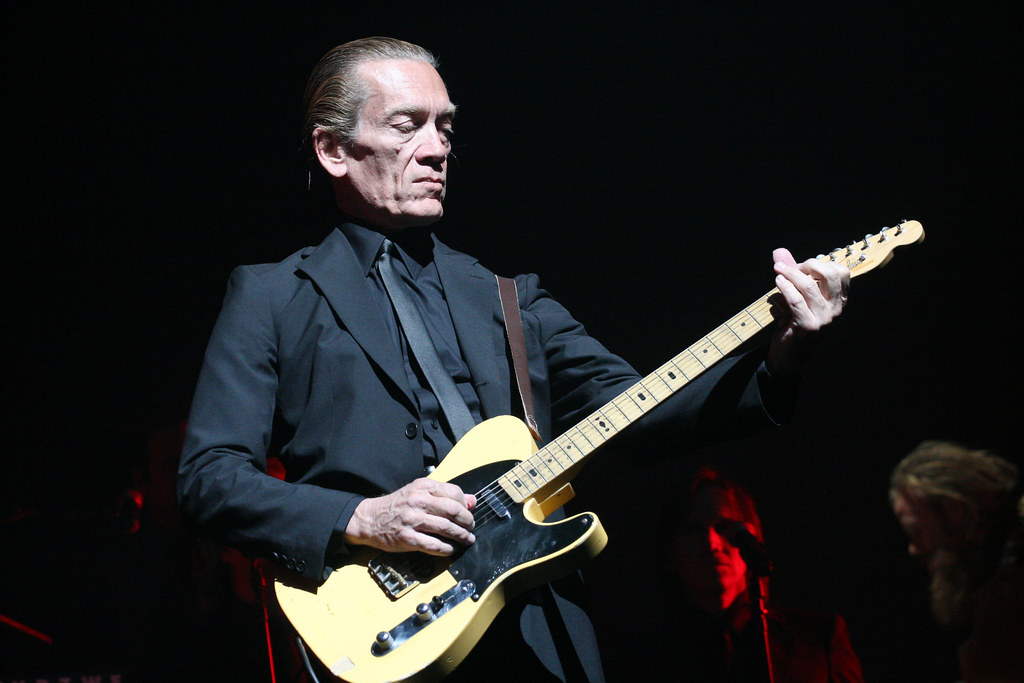
Welcome back to Guitardoor.com, where we celebrate the “guitarist’s guitarists” who are the secret weapons behind the biggest names in music. Today, we focus on one of the most respected, recognizable, and versatile players in the history of rock and roll: the one and only G.E. Smith. As the iconic, long-serving musical director for Saturday Night Live, and the trusted lead guitarist for Hall of Famers like Bob Dylan, Hall & Oates, and Roger Waters, G.E. Smith is the absolute definition of a master sideman he is a player with an encyclopedic knowledge of American guitar, impeccable taste, and the uncanny ability to play the perfect part, for any song, at any time.
The Chameleon of Rock and Roll
The musical style of G.E. Smith is a living encyclopedia of great American guitar. He is a true chameleon, a master of virtually every roots-based genre imaginable. On any given night, he can move with absolute authenticity from the greasy twang of rockabilly and the stinging bite of Chicago blues to the clean precision of country and the raw power of classic rock and roll. His genius was most famously showcased during his decade-long tenure leading the SNL band. It was a high-pressure, live television gig that required him to be a master of all styles, flawlessly backing a staggering array of musical guests, from blues legends to pop superstars, cementing his reputation as one of the most reliable and musically intelligent guitarists in the business.
Anatomy of a Master Craftsman
The guitar playing of G.E. Smith is a masterclass in taste, tone, and pure, no-frills musicality. His approach is not about flashy, self-indulgent solos; it’s about a deep and profound understanding of what a song needs to feel great. He is the ultimate musical craftsman, a player who uses his incredible skill to build a perfect, solid foundation, always serving the song and the artist he is supporting. His sound is the sonic equivalent of a perfectly tailored suit—classic, sharp, and flawlessly executed.
The Rhythmic Foundation:
Smith is a phenomenal rhythm player with a deep, unshakable pocket. His style is built on a mastery of classic American techniques like chicken pickin’ and hybrid picking, which he uses to create the snappy, percussive, and twangy sound that is his signature.
Tasteful and Tele-Driven:
His lead playing is concise, melodic, and always perfectly phrased. He is a master of soulful string bending and has a vocabulary of licks that is both authentic and encyclopedic.
The Telecaster King: He is one of the ultimate icons of the Fender Telecaster and its single-pickup sibling, the Esquire. His collection of battle-scarred, vintage Fenders is legendary. The bright, cutting, and incredibly versatile tone of these guitars is the absolute core of his sound.
Pure, Direct Tone:
G.E. is a true purist when it comes to tone. His sound is most often the pure, unadorned sound of his vintage guitar plugged directly into a vintage Fender tube amplifier, like a Twin Reverb or a Deluxe. He uses very few effects, preferring to get his incredible range of sounds directly from his hands and the guitar’s volume and tone controls.
The Essential Parts
To understand the genius of G.E. Smith, you have to look at his iconic work as a sideman. His brilliance is in the perfect parts he crafts for legendary songs.
The Saturday Night Live Theme
This is the gig that made him a household name. His role here was the ultimate test of versatility. To approach playing in a style like the SNL band requires a deep musical vocabulary and the ability to think on your feet. The key is to be a great listener, locking into the rhythm section and being prepared to play anything from a funky R&B groove to a hard rock riff at a moment’s notice. It is a masterclass in professional musicianship.
“Things Have Changed” (with Bob Dylan)
During his time as Dylan’s musical director, G.E. provided the perfect, muscular-yet-tasteful counterpoint to Bob’s iconoclastic style. On this Oscar-winning track, his playing is a lesson in supportive, atmospheric guitar work. To approach this style, the key is to use simple, bluesy fills and subtle, tremolo-soaked chords to create a moody texture that enhances the dark, world-weary vibe of the lyrics without ever getting in the way.
“You Make My Dreams” (with Hall & Oates)
His iconic guitar part on this massive hit is a perfect example of his “less is more” genius. The entire song is driven by his sharp, clean, and incredibly catchy staccato guitar riff. To play it, the approach is all about rhythmic precision. The key is to keep the notes short, sharp, and perfectly in the pocket with the bass and drums. It is a simple part, but it is the song’s essential melodic and rhythmic hook—a moment of pure, pop-rock perfection.
Hall & Oates performing You Make My Dreams on SNL in 1982.
byu/nialldude3 inLiveFromNewYork
In the end, G.E. Smith’s legacy is that of the consummate professional, the ultimate sideman. He is a living library of American guitar styles, a master of taste and tone who has been the trusted right-hand man for some of the biggest icons in music history. He is a true “guitarist’s guitarist,” revered by his peers for his incredible skill, his deep musical knowledge, and his unwavering commitment to always, always serving the song.
Cover Photo Credit “G.E Smith på gitar” by aktivioslo is licensed under CC BY-NC-ND 2.0