
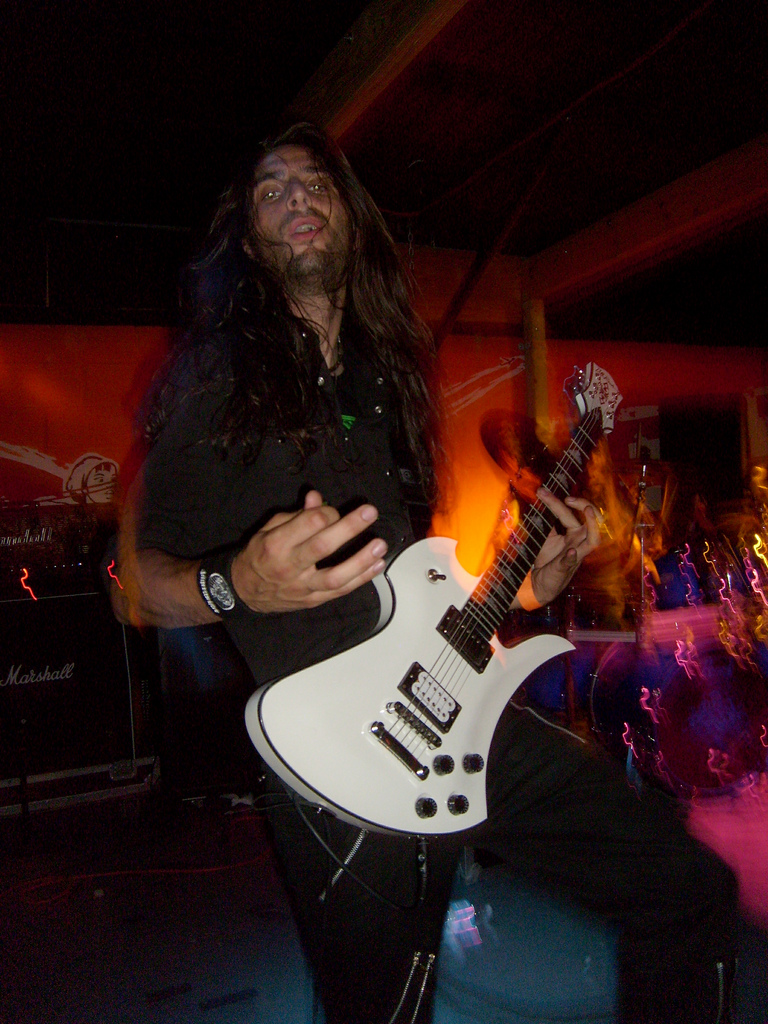
Danny Marino is the lead guitarist and a founding member of the Montreal-based melodic death metal powerhouse The Agonist. Since the band’s formation in 2004, Marino has established himself as one of the most technically proficient and creative guitarists in the modern metal landscape. His work is defined by a seamless blend of crushing aggression and sophisticated melody, helping to anchor the “Montreal sound” that has exported world-class extreme metal for decades. Unlike many in the genre who prioritize speed alone, Marino treats the guitar as an orchestral tool, layering intricate textures to create a sound that is as intellectual as it is visceral.
The Legacy of the Marino Name
It is impossible to discuss Danny’s career without acknowledging his profound musical lineage. Danny is the nephew of the legendary Frank Marino, the guitar virtuoso behind Mahogany Rush. While Frank is celebrated for his Hendrix-inspired blues-rock brilliance and psychedelic jams, Danny took that innate family aptitude for the fretboard and pivoted toward the structured, high-intensity world of heavy metal. Despite the stylistic gap, you can hear a shared DNA in their fluid legato and the sheer confidence with which they navigate complex scales. Danny has successfully honored the family name while carving out a distinct identity in a completely different musical era.
A Master of Technical Versatility
Danny Marino’s style is a masterclass in modern metal technique. He is a proponent of the 7-string guitar, using the extended range to provide a thick, low-end foundation for the band’s dual-vocal attack. His playing is characterized by extensive use of sweep picking, rapid alternate picking, and intricate tapping sequences. However, his true strength lies in his ability to use dissonant chord voicings and odd time signatures that lean into progressive metal territory without losing the “groove.” This balance ensures that his most technical passages remain grounded and rhythmically infectious for the listener.
Career Highlights and the Montreal Metal Scene
A major highlight of Marino’s career was his role in defining a specific era of Canadian metal. He was instrumental in the band’s early success, providing the melodic backbone for the operatic growls of original vocalist Alissa White-Gluz on landmark albums like Lullabies for the Dormant Mind. Later, he demonstrated remarkable creative resilience by navigating a major lineup change, seamlessly integrating the versatile range of Vicky Psarakis into the band’s sound. Throughout nearly two decades of touring and recording, Marino’s guitar work has remained the stabilizing force and creative engine of the group.
Top 3 Song Showcases
1. “Thank You, Pain”
Often cited as the definitive anthem of The Agonist, “Thank You, Pain” is a masterclass in how to balance accessibility with uncompromising technicality. On this track, Marino demonstrates a sophisticated understanding of melodic phrasing that mirrors the operatic intensity of the vocals. While the song is famous for its soaring chorus, it is the underlying guitar work that provides the necessary tension and release. Danny employs a blend of rapid-fire tremolo picking and intricate minor-scale runs that weave through the arrangement like a second voice.
The highlight of the track is undoubtedly the solo. Here, the “Marino” lineage becomes most apparent; much like his uncle Frank, Danny crafts a solo that isn’t just a display of speed, but an emotional arc. He utilizes wide intervals and fluid legato transitions that elevate the song from a standard melodic death metal track into something more cinematic. It remains a benchmark for “shredding with a purpose,” showing that even within the chaos of extreme metal, a well-placed melody can remain the most powerful tool in a guitarist’s arsenal. The track proved that technical metal could have a “soul,” reaching a massive audience without dumbing down the intricate fretwork that Danny is known for.
2. “Panophobia”
In “Panophobia,” Marino steps away from pure melody to showcase his mastery of rhythmic precision and “the pocket.” This track is a prime example of the “groove metal” influence within his playing, focusing on jagged, syncopated riffs that require immense physical stamina and a metronomic sense of time. The song is built around staccato, palm-muted patterns that create a breathless, claustrophobic energy, perfectly reflecting the song’s title. What makes this performance stand out is Danny’s use of silence as an instrument; he incorporates complex rhythmic stops and starts that force the listener to stay on edge, creating a percussive interplay with the drums that is rare in the genre.
Rather than relying on a wall of constant sound, he allows the “chug” to breathe, highlighting the percussive “clank” of his tone. This approach emphasizes the mechanical, driving force of the 7-string guitar, providing a foundation that is as heavy as it is structurally complex. For any guitarist looking to study the “groove” side of technical metal, “Panophobia” is a mandatory case study in how to be heavy without being messy. It stands as a testament to his ability to anchor a song’s energy entirely through rhythmic innovation and right-hand technique.
3. “Gates of Horn and Ivory”
Representing the more progressive and aggressive era of the band, “Gates of Horn and Ivory” is perhaps the most technically demanding piece in Marino’s repertoire. The opening riff alone is a dizzying display of intricate string-skipping and heavy syncopation. This technique involves jumping across non-adjacent strings at high speed, a move that requires surgical accuracy with the picking hand to avoid unwanted noise. It creates a wide, angular sound that feels distinctly modern and “mathematical,” pushing the listener to stay engaged with every shifting interval.
As the song progresses, Marino shifts between crushing low-end riffs and shimmering, dissonant chord voicings that push the boundaries of traditional metal harmony. This track highlights his ability to adapt to a more “extreme” vocal palette while maintaining the sophisticated melodic sensibilities he is known for. The complexity of the arrangement—frequently shifting time signatures and tonal centers—highlights Danny’s growth as an architect of sound. It proves that he can navigate the most aggressive territories of the genre without sacrificing the intellectual depth of the music. For the modern metal fan, this track is a definitive example of how 21st-century metal has evolved into a highly technical, yet emotionally resonant, art form.
Conclusion: A Guardian of the Modern Riff
Danny Marino remains a “guitarist’s guitarist,” a musician who prioritises the song over the ego. His ability to balance the raw energy of a metal show with the precision of a classical composer has made him one of the most distinctive voices of his generation.
Whether he is playing a lightning-fast sweep-picked arpeggio or a heavy, syncopated groove, Marino’s playing is always infused with a sense of purpose and technical excellence. He has ensured that the Marino name remains synonymous with guitar mastery, moving the legacy from the blues-rock of the 70s into the cutting-edge metal of today.