
You’ve mastered the open chords. You can strum through the “Big Five” (C, A, G, E, D) and you know how to string them together to create emotion. But do you ever feel stuck?
Many guitarists hit a wall where they feel trapped in the first three frets—the “Campfire Zone.” You look at your favorite players soloing high up the neck or playing chords in the middle of the fretboard, and it looks like a completely different language.
It isn’t. They are using the exact same shapes you already know. They are just using the CAGED System.
What is the CAGED System?
The CAGED system is the map of the guitar neck. It reveals a simple truth: There are only five major chord shapes on the guitar.
The names of these shapes come from the open chords you already learned:
- C Shape
- A Shape
- G Shape
- E Shape
- D Shape
The secret is that these shapes aren’t fixed to the bottom of the neck. They are movable. By sliding these shapes up and down the fretboard, you can play any chord anywhere.
The Secret Weapon: Your Index Finger
In the open position, the white plastic piece at the top of your neck (the nut) holds the strings down for you.
To move these shapes up the neck, you have to replace the nut with your own finger. This is what we call a Barre Chord. Your index finger clamps across the strings, acting as a movable nut, while your other fingers form the shape of the chord in front of it.
The “E Shape” Example
This is the most common barre chord in rock music.
- Make an open E Major chord.
- Now, imagine you want to slide that shape up one fret.
- You have to bar the 1st fret with your index finger.
- Play the E shape with your remaining fingers.
Congratulations! You are now playing an F Major chord. If you slide it up to the 5th fret, it becomes an A Major. It’s the same shape, just a different location.
Why Bother? The Emotion of Voicing
You might ask, “Why should I learn a difficult barre chord at the 5th fret if I can just play an open A at the bottom?”
The answer is Texture and Emotion.
While an open C Major sounds “big” and “resonant,” a C Major played using the “A Shape” at the 3rd fret sounds tighter, punchier, and more rhythmic. A C Major played using the “E Shape” at the 8th fret sounds screaming and powerful.
- Low on the neck: Great for big, ringing strumming (Folk, Country).
- Middle of the neck: Great for rhythmic, percussive “chugs” (Rock, Funk).
- High on the neck: Great for cutting through the mix (Solos, Reggae).
How to Practice CAGED Without Going Crazy
The CAGED system can seem overwhelming if you try to learn it all at once. Start small with this exercise:
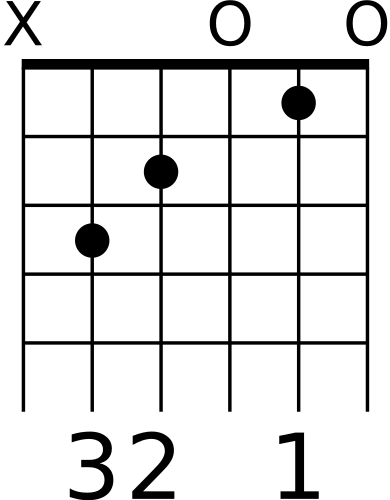
- Pick one chord (Let’s use C Major).
- Play the standard Open C. Listen to it.
- Now, find a C Note on the Low E string (8th Fret).
- Build the “E Shape” barre chord there.
- Strum them back and forth. Open C… High C… Open C… High C.
You will hear that they are the same chord, but they “feel” completely different. One is a warm hug; the other is a shout.
The Bottom Line
The guitar neck isn’t a mystery; it’s just a repeating pattern of the five shapes you learned on day one. The CAGED system turns the fretboard from a confusing map into a familiar playground.
Next Steps: Grab your guitar and try to find the G Major chord in three different places on the neck using the E-shape, A-shape, and open position.
Cover Photo Credit “Guitar CAGED system of fretboard familiarization.” by Sixtysome is licensed under CC BY-NC 2.0