
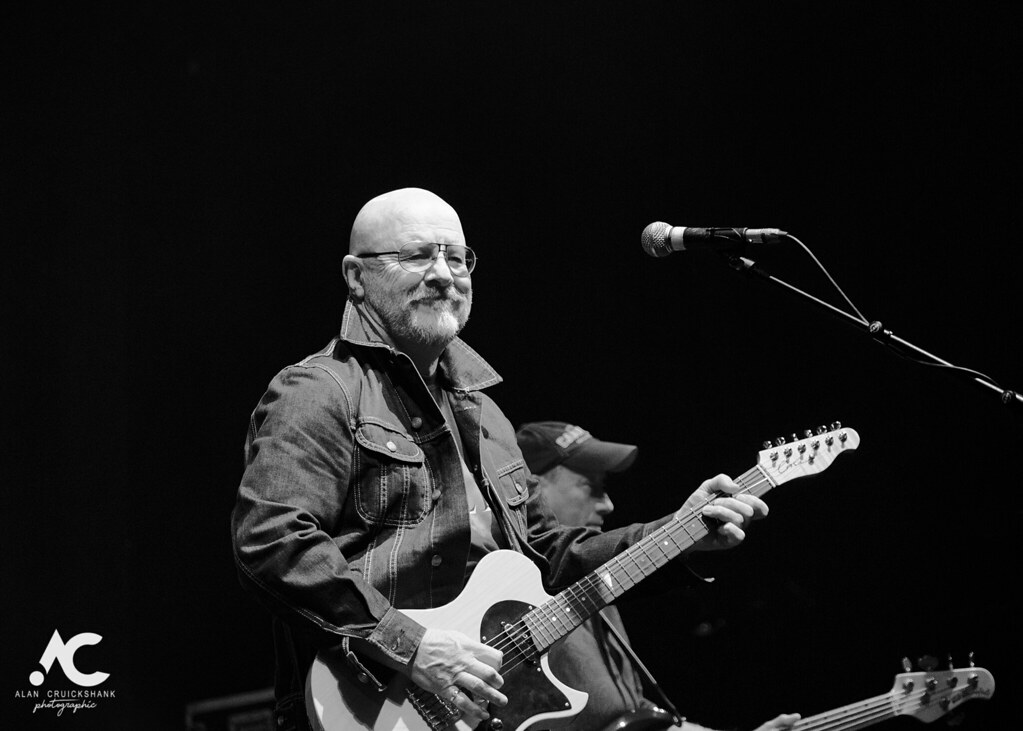
Welcome back to Guitardoor.com, where we celebrate the pioneers who created new languages for the electric guitar. Today, we focus on a profoundly influential player and the enduring leader of a legendary British rock band: the one and only Andy Powell of Wishbone Ash. As a co-founding guitarist, Powell was a key architect of the band’s revolutionary dual-lead harmony guitar sound—a sound that would echo through decades of hard rock and heavy metal and cement his legacy as a true master of melody and interplay.
The Birth of the Twin-Lead
The musical style of Wishbone Ash, which emerged in the early 1970s, was a unique and beautiful tapestry of hard rock, progressive ambition, British folk melodies, and the blues. At the very heart of this innovative sound was the groundbreaking guitar partnership between Andy Powell and his original co-guitarist, Ted Turner. In an era dominated by the single “guitar hero,” Wishbone Ash built their identity around two lead guitars playing together as one.
Powell and Turner crafted intricate, interwoven guitar parts, playing soaring melodies in harmony, typically in thirds. This created a rich, majestic, and almost orchestral quality that was a revolutionary concept for a rock band. Within this partnership, Powell was known for his fiery, expressive, and highly melodic soloing, a perfect complement to the band’s epic and often folk-inspired songwriting. He wasn’t just a part of the sound; he was, and remains, its most passionate and enduring champion.
The Anatomy of a Flying V Master: Technique and Tone
The technique that Andy Powell helped pioneer was built on the art of deep musical communication. Playing in a dual-lead context requires incredible listening skills and the ability to perfectly match the phrasing, vibrato, and timing of another player to create a seamless, unified sound. It is a musical conversation, and Powell has always been one of its most eloquent speakers.
His choice of instrument is one of the most iconic and enduring pairings in rock history. Andy Powell is inextricably linked with the Gibson Flying V. His vintage 1967 Flying V has been his primary musical partner for most of his career. The guitar’s unique, futuristic look, its powerful humbucker pickups, and its excellent upper-fret access made it the perfect instrument for his soaring, melodic lead style. The Flying V became his visual and sonic signature, a tool he used to launch countless unforgettable harmonized leads.
The classic Wishbone Ash tone was forged with quintessential British amplification. Powell was a famous early user of Orange amplifiers, whose loud, crunchy, and harmonically rich sound provided the power and grit their music demanded. This, combined with later use of Marshall stacks, created a tone that was thick and powerful, yet retained the crucial clarity needed for the intricate harmony lines to be heard distinctly.
Essential Powell: The Wishbone Ash Canon
The early albums of Wishbone Ash are a masterclass in songwriting and the art of the dual-guitar harmony. To truly understand the groundbreaking sound that Andy Powell co-created and has carried forward for over 50 years, these three tracks are essential.
“Blowin’ Free”
“The King Will Come”
“Phoenix”
Andy Powell is a true pioneer of rock guitar. The twin-lead harmony sound he forged with Wishbone Ash became a foundational element of the hard rock and heavy metal vocabulary, directly influencing the dual-guitar attacks of legendary bands like Thin Lizzy, Judas Priest, and Iron Maiden. As the keeper of the flame who has passionately and skillfully led Wishbone Ash for more than five decades, his dedication is as legendary as his playing. He is, without question, one of the great and enduring architects of harmony.
Cover Photo Credit “Andy Powell, Wishbone Ash” by Alan Cruickshank Photographic is licensed under CC BY-ND 2.0