Welcome back to Guitardoor.com, where we celebrate the true visionaries who didn’t just play the guitar, but completely reinvented it. Today, we journey into the cosmos to explore the legacy of one of the most unique, innovative, and harmonically advanced guitarists in history: the one and only Allan Holdsworth.
A true “guitarist’s guitarist” revered by the world’s greatest musicians, Holdsworth was a visionary who treated the guitar not as a fretted instrument, but as a wind instrument, a synthesizer, and a vehicle for a harmonic language that was truly alien, breathtakingly original, and utterly brilliant.
The Sound of Another Planet
Allan Holdsworth’s musical style was a highly advanced and deeply personal form of jazz fusion. His music was a complex blend of the boundless improvisational spirit of jazz saxophonist John Coltrane, the raw power of progressive rock, and a unique harmonic and melodic vocabulary that was entirely his own creation. His primary goal was to achieve the seamless, fluid, and endlessly flowing lines of a saxophone, freeing the guitar from the percussive “plink-plink” attack of a picked string.
His chordal work was just as revolutionary. He didn’t play standard major or minor chords; instead, he created vast, atmospheric, and beautifully complex chord voicings using wide, seemingly impossible finger stretches.
These “cluster” chords created a lush, ambient soundscape that was the perfect launching pad for his otherworldly solos.
Anatomy of an Alien
The key to Allan Holdsworth’s unique sound was his absolute mastery of legato technique. He was, and remains, the undisputed king of this style.
The Legato Master: He almost completely eliminated picking from his lead playing, instead relying on a flawless and incredibly fluid system of hammer-ons and pull-offs to articulate his notes. This created his signature smooth, flowing, and breathtakingly fast “sheets of sound” that were more akin to a saxophone than a traditional guitar.
The Chordal Stretches: His unique chord voicings were only possible due to his incredible left-hand flexibility, allowing him to hold down notes across a 5 or 6 fret span to create his signature harmonies.
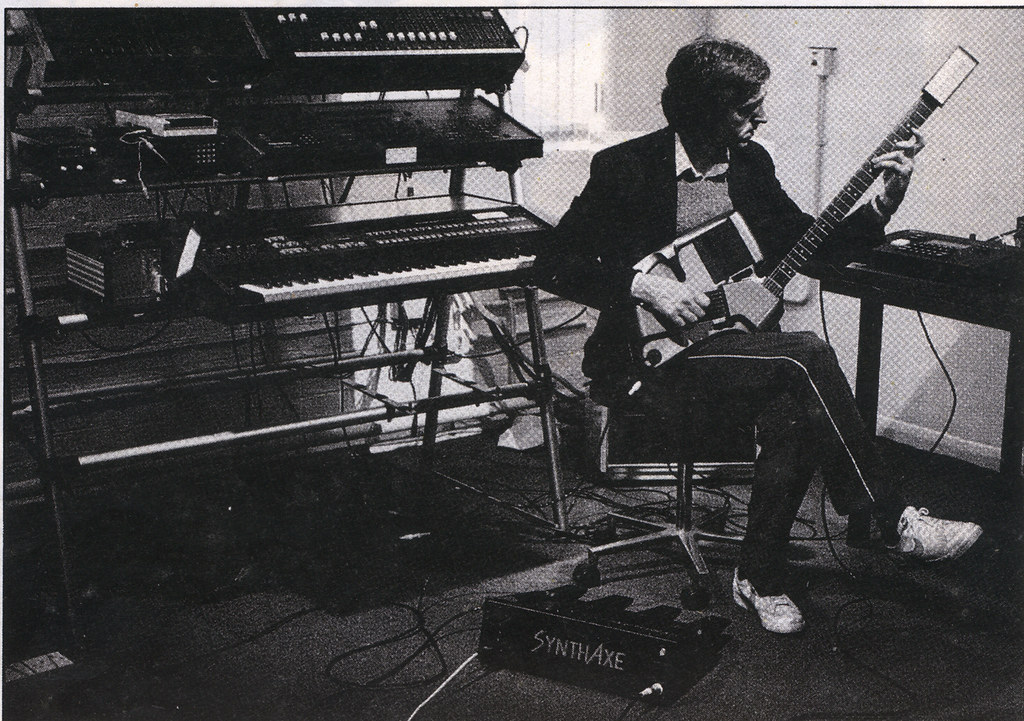
The SynthAxe: He was a famous pioneer of the SynthAxe, a rare and incredibly complex early guitar synthesizer. This futuristic instrument allowed him to control synthesizers and create even more unique and otherworldly textures, further distancing his sound from that of a traditional guitar.
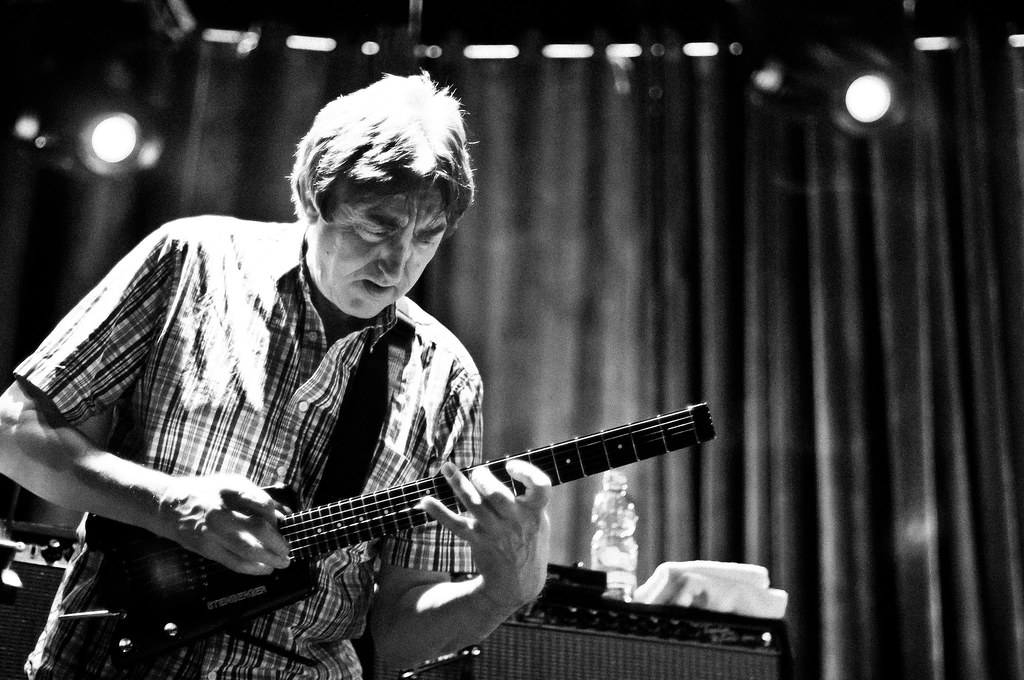
His choice of gear was as forward-thinking as his music. He was a famous early adopter and lifelong player of headless guitars, favoring them for their stability and balance. He is famously associated with Steinberger guitars and later had his own signature models with builders like Carvin/Kiesel.
His signature lead tone was a smooth, singing, and heavily saturated high-gain sound, but with the initial pick attack often softened or removed entirely, either through his legato technique or by using a volume pedal. He used a variety of amplifiers and a sophisticated stereo effects rig, featuring delays and choruses, to create a wide, atmospheric, and almost “violin-like” sound.
Essential Holdsworth: A Journey into the Abstract
Allan Holdsworth’s music is a deep and rewarding dive into the outer limits of harmony and technique. To begin to understand his genius, these three tracks are a perfect starting point.
“Proto-Cosmos” (with Tony Williams Lifetime)
This track from the legendary fusion album Believe It is a perfect example of Holdsworth’s early, fiery genius. While his signature legato is already present, his playing here is more aggressive and rock-infused, showcasing the raw power and already-developing unique phrasing that would become his trademark.
“Metal Fatigue”
The title track from one of his most beloved and accessible solo albums, “Metal Fatigue” is a fantastic entry point into his world. It features a rare vocal performance, his signature atmospheric chord work, and, of course, a solo filled with the breathtaking, liquid-smooth legato runs that defined his sound.
“The Sixteen Men of Tain”
A stunning showcase of his mature style, this track is a complex, swinging, and beautifully melodic piece from his later career. The song demonstrates the absolute peak of his fluid legato technique and his incredibly advanced harmonic thinking, all delivered with an effortless grace that is simply awe-inspiring.
Allan Holdsworth was a true original, a visionary who operated on a completely different musical plane from his contemporaries. His influence on a generation of advanced players—from Eddie Van Halen and Joe Satriani to a legion of modern fusion, prog, and metal guitarists—is immeasurable. He is one of the very few players in history who truly and fundamentally changed the sound, the technique, and the very possibilities of the electric guitar.