
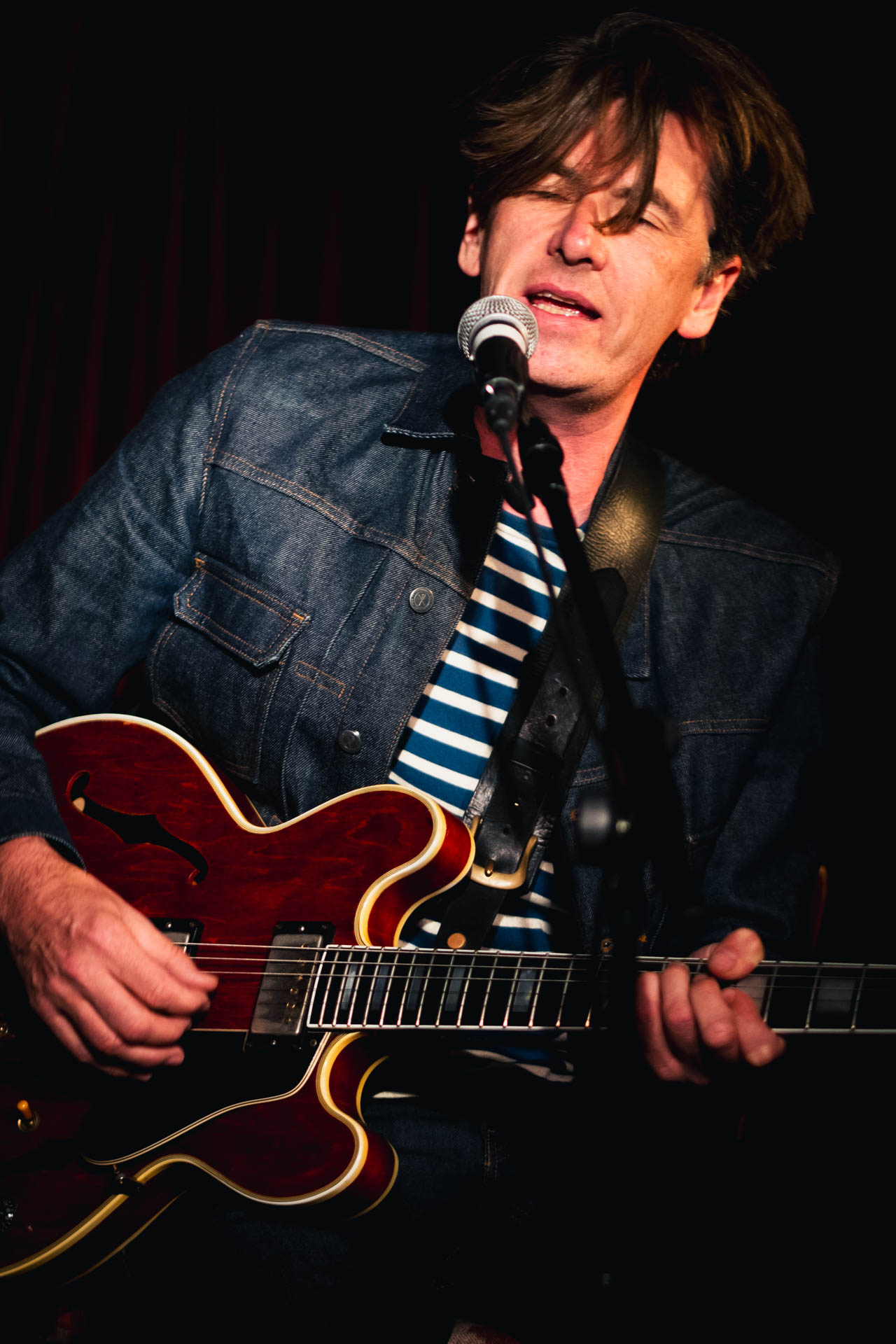
When Suede crash-landed into the drab, post-grunge world of the early 90s, they were a glorious explosion of androgyny, drama, and seedy romance. Driving that sound was a guitarist who seemed to have been beamed in from another planet: Bernard Butler. While his contemporaries were stomping on distortion pedals and chugging power chords, Butler was busy creating layered, complex “guitar orchestras,” becoming the true heir to his own heroes, Johnny Marr and Mick Ronson.
What makes Butler so great isn’t just his technical skill (which he has in spades), but his brain. As the sole guitarist in Suede’s classic lineup, he had to be the rhythm and lead player simultaneously. He did this by building songs from multiple, intricate parts. He’d lay down a shimmering, arpeggiated clean part, then overdub a snarling, bluesy riff, and top it all off with a solo that was equal parts melodic beauty and atonal, feedback-drenched chaos. He is a master of texture, tension, and melody.
🎸 Getting the Butler Tone
While Butler has used various guitars, his Suede-era sound is defined by one iconic instrument: a cherry red 1961 Gibson ES-355. That semi-hollow body is key, giving his tone a woody, resonant “air” that cuts through a mix.
Guitars: A Gibson ES-355 or 335 is the ideal. For heavier tracks like “Animal Nitrate,” he often used a Gibson Les Paul.
Amps: Butler is a Vox AC30 devotee, often running one (or two) for that classic, chiming British top-end that breaks up beautifully.
Pedals: His signature crunch came from stacking gain. The essential ingredients are a Pro Co RAT distortion and a Boss DS-2 Turbo Distortion. For texture, he’d often add a Boss Flanger (BF-2), which is crucial for those swirling, jet-plane sounds on tracks like “Animal Nitrate.”
3 Essential Tracks: Your Bernard Butler Masterclass
Ready to plug in? Here are three quintessential Butler tracks and how to approach capturing their magic.
“Animal Nitrate”
This is the sound of glam-rock kicking down the door. It’s pure, snarling attitude built on a riff that is both simple and brilliantly dissonant.
The Approach: This song is all about aggression and attitude. Butler used a Les Paul for this, tuned down a half-step ($Eb-Ab-Db-Gb-Bb-Eb$). The main riff is a staccato, rhythmic stomp, and the key to the tone is a heavy distortion (like a RAT or DS-2) mixed with a Flanger pedal to get that “whooshing” sound. The solo is pure chaos. Don’t think about scales; think about noise. It’s all atonal bends, pre-bends, and aggressive vibrato—it’s meant to sound like the song is falling apart in the most glorious way.
“The Drowners”
Suede’s debut single is a whirlwind of jangling, arpeggiated guitars. This is Butler’s ultimate love letter to his hero, Johnny Marr.
The Approach: This is all about arpeggios and open-string drones. Use a bright, clean-ish tone (the 355’s bridge or middle pickup) with just a hint of breakup from your amp. The fast, cycling riff is based in A (you can play it in G with a capo on the 2nd fret, or in A-shapes up the neck). The key is to let the open A and high E strings ring out against the moving fretted notes. This creates that shimmering, overlapping guitar orchestra sound all by himself.
“Yes” (by McAlmont & Butler)
After leaving Suede, Butler teamed up with vocalist David McAlmont for this soulful, defiant epic. The track is a widescreen masterpiece, built around a sweeping rhythmic soul foundation that let Butler’s dramatic arranging instincts run completely wild. The guitar solo at the climax is, without exaggeration, one of the greatest of all time.
The Approach: This song is a lesson in dynamics and melodic construction. It’s built on intricate acoustic and clean electric parts (his ES-355). The solo, however, is the main event. Use a warm, singing overdrive with plenty of sustain. This isn’t about speed; it’s about phrasing. Every single note is chosen for maximum emotional impact. Focus on wide, vocal-like string bends, perfect vibrato, and building the solo from a quiet, soulful melody to a screaming, feedback-drenched climax. It’s pure emotion captured on a fretboard.
The Arranger’s Legacy
Bernard Butler’s influence is undeniable. He’s a true “guitarist’s guitarist” who brought a level of harmonic sophistication and compositional depth back to rock music. He’s the perfect blend of glam-rock swagger and sensitive, layered artistry, proving that a guitar hero can be both a poet and a brawler.