
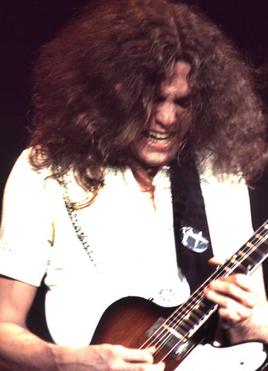
Welcome back to Guitardoor.com, where we celebrate the legendary players whose fire and fury defined the sound of rock and roll. Today, we pay tribute to the high-energy, freewheeling heart of the immortal band Lynyrd Skynyrd: the one and only Allen Collins. As a founding member, a primary songwriter, and the band’s most aggressive lead guitarist, Collins was the frantic, fiery engine of their legendary three-guitar assault, a player whose blistering speed and iconic Gibson Firebird became the very symbol of Southern Rock’s untamed spirit.
The Sound of the Firebird
The sound of Lynyrd Skynyrd was a powerful and authentic blend of hard rock, country, and raw, electric blues, and Allen Collins was its high-octane fuel. While his lifelong friend and guitar partner, Gary Rossington, provided the soulful, Les Paul-driven blues foundation, Collins was the wild card—the frantic, treble-charged gunslinger. His playing was a raw, high-energy storm of notes, deeply influenced by the British blues-rock heroes but supercharged with a uniquely American, Southern fury. He was a key architect of the band’s most enduring anthems, and his sharp, biting guitar work was the perfect, aggressive counterpoint that made their sound so dangerous, dynamic, and unforgettable.
Anatomy of the Fury
The guitar playing of Allen Collins was a thrilling, high-wire act, a perfect storm of blistering technique and raw, untamed attitude. To listen to his solos is to hear a player who was always pushing the limits, channeling a frantic, almost nervous energy into long, intricate, and brilliantly composed musical statements. He was a storyteller who spoke in lightning-fast phrases and screaming, sustained notes, creating a sound that was less a conversation and more a fiery declaration. His style was a masterclass in controlled chaos, a sound that has become a fundamental part of the hard rock vocabulary.
The Firebird Master:
Collins is one of the ultimate icons of the Gibson Firebird. With its unique, reverse-body shape and brighter, tighter-sounding mini-humbucker pickups, the Firebird was the perfect vehicle for his sharp, cutting, and aggressive tone. His image, a lanky figure wielding his iconic Firebird, is one of the most enduring in all of rock. He also famously used a Gibson Explorer in the band’s later period.
Blistering Speed and Phrasing:
His technique was built on incredibly fast and fluid alternate picking. He was a master of crafting long, complex, and often minor-key solos that built to a fever pitch, full of intricate runs and a stinging, aggressive vibrato that was all his own.
The Southern Rock Roar:
The legendary Skynyrd “wall of sound” was a product of pure power. Collins, like the rest of the band, famously used a combination of Marshall amps and, crucially, the powerful, solid-state Peavey Mace amplifiers. This combination gave him the massive volume and cutting, trebly tone needed to slice through the mix and deliver his high-speed assaults with clarity and power.
The Essential Fire
Allen Collins’s fiery guitar work is the explosive heart of Lynyrd Skynyrd’s most legendary songs. To truly understand his incredible speed and his genius as a rock soloist, these three tracks are absolutely essential.
Free Bird
This is it. His masterpiece. The single most iconic and epic guitar solo in the history of rock and roll. While Rossington handles the beautiful slide intro, the entire, legendary, five-minute outro is Allen Collins. It is a marathon of breathtaking speed, brilliant melodic phrasing, and sheer, raw stamina. To approach playing it, one must think of it as a complete composition, building from its melodic beginnings into a relentless, high-speed frenzy that never lets up. It is the definitive statement of his legendary talent.
Gimme Three Steps
A classic, good-time, Southern rock and roll story, this track features a more concise but equally attitude-filled solo from Collins. The approach here is all about capturing the swagger and the storytelling. The solo is full of his signature fast, stinging licks and bluesy, double-stop bends. The key is to play it with a sense of fun and urgency that perfectly matches the song’s narrative of a close call in a rough-and-tumble bar.
That Smell
This is Collins at his most dark, menacing, and brilliant. The song’s heavy theme of death and decay is perfectly matched by his sharp, biting, and incredibly powerful solo. To approach this, a guitarist needs to tap into a more aggressive and sinister feel. Use a sharp pick attack and a wide, frantic vibrato. The solo is a masterclass in using the guitar to create a sense of danger and impending doom, a perfect and powerful piece of musical commentary.
In the end, Allen Collins’s legacy is that of the fiery, untamed spirit of Lynyrd Skynyrd. He was a brilliant and prolific songwriter and a guitarist whose incredible energy and blistering speed set a new standard for rock and roll. Though his life was marked by tragedy, the powerful, iconic, and immortal music he created ensures that his ferocious Southern fury will never be forgotten.
